
Sourcing wholesale part-worn tyres can feel like walking a tightrope between high profit margins and strict legal compliance. For garage owners and tyre retailers across the UK, the stakes have never been higher, as Trading Standards continues to crack down on substandard stock. However, when managed correctly, part-worn rubber represents a brilliant opportunity to offer premium brands like Michelin and Pirelli at a fraction of the cost of new budget tyres. This guide explores how a professional wholesale partnership anchored in the Motor Vehicle Tyres (Safety) Regulations 1994 can transform your inventory from a legal headache into your most profitable asset.
Navigating the 2026 UK Legal Landscape (Regulation 1994)
The most critical hurdle for any tyre retailer is understanding that the law for selling a part-worn tyre is much stricter than the law for driving on one. While the UK road-legal minimum tread is 1.6mm, Regulation 7 of the 1994 Act mandates that any part-worn tyre sold must have at least 2mm of tread depth across the entire breadth and circumference. This extra “buffer” ensures that the consumer doesn’t leave the garage on the brink of illegality. One veteran garage owner on a popular UK trade forum recently noted, “I’ve seen shops get fined thousands because they thought ‘road legal’ meant ‘sale legal’—it’s a mistake you only make once.” To stay safe, always verify that your wholesaler provides stock that comfortably exceeds this 2mm floor.
Beyond the tread, the physical marking of the tyre is where most non-compliance occurs. Every single tyre in your wholesale batch must be permanently marked with the words “PART-WORN” in uppercase letters at least 4mm high. This marking must be indelible and placed adjacent to the “E” approval mark. Crucially, the law forbids “hot branding” or cutting into the rubber to apply this mark, as it could compromise the tyre’s structural integrity. At our Uxbridge warehouse, we ensure every tyre meets this marking standard before it ever hits a delivery pallet, protecting our partners from the “administrative” fines that often catch out smaller, less diligent suppliers.
Finally, the law requires that every tyre passes a rigorous structural inspection. It must be free from large cuts (exceeding 25mm), lumps, bulges, or any exposed cords/plies. The most reliable way to guarantee this is through pressure testing, which involves inflating the tyre to its maximum operating pressure to reveal hidden defects that the naked eye simply cannot see. As a business, you aren’t just selling rubber; you are selling peace of mind. By adhering to these official government safety guidelines and sourcing from a reputable wholesale partner, you ensure your garage remains a trusted pillar of the local community.
The "UK Advantage": Why European Sourcing Leads the Market
If there is a “secret sauce” to the UK’s premium part-worn market, it is undoubtedly the UK supply chain. In UK, safety culture and legal mandates create a unique surplus: while the UK’s road-legal limit is 1.6mm,UK motorists are legally required to swap their tyres once they reach 3mm of tread depth. Furthermore, the strict seasonal transition laws in UK—where drivers must switch between dedicated winter and summer sets—result in thousands of high-end tyres being removed long before they are actually worn out. For a UK retailer, this means gaining access to “A-Grade” stock that often has 5mm to 7mm of tread remaining essentially providing a nearly-new Michelin or Continental tyre for a fraction of the retail price.
By tapping into this European surplus, G Tyres Ltd ensures that our warehouse in Uxbridge remains stocked with the “cream of the crop” that meets both UK safety standards and customer expectations for longevity.
Environmental Impact: Part Worn Tyres and the Circular Economy
Choosing part-worn tyres isn’t just a win for the balance sheet; it’s a major victory for the planet. The manufacturing of a single new car tyre requires approximately 26 litres of oil and significant energy for vulcanization and transport. When a tyre capable of 40,000 miles is discarded at 20,000 miles, half of its productive life is wasted. By reintegrating these tyres into the market, we are participating in a Circular Economy that prevents millions of tonnes of rubber from entering the waste stream prematurely.
Reusing high-quality tyres reduces the demand for new raw materials and lowers the carbon footprint associated with global shipping and manufacturing. At G Tyres Ltd, we view our role as more than just wholesalers; we are facilitators of a sustainable lifecycle. Every 1,000 tyres we supply helps divert massive amounts of waste from landfills, proving that being “green” can actually be the most profitable way to run a modern garage. As one eco-conscious fleet manager put it, “The greenest tyre is the one that’s already been made
Grading Deciphered: Choosing Between Grade A, A+, and Budget Stock
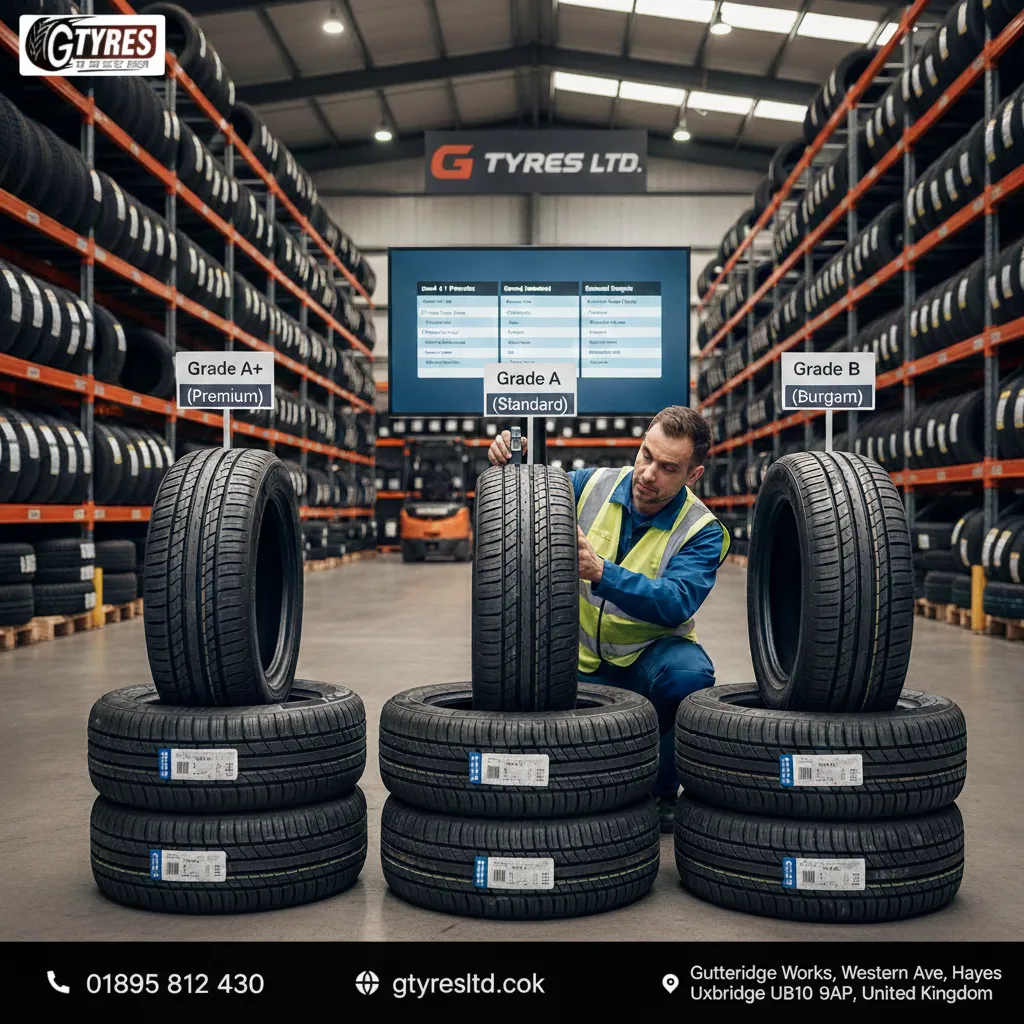
In the wholesale tyre world, “grading” is the language of trust. Since there is no single universal standard, most reputable UK wholesalers like G Tyres Ltd use a tiered system based on tread depth and cosmetic condition. Understanding these tiers is the key to managing your garage’s ROI. Grade A+ (Premium) stock is the “jewel” of the used tyre market, typically boasting 6mm to 7mm+ of remaining tread. These are often “delivery mileage” tyres or seasonal swaps from Germany where the rubber is barely scuffed. For your retail customers, these represent a “near-new” experience at roughly 40-50% of the cost of a brand-new tyre, making them incredibly easy to sell.
Grade A stock is the industry workhorse, generally offering 4mm to 5.5mm of tread. This is the sweet spot for many independent garages because it balances a low wholesale cost with plenty of legal life for the end user. At the bottom of the “quality” tier sits Grade B (Budget) stock, which usually hovers between 2.5mm and 3.5mm. While still legally compliant with the UK’s 2mm sale rule, these are better suited for temporary fixes or price-sensitive customers. As one warehouse manager in Uxbridge told us, “You don’t just sell a tyre; you sell the next 10,000 miles. Grade A ensures that customer comes back to you next year, not next month.”
Feature | Grade A+ (Premium) | Grade A (Standard) | Grade B (Budget) |
Typical Tread Depth | 6mm – 7.5mm | 4mm – 5.5mm | 2.5mm – 3.5mm |
Brands Included | Michelin, Pirelli, Conti | Mixed Premium/Mid-Range | Budget & Mixed |
Estimated Lifespan | 15,000+ miles | 8,000 – 12,000 miles | 3,000 – 5,000 miles |
Best For | High-end SUVs / Luxury | Daily Commuters | Economy / Short-term |
The Business Growth Angle: Maximizing Margins with Premium Brands
The real “hack” for growing a tyre business in 2026 isn’t just selling more rubber it’s selling the right rubber. While budget part-worns have their place, the highest profit margins are found in Premium Brands. A customer might hesitate to pay £180 for a new Michelin Pilot Sport, but they will jump at the chance to get a Grade A+ version for £75. For the garage owner, the wholesale cost of that premium part-worn is significantly lower than the wholesale cost of a new “no-name” budget tyre, yet the retail value is higher because of the brand prestige.
By focusing your inventory on 17-inch to 22-inch sizes which are now standard on most modern SUVs and EVs you tap into a market segment that values performance. High-performance tyres like the Michelin CrossClimate or Pirelli P Zero are engineered with superior compounds that hold their grip even at 4mm of tread, far outperforming a brand-new low-end budget tyre in wet braking tests. Stocking these brands from a reliable wholesaler doesn’t just increase your margin; it builds a reputation for quality that “cheap” tyres simply can’t match.
Quality Control: The G Tyres 5-Point Inspection Process
In the wholesale tyre industry, a visual check is merely the starting line not the finish. To ensure our partners in Uxbridge and beyond receive only “ready-to-retail” inventory, we employ a rigorous 5-point inspection framework. We begin with a Deep Tread Analysis, ensuring every groove across the 50,000+ tyres in our warehouse meets the 2mm legal minimum for resale. Next, we move to a Sidewall & Bead Integrity Check, where our technicians look for the “hidden killers” like bead wire exposure or “marbling” on the inner liner telltale signs a tyre was once run flat. As one of our long-term garage clients noted, “The reason I stick with G Tyres is the lack of surprises. When a pallet arrives, I know I’m not going to spend half my morning sorting scrap from stock.”
The most vital stage of our process is the Mandatory Pressure Test. This isn’t just a recommendation; it’s a legal requirement under UK law to ensure structural safety. We inflate every approved tyre to its maximum operating pressure using specialized machinery to detect slow leaks, micro-tears, or internal bulges that only manifest under stress. This is followed by a DOT Code Audit to verify the tyre’s age; even with deep tread, rubber that is 10+ years old can suffer from “dry rot” or perishing, making it unsafe for high-speed use. Finally, we finish with Legal Compliance Marking, permanently stamping “PART WORN” in the required 4mm uppercase lettering, ensuring your business is 100% protected from Trading Standards scrutiny.
Pressure Testing: Why Visual Checks Aren't Enough
You can’t see the air that isn’t there. A tyre might look pristine on a rack, but a visual inspection cannot detect a microscopic sidewall separation or a porous repair that will lead to a blowout on the motorway. Pressure testing is the only way to simulate real-world driving conditions before the tyre is even fitted to a vehicle. By subjecting the rubber to 30+ PSI, we force any hidden structural failures to reveal themselves as visible bulges or audible leaks. It is this commitment to “safety under pressure” that allows G Tyres Ltd to maintain our reputation as a top-tier UK supplier.
DOT Code Auditing: Avoiding "Perished" Rubber
Every tyre has a “birth certificate” moulded into its sidewall the DOT Code. The last four digits tell you exactly when the tyre was manufactured (e.g., “3225” means the 32nd week of 2025). As tyres age, the essential oils in the rubber compound evaporate, causing the material to harden and lose its “tackiness” or grip. At G Tyres, we prioritize “Fresh Stock” (tyres under 5–6 years old) because we know that a 10-year-old tyre even one with 7mm of tread is a liability in the wet. Checking the DOT code is a simple but powerful habit that separates professional retailers from “van-and-man” operations. You can learn more about deciphering tyre markings from the NTDA.
Bulk Logistics: How We Supply 30,000+ Tyres Monthly Across the UK
Moving thousands of tyres every month requires more than just a big warehouse; it requires a precision logistics engine. At G Tyres Ltd, our Uxbridge hub (UB10 9AP) serves as the nerve centre for a distribution network that handles over 30,000 tyres monthly. Whether you are an independent garage in London looking for a pallet of 50 mixed premium tyres or a large-scale retailer in Scotland requiring a weekly 1,000-unit restock, we have the infrastructure to keep your shelves full. We primarily use a “Herringbone” stacking method for bulk orders, which allows us to maximize space without compromising the structural integrity of the tyre beads a common mistake made by inexperienced loaders that can lead to fitting headaches for you.
For our nationwide partners, we offer flexible delivery windows, including same-day collection for local Uxbridge trades and next-day palletized shipping for the rest of the UK mainland. We understand that in the tyre trade, “out of stock” means “lost profit,” so we utilize GPS-tracked logistics to provide real-time updates on your inventory’s journey. As one mobile tyre fitter recently shared in a review, “G Tyres is my ‘back pocket’ warehouse. I can order on a Tuesday and be fitting those Michelins by Wednesday afternoon the speed is what keeps my customers loyal.” By maintaining high ex-stock availability, we essentially act as your off-site stockroom, reducing your need for expensive on-site storage.
Container Loading (20ft/40ft) vs. Nationwide Pallet Delivery
Every business has a different “appetite” for stock, which is why we provide two distinct logistics paths:
- Nationwide Pallets: Ideal for local garages and regional dealers. Tyres are securely shrink-wrapped on standard pallets to prevent shifting during transit. We recommend this for orders of 50 to 200 tyres where speed and ease of unloading are the priority.
- Full Container Loads (FCL): For our large-scale and international clients, we specialize in 20ft (approx. 1,200 tyres) and 40ft (approx. 2,800–3,200 tyres) containers. Using specialized hydraulic “tripling” machines, we can safely nest tyres within each other to triple the capacity of a standard load, significantly reducing your shipping cost-per-unit.
Exporting from Uxbridge: Managing Customs and Documentation
As we move through 2026, the regulatory landscape for exporting used rubber has become increasingly complex, particularly regarding “Green List” waste classifications and Annex VII movement forms. Exporting from G Tyres Ltd means you aren’t just getting rubber; you’re getting a partner who understands the HM Revenue & Customs (HMRC) requirements. We provide the correct commodity codes (4012 2000) for used pneumatic tyres and assist with the necessary proof of export to ensure VAT-exempt transactions for international buyers. Whether you are shipping to Africa, Europe, or beyond, we ensure your documentation is as robust as your tyres, preventing costly border delays.
Frequently Asked Questions
Yes, provided they meet the 1994 Safety Regulations. They must have at least 2mm tread, no structural defects (bulges/exposed cords), pass a pressure test, and be permanently marked "PART WORN" in 4mm uppercase letters.
Grade A tyres are premium units with 5mm–7mm+ tread, often sourced from German seasonal swaps. Grade B tyres are budget-friendly with 3mm–4.5mm tread. Both must be pressure-tested and legal for resale.
Germany has a legal "recommendation" to swap tyres at 3mm (compared to the UK’s 1.6mm). This creates a surplus of high-quality, branded rubber with deep tread that is perfect for the UK wholesale market.
Every tyre undergoes a 5-point inspection, including visual sidewall checks, internal liner audits for "run-flat" damage, and a mandatory pressure test to ensure structural integrity under load.
Yes. Unlike "mystery load" suppliers, G Tyres Ltd allows you to tailor your order to the specific sizes your garage needs (e.g., 18" SUV or 16" Transit van tyres) to ensure fast turnover.
We offer 48-hour nationwide delivery across the UK from our Uxbridge hub. Local garages in London and the Home Counties can often benefit from even faster turnaround or same-day collection.
Conclusion:
The UK’s part-worn tyre market is no longer a “back-alley” trade; it is a sophisticated, highly regulated sector of the automotive industry. For the modern garage owner, the choice to stock quality part-worns is a strategic one. It allows you to offer your customers premium performance the safety of a Michelin or the grip of a Continental at a price point that fits their budget.
Success in this business isn’t found in cutting corners, but in finding a partner who does the heavy lifting for you. By sourcing from a wholesaler that prioritizes German imports, legal compliance, and rigorous pressure testing, you protect your reputation and your bottom line. At G Tyres Ltd, we are proud to be that partner for over 500 garages across the UK.