
Recent estimates indicate that roughly 50 million tyres, equivalent to almost 700,000 tonnes, enter the UK’s end-of-life tyre system each year. That does not mean all 50 million are recycled inside Britain. The total includes tyres prepared for reuse, retreaded, processed into recovered materials, exported or sent for energy recovery.
The Tyre Recovery Association stated in March 2025 that the UK produces almost 700,000 tonnes of end-of-life tyres annually.
Key Takeaways
- Roughly 50 million tyres enter the UK end-of-life system each year.
- The figure does not represent tyres recycled exclusively inside Britain.
- Suitable casings may be reused or retreaded before recycling.
- Export figures must not be confused with domestic recovery figures.
- Garages must sort, store and transfer genuine waste tyres correctly.
Where Does the 40 Million Tyre Figure Come From?
The widely repeated figure of 40 million tyres came from a 2019 Highways England announcement about recycled rubber being trialled in road surfacing. It was a reasonable estimate at the time, but more recent evidence places annual UK end-of-life tyre volumes closer to 50 million or almost 700,000 tonnes.
The strongest current answer is that roughly 50 million tyres enter the UK end-of-life system annually, rather than saying every one is recycled domestically.
The recovery system includes:
- Direct reuse of suitable tyres
- Preparation of casings for retreading
- Mechanical shredding and granulation
- Processing into secondary materials
- Energy recovery
- Export to overseas recovery facilities
Garages sourcing quality part-worn tyres operate at an important point in this system. Correct assessment can preserve useful service life, while poor sorting either wastes a suitable casing or returns an unsuitable tyre to the road.
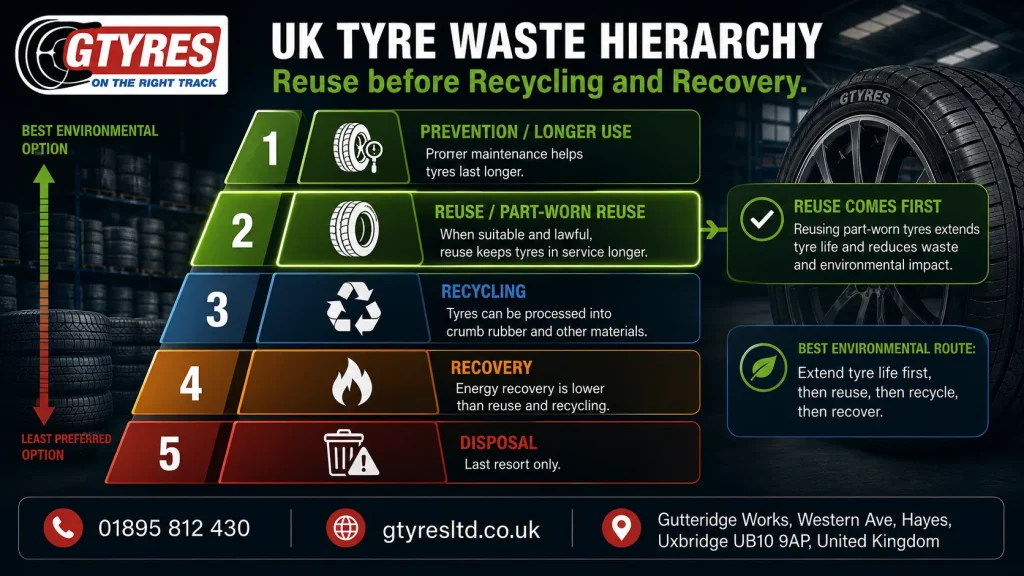
Reuse and Recycling Are Different Processes
Reuse keeps a suitable tyre working as a complete product. Recycling begins once an end-of-life tyre is broken down or processed into another material.
The UK waste hierarchy places prevention first, followed by preparing for reuse, recycling, other recovery and disposal. A tyre prepared for resale should therefore not be counted automatically as material recycling.
Only tyres that meet the correct condition and specification requirements should return to service. Remaining tread alone is not enough. The casing, wear pattern and previous repairs must also support resale.
Why the Figures Matter to UK Tyre Businesses
Tyre businesses decide which removed tyres retain useful life and which have reached the end of it. That decision affects stock value, customer safety and the accuracy of the waste stream.
The article on the environmental benefits of reusing part-worn tyres explains the wider sustainability argument. In practice, garages need a repeatable sorting process that separates resalable stock from genuine waste without exaggerating the environmental benefit of either route.
Where Do the UK’s Used Tyres Go?
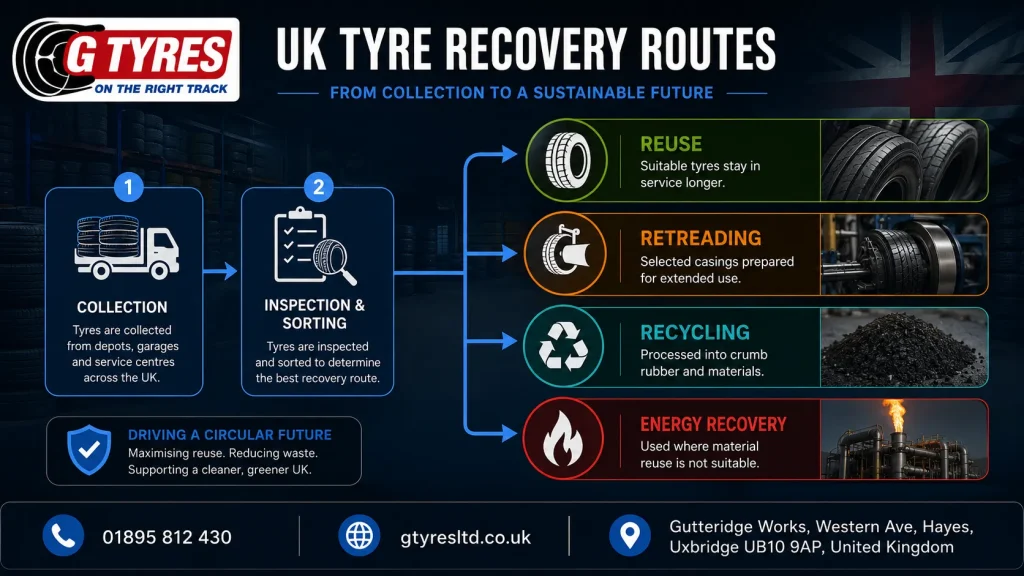
Used tyres follow different routes according to their condition and legal status. Suitable casings can be reused or retreaded. End-of-life tyres may be shredded, granulated, baled, processed into secondary materials, sent for energy recovery or exported to authorised facilities.
A tyre’s recovery route should be determined by its condition, not by the quickest disposal option.
Recovery route | What happens | Trade relevance |
Direct reuse | A suitable tyre returns to service | Preserves its remaining useful life |
Retreading | A suitable casing receives a renewed tread | Extends use of the original casing |
Granulation | Rubber is reduced into smaller particles | Creates material for approved applications |
Baling | Whole tyres are compressed into construction bales | Requires compliant treatment and use |
Shredding | Tyres are cut for further processing | Supports material separation and recovery |
Energy recovery | Tyre-derived material is used as industrial fuel | Used where higher-value routes are unsuitable |
Reuse Preserves More Than Raw Material
Recycling can recover rubber, steel and other components, but the tyre first stops functioning as a complete product. Preparing a suitable casing for reuse preserves the materials and manufacturing work already contained in it.
That does not justify reselling weak stock. The guide explaining how part-worn tyres are graded before wholesale shows why tread consistency, casing condition and specification must be assessed together.
Recycling Produces Several Different Materials
Mechanical treatment does not produce one standard recycled product. Tyres may become rubber granulate, shavings, bales or feedstock for further recovery.
Current Environment Agency T8 guidance covers granulating, baling, peeling, shaving, shredding and retreading. It permits registered operators to store or treat up to 60 tonnes of truck tyres or 40 tonnes of other tyres during any seven-day period. Operations exceeding those limits require the appropriate environmental permit.
Need wholesale stock with useful life still available? G Tyres supplies every tyre with a minimum 4mm tread, selected from 50,000+ tyres in stock. Many UK orders arrive within 48 hours. Call 01895 812 430 to discuss the sizes and stock mix your business needs.
Why Is the Exact UK Recycling Total Difficult to Confirm?
The domestic recycling total is difficult to isolate because published figures measure different stages of the tyre chain. Some count the number of tyres removed from vehicles, while others measure tonnage, exports, permitted treatment or material recovery.
Annual tyre arisings, export volumes and domestic recycling output are separate statistics and should not be used interchangeably.
Preparation for reuse and retreading may also sit outside a narrow calculation of tyres mechanically converted into recovered raw materials.
Exported Tyres Complicate the Annual Figures
Industry reporting on the Environment Agency’s August 2025 review of waste-tyre exports calculated that approximately 86.9% of UK waste-tyre exports went to India. The official Environment Agency summary uses a rounded figure of 89% for UK waste rubber exported to India. Neither percentage means that 86.9% or 89% of every waste tyre generated in Britain was exported there.
The Environment Agency introduced enhanced verification from October 2025. Exporters covered by information notices must provide evidence that tyres sent to India will be recovered in an environmentally sound manner, along with the required shipment documentation.
Traceability Is Becoming More Important
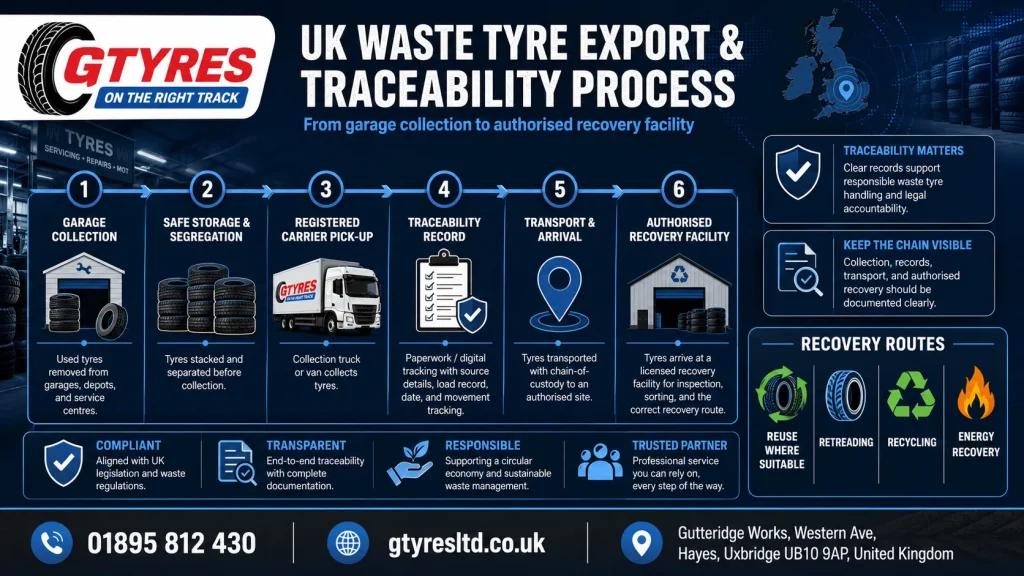
Sending tyres overseas does not prove that they have been recycled correctly. The shipment must reach the intended facility and be managed according to applicable waste-shipment and environmental requirements.
Tyre businesses should retain records showing:
- Which tyres were retained as resale stock
- Which tyres were rejected as waste
- Who collected the waste
- The collector’s registration details
- The date and quantity transferred
- The stated destination
- The relevant transfer documentation
Better Sorting Reduces Avoidable Waste
A suitable casing should not enter mechanical recycling simply because it has been removed from one vehicle. The reverse is equally important. A damaged tyre must not return to sale merely because some tread remains.
The guide on whether part-worn tyres are safe for resale explains the condition and legality checks that support this separation.
What Should Tyre Businesses Do With Removed Tyres?
Tyre businesses should classify removed tyres before arranging resale or waste collection. Suitable casings should follow an appropriate reuse route, while rejected tyres must be stored securely and transferred through registered waste businesses.
Clear sorting and complete paperwork protect the environment, the customer and the garage.
Use this trade checklist:
- Separate potential resale stock from end-of-life tyres
- Record why rejected tyres are unsuitable
- Keep different waste streams separated
- Store tyres securely and manage fire risks
- Check the collector’s waste-carrier registration
- Complete the correct transfer documentation
- Record the quantity, date and destination
- Confirm that the receiving site is authorised
GOV.UK requires businesses to minimise waste through prevention, reuse, recycling and recovery in that order where reasonably possible. Businesses must store waste securely, check the carrier’s registration and complete a waste transfer note for applicable loads leaving their premises.
Apply the Waste Hierarchy Before Recycling
Preparing a suitable tyre for reuse is prioritised above material recycling. A casing that still holds structural integrity, meets legal tread requirements and passes inspection has more value kept in service than broken down for its raw material. Recycling becomes appropriate only once the casing no longer offers safe, legal and commercially credible service life — for example when the tread falls below the legal minimum, the sidewall shows damage, or previous repairs make further use unsafe.
Getting that judgement right is what protects both margin and reputation. A tyre wrongly accepted into stock creates liability; one wrongly rejected wastes usable value. The trade guide on how to spot quality part-worn tyres sets out a practical basis for assessing tread depth, specification, wear pattern and overall condition before a tyre is accepted into stock, helping buyers apply consistent standards across every batch.
Keep Evidence of Every Waste Transfer
For each load of non-hazardous waste moved from business premises, both parties the business handing over the waste and the one collecting it need a waste transfer note or an equivalent document containing the required information. Any document, including an invoice or delivery receipt, can serve this purpose provided it carries all the legally required details: a description of the waste, its EWC code, the quantity, the time and place of transfer, the names and addresses of both parties, and the carrier’s registration details, signed by both sides. Countrystylerecycling
Current GOV.UK guidance requires both businesses to keep a paper or electronic copy for two years, and to produce it for an enforcement officer from the local council or the Environment Agency if asked. Retaining the record is not optional housekeeping failing to produce it on request is itself an offence.
Where the same waste is collected regularly, a season ticket avoids completing a fresh note for every collection. It can cover multiple transfers of non-hazardous waste over a period of up to a year, sometimes called an ‘annual waste transfer note’, but only while the waste holder, carrier and waste type remain unchanged. If any of those details change, a new season ticket or a single transfer note is required. A season ticket must also be backed by a separate schedule logging each individual collection, and the season ticket and its schedule must be kept for two years after the last transfer.
Final Words: How Many Tyres Are Recycled in the UK?
Recent evidence indicates that roughly 50 million tyres, equivalent to almost 700,000 tonnes, reach the UK end-of-life system each year. No single current national dataset identifies exactly how many are materially recycled entirely within Britain.
The honest answer is that the UK handles approximately 50 million end-of-life tyres annually, but the final routes include reuse, retreading, domestic recovery, energy recovery and export.
For garages and tyre retailers, the practical priority is not claiming an inflated recycling percentage. It is preserving suitable tyres through responsible reuse, rejecting unsafe casings and documenting genuine waste transfers correctly.
Call G Tyres Ltd on 01895 812 430 or register your business and request stock availability. With 20 years of trade experience, 50,000+ tyres in stock, a 4mm minimum tread standard and many UK orders delivered within 48 hours, G Tyres helps trade buyers source stock with useful service life remaining. WhatsApp +44 7399 988873 or email sales@gtyresltd.co.uk.
UK Tyres Deserve a Second Life
Discover how reuse, retreading and recycling keep millions of tyres in circulation while helping UK garages reduce avoidable waste.
Frequently Asked Questions
Recent estimates indicate that roughly 50 million tyres, equivalent to almost 700,000 tonnes, reach the UK end-of-life system annually. No single current figure shows how many are recycled inside Britain because the total includes reuse, retreading, exports, material recycling and energy recovery.
No. Some suitable tyres are reused or retreaded, while genuine end-of-life tyres may be processed into recovered materials, sent for energy recovery or exported. The annual tyre-arising estimate should not be presented as a domestic recycling total.
Reuse keeps a suitable tyre or casing in service without breaking it into raw materials. Recycling processes an end-of-life tyre into another material through methods such as shredding or granulation. Preparing for reuse sits above recycling in the official waste hierarchy.
Processed tyres can produce rubber granulate, shavings, tyre bales, recovered steel and tyre-derived fuel. Depending on the process and relevant standards, recovered material may be used for construction, surfacing, equestrian areas or further industrial processing. (gov.uk)
Yes. Industry analysis of the Environment Agency’s 2025 review reported that India received approximately 86.9% of UK waste-tyre exports. That percentage applies only to exported tyres and does not mean that 86.9% of every waste tyre generated in the UK went to India.
Preparing a suitable tyre for reuse is prioritised above recycling because it preserves the complete product. However, only correctly specified and legally compliant tyres should return to service. Unsafe, damaged or unsuitable casings must enter an authorised recovery route.
Businesses must retain paper or electronic copies of non-hazardous waste transfer notes for two years. A season ticket can cover repeated transfers for up to one year when the waste holder, carrier and type of waste remain unchanged.
Current Environment Agency guidance permits a registered T8 operation to store or treat up to 60 tonnes of truck tyres or 40 tonnes of other tyres during any seven-day period. Operators exceeding those limits require an appropriate environmental permit. (gov.uk)
Tyre businesses should separate suitable reusable casings from genuine end-of-life tyres, record why stock is rejected and use registered waste carriers. Accurate grading prevents usable tyres from entering recycling too early while ensuring damaged tyres do not return to the road.