
The dreaded MOT day. We’ve all been there, sitting in the waiting room, sipping lukewarm coffee, and jumping every time the garage door creaks. You start calculating the potential “repair bill” in your head. One of the biggest anxiety triggers for UK drivers is the rubber meeting the road. Many motorists believe that having “second-hand” or part-worn tyres is an automatic red card from the tester. Let’s clear the air immediately: No, you cannot fail an MOT simply because your tyres are part-worn. The MOT tester doesn’t care if your tyres were born in a factory yesterday or if they’ve seen a few thousand miles on another vehicle. What they do care about is the “Safety and Legal Standard” of that rubber. As long as your tyres meet the DVSA’s strict safety criteria, they are perfectly legal. However, the margin for error is slim. A tyre that looked “okay” in your driveway might reveal a hidden bulge or a dangerously low tread under the garage’s high-intensity inspection lights.
The 2026 MOT Standards: What Testers Actually Look For
When the tester hoist your car up, they aren’t looking for brand names; they are looking for integrity. In 2026, the inspection has become even more rigorous to ensure road safety. The primary focus remains on the “Big Three”: Tread depth, structural condition, and fitment. Think of your tyres like the soles of your shoes. If the grip is gone, you’re going to slip; if there’s a hole in the side, you’re going to get wet. On the road, a “slip” at 60mph is a catastrophe. Real-world users on forums like r/CarTalkUK often share stories of failing for things they didn’t even notice, like a tiny “nick” in the sidewall that exposed the inner cords. One user noted, “I thought my tyres were mint because they had loads of tread, but the tester found a bulge on the inner wall I couldn’t see without a lift. Instant fail.” This is why professional inspection is non-negotiable.
The 1.6mm Tread Depth Rule: The Absolute Minimum
In the UK, the magic number is 1.6mm. This must be present across the central three-quarters of the tyre’s breadth and around its entire circumference. If your tyre is 1.5mm, you don’t just fail; you risk a “Dangerous” classification, which means you can’t legally drive the car away from the garage. Imagine trying to run on ice with smooth plastic slippers, that is what 1.6mm feels like in a British rainstorm. While 1.6mm is the “Legal Limit,” most safety experts, including us at G Tyres Ltd, consider this the “Danger Zone.” At this depth, your stopping distance on wet roads increases significantly compared to a tyre with 4mm tread depth. This is why we specialize in Premium Part Worn Tyres that consistently provide that extra cushion of safety.
Sidewall Damage: When a Cut Becomes a Failure
The sidewall is the backbone of your tyre. It handles the pressure and keeps the tyre’s shape during cornering. Testers look for “Major Defects” here, specifically bulges, lumps, or tears. A bulge usually indicates that the internal structure of the tyre has failed, often from hitting a pothole or a curb too hard. If a tester sees a cut deep enough to reveal the “carcass” or cords (the fabric/metal mesh inside the rubber), it’s a “Major Fail.” It feels like a ticking time bomb; you never know when that weakened spot will give way. Sensory-wise, if you run your hand along the sidewall (when the tyre is cool!) and feel any uneven “egg-shaped” bumps, you’re likely looking at a failure. Always check the inner sidewall too, as this is a common blind spot for DIY checks.
TPMS and Pressure: The Dashboard Warning You Can’t Ignore
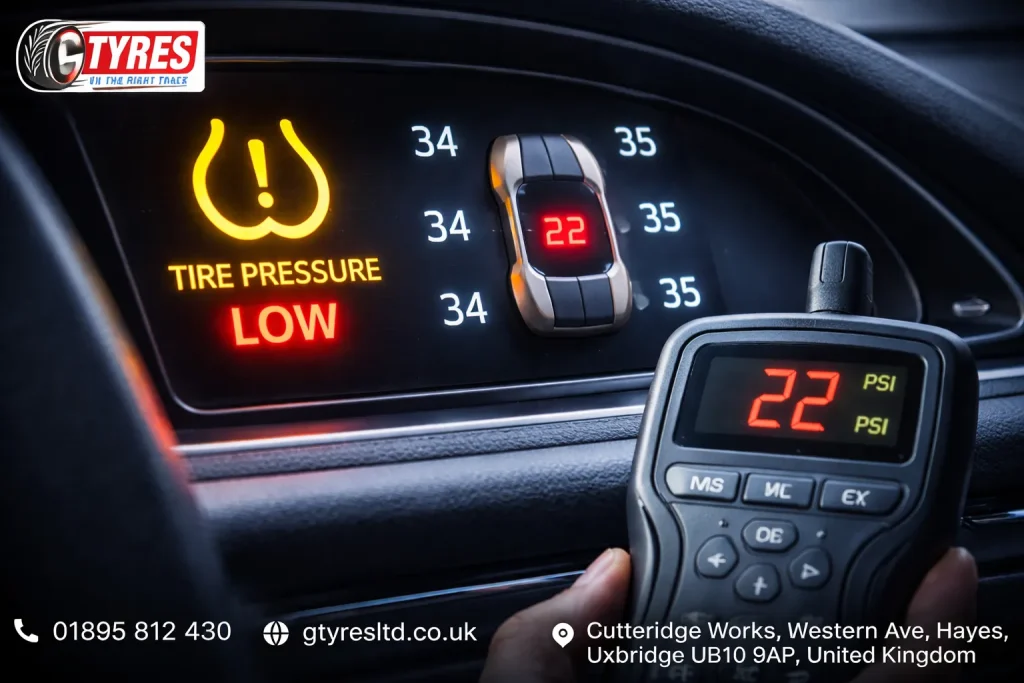
Since 2015, the Tyre Pressure Monitoring System (TPMS) has been a staple of the MOT test for cars registered after 2012. If that little yellow “horseshoe” icon is glowing on your dashboard, your car will fail. It doesn’t matter if the tyres look perfectly inflated to your eye; a malfunctioning sensor or a genuine pressure drop is a safety violation. Modern MOT testers check that the light illuminates during the “test cycle” and then goes off. If it stays on, it indicates a fault in the system. Many users on Quora complain about this: “Failed my MOT over a £10 sensor light even though my tyres were brand new!” It’s a frustrating but essential safety feature designed to prevent blowouts. Before you head to the garage, ensure your pressures are set to the manufacturer’s spec and the light is cleared.
Part-Worn vs. New Tyres: Which is Best for Your MOT?
The moment of truth arrives when you realize your current rubber won’t pass the test. Now you face the classic British motoring dilemma: do you drop £400+ on a set of brand-new premium tyres, or do you look for a high-quality part-worn tyres alternative? Many drivers feel a sense of “shame” or “risk” when considering used tyres, but this is largely due to a lack of transparency in the market. In reality, a premium part-worn tyre from a brand like Michelin or Bridgestone often outperforms a “budget” new tyre from an unknown manufacturer. Think of it like buying a certified pre-owned luxury watch versus a cheap plastic one from a supermarket; the heritage and engineering in the premium casing remain superior. On forums like PistonHeads, seasoned drivers often argue that a Premium Part Worn Tyre with 4mm or 5mm of tread provides better wet-weather grip and lower road noise than a “brand new” budget tyre that feels like it’s made of hard plastic.
The "Safe vs. Legal" Gap: Why 1.6mm is Often an Advisory
There is a massive difference between what the law allows and what a MOT tester recommends. If you roll into the test center with 1.7mm of tread, you will technically “pass,” but you will walk away with an Advisory Notice. An advisory is the tester’s way of saying, “You’re legal today, but you’re a danger tomorrow.” Most UK safety organizations, including TyreSafe, suggest replacing tyres once they hit 3mm. Why? Because the physics of water displacement changes drastically below that point. At 1.6mm, your tyre is barely scratching the surface of a wet road, leading to a high risk of aquaplaning, that terrifying sensory experience where your steering wheel goes light and you feel the car “floating” on a puddle. At G Tyres Ltd, we believe in skipping the advisory altogether. By providing tyres with a 4mm tread depth, we ensure you aren’t just scraping past the legal limit but are driving with a significant safety buffer.
Matching Tyres on the Same Axle: A Common Fail Point
One of the “sneaky” reasons cars fail the MOT is mismatched tyres on the same axle. You might have two part-worn tyres with 6mm of tread, but if one is a “Radial” construction and the other is “Cross-ply” (though rare on modern cars), it’s an immediate failure. More commonly, testers look for mismatched sizes. If your front-left is a 205/55/R16 and your front-right is a 215/55/R16, you are going to fail. The car’s handling becomes unpredictable when the footprint is uneven. A user on Quora recently shared their frustration: “I bought two used tyres from different shops to save money, but because the load ratings were different, the MOT tester flagged it as a major defect.” This is why we always recommend buying in pairs or sets. When we supply Wholesale Tyres to garages across the UK, we ensure they are matched perfectly to keep the vehicle balanced and MOT-compliant.
The 10-Year Age Limit Rule for Front Axle Tyres
A relatively new addition to the MOT criteria (introduced in 2021) is the age of the tyres on certain vehicles. For heavy vehicles, minibuses, and coaches, tyres on the front steered axle must not be more than 10 years old. While this doesn’t apply to standard passenger cars yet, testers still look for “signs of aging” like perishing or cracking. Rubber is a natural product; over time, UV rays and heat cause it to lose its elasticity. If you look closely at a tyre and see tiny “spider-web” cracks in the grooves (often called “crazing”), that is a sign the rubber is dying. Even if it has 7mm of tread, if it’s 12 years old and cracking, it’s a safety hazard. We always check the DOT code (the four-digit number on the sidewall) to ensure our stock is fresh and resilient, giving you peace of mind that your “new-to-you” tyres aren’t ancient history.
Why "Quality" Part-Worn Tyres are 100% MOT-Compliant
The stigma surrounding part-worn tyres usually comes from “backyard” sellers who don’t test their stock. However, legally sold part-worn tyres in the UK must meet the Motor Vehicle Tyres (Safety) Regulations 1994. This means they must be pressure-tested, free from large repairs, and clearly marked “PART-WORN” on the sidewall. When you choose a reputable supplier, you are essentially getting a premium product that has simply been “broken in.” Most of our stock comes from European countries where the legal limit is higher (often 3mm or 4mm), meaning these tyres are discarded long before they are actually “worn out” by UK standards. This creates a “Smart Saving” opportunity for the UK driver. You get a Michelin tyre or Pirelli tyre with 4mm of tread for roughly 30% of the price of a new one. It’s an eco-friendly, budget-conscious, and MOT-safe solution that doesn’t compromise on the quality of your drive.
How to Pass Your MOT First Time: A 2-Minute Pre-Check
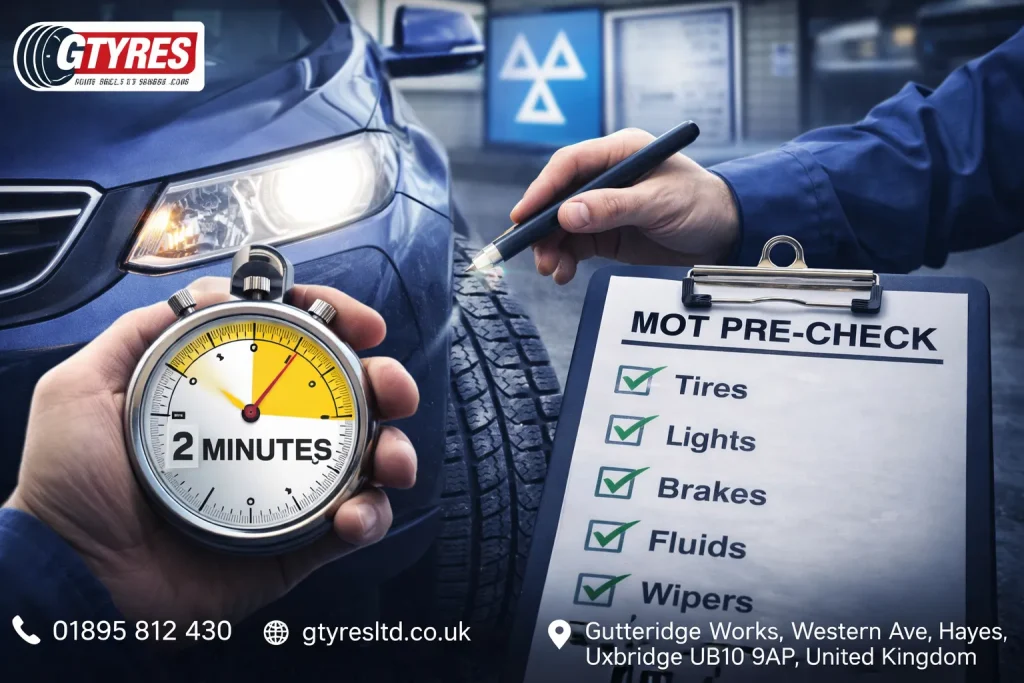
Most MOT failures are preventable. It is heartbreaking to see a car fail for a tyre that could have been replaced for forty quid the day before. To avoid the “Fail” certificate and the stress of a re-test, you need to be proactive. Think of this as a “pre-flight check” for your car. You don’t need to be a mechanic with a hydraulic lift to spot the most common issues; you just need a bit of light, a bit of patience, and a humble 20p coin. By catching a 1.5mm tread or a bulging sidewall early, you can order your Wholesale Part Worn Tyres and have them fitted before the tester even sees the car. This not only saves you the “Partial Re-test” fee at most garages but also ensures you aren’t stranded at the MOT station without a legal vehicle to drive home.
The 20p Coin Test: A Quick DIY Hack
The “20p Test” is the gold standard for UK drivers. It’s incredibly simple because of a lucky coincidence: the outer rim of a 20p coin is approximately 3mm wide. To perform the test, simply insert the coin into the main tread grooves of your tyre. If you cannot see the outer band of the coin, your tread is above 3mm, and you are well within the legal limit (1.6mm). However, if the outer rim of the coin is visible, your tyre may be approaching the legal limit, and a tester will likely slap you with an “Advisory.” For many users on YouTube maintenance channels, this is the “Eye-Opener.” One commenter noted, “I always thought my tyres were fine until I tried the 20p trick. The rim was showing on all four! Saved me a fail the next morning.”
Checking the DOT Code: Is Your Tyre Too Old?
We often talk about tread, but we forget about “rubber fatigue.” Every tyre has a birth certificate stamped on its sidewall, the DOT Code. Look for a small oval window with four digits (e.g., “1224”). The first two digits are the week of manufacture, and the last two are the year. “1224” means the tyre was made in the 12th week of 2024. In the UK, tyres on the front steered axles of heavy vehicles over 10 years old are an automatic fail. While passenger cars aren’t strictly failed on age yet, a 10-year-old tyre will almost certainly have “perishing” (cracking in the rubber). If a tester sees deep cracks in the tread base or sidewall, they will fail it under “Condition.” At G Tyres Ltd, we rotate our stock rapidly to ensure that our Premium Tyres are fresh, supple, and far from their expiry date.
The 4mm Advantage: Passing Your MOT with Confidence
Why do we talk so much about 4mm? Because it is the “Safety Sweet Spot.” While 1.6mm is the legal minimum, and 3mm is the typical “Advisory” threshold, 4mm tread depth offers a level of performance that 1.6mm simply cannot match. In heavy UK rain, a tyre with 4mm of tread can stop a car significantly faster than a “legal” 1.6mm tyre. From a business perspective, supplying 4mm tyres to our wholesale partners means their customers walk away happy, safe, and with a “Clean” MOT certificate, no advisories, no warnings. It’s the difference between “just getting by” and “driving with total peace of mind.” For a budget-conscious driver, a 4mm part-worn tyre is often the smartest financial decision they can make; it’s safer than a 2mm tyre but a third of the price of a new one.
Where to Buy MOT-Ready Wholesale Part-Worn Tyres in the UK
Finding a reliable supplier is the final step in your search journey. You need a partner who understands the high stakes of the MOT test. At G Tyres Ltd, we have built our reputation on being the “Hidden Secret” of the UK tyre industry. With over 50,000 tyres in stock and a rigorous pressure-testing process, we ensure that every tyre leaving our warehouse is fit for purpose. Whether you are a garage owner looking to restock or a fleet manager preparing for a block of MOTs, our Nationwide Delivery ensures you get your rubber within 48 hours. We don’t just sell “used” tyres; we sell inspected, A-Grade components from world-class brands like Michelin, Continental, and Pirelli.
Final Words: The Smart Way to Pass Your MOT
Navigating the MOT doesn’t have to be a financial nightmare. By understanding that Part-Worn Tyres are a perfectly legal and safe solution, provided they are sourced from a Reputable Wholesale Supplier, you can save hundreds of pounds without risking your life. Remember, the MOT tester is looking for safety, not a “Brand New” sticker. If your tyres have a healthy tread (ideally 4mm+), no structural bulges, and matching sizes on each axle, you are already halfway to a “Pass” certificate. Don’t wait for the tester to find a fault; use the 20p test today and be proactive about your vehicle’s health.
Final Checklist Before You Go
• Tread: Use a 20p coin to check all four tyres (and the spare!).
• Condition: Run your hand along the sidewalls to feel for lumps or “egg” shapes.
• Dashboard: Ensure no tyre-related warning lights are active.
• Matching: Check that the numbers on the sidewall match for both tyres on the same axle.
Ready to Secure Your MOT-Ready Tyres?
If your pre-check has revealed a tyre that won’t make the cut, don’t panic. At G Tyres Ltd, we specialize in providing high-quality, pressure-tested Wholesale Part Worn Tyres across the UK. From London to Manchester and beyond, our nationwide 48-hour delivery means you won’t be off the road for long. With over 50,000 tyres in stock and a commitment to the 4mm safety standard, we are the trusted partner for garages and individual drivers alike.
Frequently Asked Questions
Yes. The legal limit in the UK is 1.6mm, so a tyre with 3mm of tread will comfortably pass the test. However, the tester may issue an 'Advisory' notice because braking performance begins to decline significantly below 3mm. G Tyres Advice: Our 4mm tyres provide an extra safety margin, ensuring your vehicle remains safe and MOT-compliant for much longer.
No. You will not fail as long as the size and structure (Radial or Cross-ply) are identical on the same axle. While brands can differ between the left and right sides, having mismatched sizes or structures on the same axle is an automatic failure.
It depends. If the cracks are merely superficial (surface-level) due to the natural ageing of the rubber, the tester will likely only give an 'Advisory.' However, if the cracks are deep enough to expose the internal cords or fabric, it is classified as a Major Failure, and the tyre must be replaced.
If the failure is marked as "Dangerous" (e.g., exposed cords or a significant bulge), it is illegal to drive the vehicle on public roads. You must replace the tyres on-site or have the car towed. If it is a "Major" failure and your old MOT certificate is still valid, you may technically drive to a repair shop, though this is highly discouraged for safety reasons.
No, An MOT tester does not differentiate between "second-hand" and "brand new" tyres. They focus strictly on four key safety areas: Tread depth (1.6mm+), Physical condition (no bulges or deep cuts), Correct fitment (matching sizes), and Pressure (TPMS warning light must be off).
Yes, If the tester notices a tyre is visibly under-inflated or finds a foreign object (like a nail or screw) embedded in the rubber that poses a safety risk, they can fail the vehicle. Additionally, in line with 2026 regulations, a dashboard TPMS warning light staying on is an automatic failure.