
Tyre performance is not just about tread depth or brand quality; it is heavily influenced by something drivers often ignore: temperature. Every degree of change in weather affects how tyres behave on the road, from grip levels to braking distance and even overall stability. When temperatures drop in the early morning or rise sharply during summer afternoons, the internal air pressure and rubber flexibility inside tyres change instantly. This is why many drivers suddenly notice warning lights, reduced control, or unusual road feel without understanding the real cause.
At G Tyres LTD, we see this confusion every day from drivers who assume their tyres are damaged when in reality it is a natural physical reaction. Cold air contracts inside tyres, lowering pressure, while heat expands it, increasing pressure beyond normal levels. These shifts directly affect how your car interacts with the road surface. Think of tyres like living components responding to environment rather than static rubber circles. Understanding this relationship is essential for safe driving, better fuel efficiency, and longer tyre life, especially for those using everyday road vehicles in changing weather conditions.
Why Tyre Performance Changes With Temperature (Simple Explanation for Drivers)
Tyres are designed using rubber compounds that react strongly to temperature changes, which means their performance is never completely stable across seasons. When temperatures drop, the rubber becomes stiffer, reducing its ability to flex and grip the road properly. On the other hand, when temperatures rise, the rubber softens, which can increase wear and slightly reduce control during high-speed driving. This constant shift is why drivers often feel their car behaves differently in winter mornings compared to hot afternoon journeys.
A common real-world example is when drivers wake up to a tyre pressure warning light on cold days, even though no puncture exists. This happens because air molecules contract overnight, reducing internal tyre pressure below the recommended level. Similarly, during long motorway drives in summer, tyres can feel harder and less responsive due to air expansion. Many drivers misinterpret these changes as faults, but they are actually normal physics at work. G Tyres LTD often advises customers that understanding this behavior can prevent unnecessary panic and improve long-term tyre care decisions.
How air pressure inside tyres reacts to heat and cold
Air inside tyres behaves according to basic thermal physics. When the temperature drops, air molecules slow down and move closer together, which reduces pressure inside the tyre. This is why a car parked outside overnight often shows lower tyre pressure in the morning, especially during winter months. Conversely, when the temperature rises, air molecules expand and increase pressure, sometimes making tyres feel overinflated during long drives or hot afternoons.
This constant expansion and contraction creates a cycle that directly impacts driving safety. Underinflated tyres reduce fuel efficiency and increase braking distance, while overinflated tyres reduce road contact, leading to reduced grip. Drivers often overlook this invisible fluctuation because it happens gradually throughout the day. At G Tyres LTD, this is one of the most common issues identified during routine tyre checks. The key takeaway is simple: tyre pressure is not static, and ignoring temperature changes can silently reduce both safety and performance.
Why tyre warning lights appear during cold mornings
Tyre pressure monitoring systems (TPMS) are extremely sensitive to small changes in air pressure, which is why warning lights often appear suddenly during cold mornings. Even a small drop caused by overnight temperature reduction can trigger the system. This does not always indicate a puncture or tyre failure, but rather a natural reaction to environmental conditions. Many drivers panic when they see this warning, assuming immediate damage, but in most cases, the issue resolves after proper pressure adjustment.
The reason mornings are the most common trigger is simple: temperatures are at their lowest point of the day. As the air inside tyres contracts overnight, pressure falls below the manufacturer’s recommended level. Once the tyres warm up during driving, pressure may return closer to normal, which is why the warning sometimes disappears later. However, relying on this natural correction is not safe. Regular pressure checks, especially during seasonal transitions, are essential. G Tyres LTD recommends checking tyres in a cold state to ensure accurate readings and consistent performance.
How rubber hardness changes in different temperatures
Rubber is a temperature-sensitive material, which means it physically changes behavior depending on weather conditions. In cold weather, rubber compounds harden, reducing flexibility and making it harder for tyres to maintain strong contact with the road surface. This is especially noticeable during braking or cornering, where grip becomes less responsive. In contrast, warm temperatures soften the rubber, improving flexibility but increasing wear rates over time.
This change is not visible, but drivers feel it through steering response, road noise, and braking performance. For example, a car that feels smooth and controlled in summer may feel slightly stiff or less responsive in winter mornings. These differences are not faults but natural material reactions. Understanding this helps drivers make better decisions about tyre maintenance and replacement timing. At G Tyres LTD, we often explain that tyre performance is a balance between temperature, pressure, and rubber condition, all working together to determine road safety.
Cold Weather vs Hot Weather: How Tyre Performance Differs
Temperature changes don’t just slightly affect tyres; they completely change how a vehicle behaves on the road. In cold weather, tyres become harder because the rubber compound loses flexibility, which reduces grip and increases braking distance. This is why cars often feel less responsive in winter mornings, especially on wet or icy roads. Drivers sometimes describe it as “floating” or “sliding slightly,” which is a direct result of reduced friction between tyre and road surface.
In hot weather, the opposite problem occurs. The rubber becomes softer due to heat expansion, which increases wear and can make tyres feel less stable during long drives at high speeds. This is especially noticeable on highways where continuous friction builds internal heat inside the tyre. At G Tyres LTD, we often explain to drivers that both extremes are dangerous in different ways, and tyre condition plays a major role in how well a vehicle adapts to these changes. Understanding this difference is essential for safe driving across seasons.
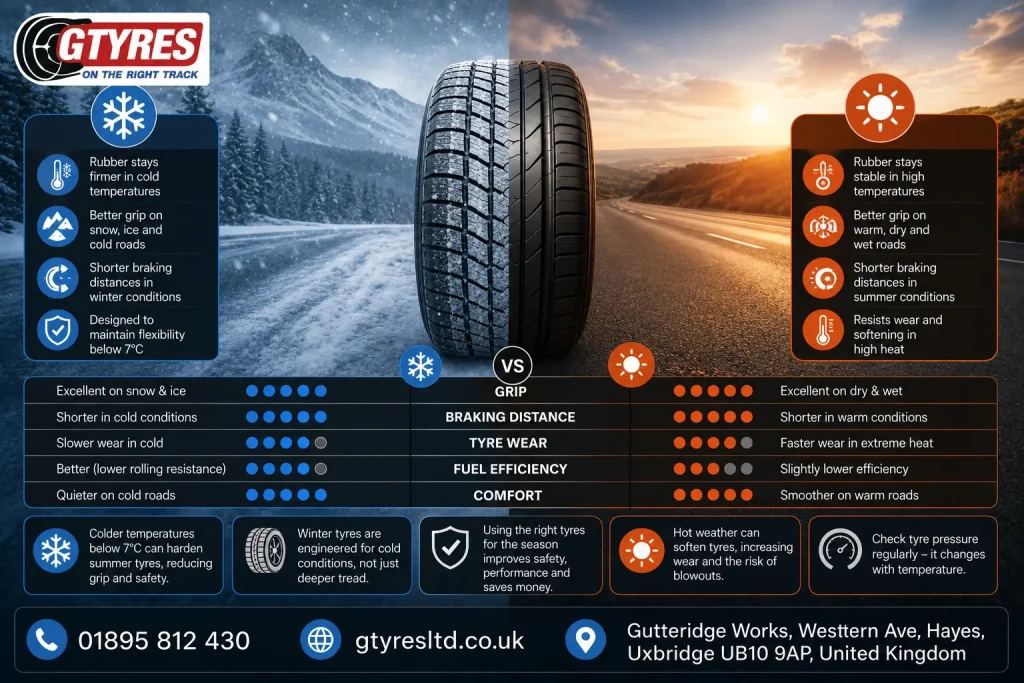
Grip and braking performance comparison
Grip and braking are the two most critical safety factors affected by temperature. In cold weather, tyres lose elasticity, meaning they cannot “stick” to the road surface as effectively. This leads to longer stopping distances, especially during sudden braking situations. Even a small drop in road temperature can significantly impact emergency braking performance, which is why winter mornings often feel more dangerous to drivers.
In hot weather, grip may initially feel stronger due to softer rubber, but it quickly becomes inconsistent during extended driving. Overheating tyres can reduce stability, especially when cornering at higher speeds. Many drivers mistake this for “good grip,” when in reality it is temporary rubber softening that leads to faster wear. This is why professional tyre checks at G Tyres LTD always include both temperature and tread condition analysis, ensuring balanced performance in all conditions.
Tyre pressure behavior differences
Tyre pressure is one of the most noticeable changes drivers experience between seasons. In cold weather, pressure drops naturally because air contracts, often triggering dashboard warnings even when tyres are not damaged. This underinflation reduces fuel efficiency and increases tyre wear on the outer edges. Drivers who ignore this often experience uneven tyre life without realizing the cause.
In hot weather, pressure increases as air expands inside the tyre. This can lead to overinflation, where the central part of the tyre wears faster and road contact becomes uneven. Long-distance driving in summer can make this effect even more intense due to continuous heat buildup. At G Tyres LTD, we always advise regular seasonal pressure checks because relying on visual inspection alone is not enough to detect these hidden changes.
Wear rate in extreme temperatures
Tyre wear is directly influenced by temperature extremes, even if the driver does not notice it immediately. In cold weather, harder rubber increases surface friction inconsistently, causing micro-level cracking over time. This type of wear is slow but affects long-term durability and performance. Drivers often notice reduced grip before they notice visible tread damage.
In hot weather, wear happens faster because softer rubber breaks down more quickly under friction and heat stress. This is especially common in urban driving with frequent stops or long motorway journeys at high speed. Over time, this leads to reduced tread depth and uneven wear patterns. At G Tyres LTD, we frequently see tyres that look fine externally but have internal heat-related stress damage that reduces safety without obvious warning signs.
Temperature Impact Comparison Table
Factor | Cold Weather | Hot Weather |
Rubber Condition | Hard & stiff | Soft & flexible |
Grip Level | Reduced | Moderate but unstable at speed |
Braking Distance | Longer | Can become inconsistent |
Tyre Wear Rate | Slow but uneven | Faster wear |
Pressure Behavior | Drops | Increases |
Real driving impact of extreme temperature changes
On real roads, temperature changes are felt more than most drivers realize. In cold weather, even small braking actions feel delayed because tyres cannot generate enough friction quickly. Steering also feels heavier, especially during early morning drives when tyres are at their coldest point. These subtle changes increase risk without obvious warning signs.
In hot weather, drivers often experience a different issue: tyres feel “light” or slightly unstable at high speeds. This happens because increased internal pressure reduces road contact surface. Combined with long-distance heat buildup, this can lead to reduced control in emergency situations. G Tyres LTD always highlights that these changes are not theoretical, they are daily driving realities that directly impact safety.
Why temperature risks increase on highways
Highways amplify temperature-related tyre risks because speed generates continuous heat. In hot conditions, this leads to rapid internal temperature rise, increasing pressure and wear simultaneously. If tyres are already worn or underinflated, this risk becomes significantly higher. Drivers may not notice any issue until performance suddenly drops at high speed.
In cold conditions, highway driving exposes tyres to prolonged low grip conditions, especially early in the journey before tyres warm up. This can make lane changes and emergency braking more dangerous than in city driving. At G Tyres LTD, we always stress that motorway safety depends heavily on tyre condition and correct pressure management, not just driving skill.
Do Different Tyre Types React Differently to Temperature?
Not all tyres respond to temperature changes in the same way, and this is where many drivers misunderstand performance differences. Tyres are made using different rubber compounds, internal structures, and manufacturing quality levels, which means their reaction to heat and cold can vary significantly. In simple terms, a high-quality tyre maintains more stable performance across changing temperatures, while lower-grade or worn tyres react more sharply to weather shifts.
In real driving conditions, this difference becomes very noticeable. A vehicle fitted with premium tyres tends to feel more predictable in both cold mornings and hot afternoon drives, while budget or older tyres may feel inconsistent. At G Tyres LTD, we often explain to customers that temperature doesn’t just affect tyres, it exposes the quality and condition of the tyre itself. This is why seasonal performance differences are not only about weather but also about tyre construction and wear level.
Budget vs premium tyre performance in heat and cold
Budget tyres and premium tyres respond differently because of how their rubber compounds are designed. Premium tyres use advanced compounds that remain more flexible in cold weather and more stable in heat, allowing better grip and more consistent braking. This means drivers experience fewer sudden changes in handling when the temperature shifts quickly.
Budget tyres, on the other hand, tend to harden more in cold weather and soften more quickly in heat. This creates uneven performance, especially during long-distance driving or sudden weather changes. Drivers may notice reduced steering precision in winter and faster wear in summer. At G Tyres LTD, this is one of the most common real-world differences customers report when switching tyre types, especially during seasonal transitions.
Rubber compound flexibility differences
Rubber compound flexibility is one of the most important factors affecting tyre performance across temperatures. Flexible compounds can adapt better to road surface changes, maintaining grip even when temperatures fluctuate. This is why modern tyres are engineered to balance softness and durability across different weather conditions.
In colder environments, less flexible rubber becomes stiff, reducing road contact and increasing braking distance. In hotter environments, overly soft rubber can degrade faster due to heat stress and friction. This balance is carefully designed in premium tyres, while cheaper or older tyres often lack this level of optimization. At G Tyres LTD, we emphasize that flexibility is not just comfort, it is a core safety factor that directly impacts real driving performance.
Wear resistance under temperature stress
Temperature has a direct impact on how quickly tyres wear down, but the rate of wear depends heavily on tyre quality and condition. In cold weather, tyres may not wear quickly, but micro-level cracking can occur due to reduced flexibility. This type of damage is often invisible until it affects performance. Drivers may think their tyres are fine because tread depth looks acceptable, but internal stress can still reduce safety.
In hot weather, wear becomes more visible and faster due to increased friction and heat buildup. Long motorway journeys or aggressive driving can accelerate tread loss, especially on already worn tyres. Over time, this leads to uneven wear patterns, reduced grip, and shorter tyre lifespan. At G Tyres LTD, we often find that temperature stress reveals hidden weaknesses in tyres that otherwise appear normal during visual inspection.
Are Part Worn Tyres Affected More by Temperature Changes?
Part worn tyres can perform safely in different weather conditions, but their response to temperature changes is often more noticeable compared to brand-new tyres. This is because they have already experienced a portion of their natural lifespan, which affects rubber elasticity and overall structural strength. In cold weather, older rubber can become slightly stiffer, reducing grip faster than newer tyres under the same conditions.
In hot weather, part worn tyres may also show quicker wear because the rubber has already undergone heat cycles during previous use. However, this does not automatically make them unsafe. When properly inspected and sourced responsibly, part worn tyres can still provide reliable performance. At G Tyres LTD, we always emphasize that condition, tread quality, and structural integrity matter more than whether a tyre is new or part worn.
Cold weather performance considerations
In cold conditions, part worn tyres may feel slightly less responsive due to reduced rubber flexibility. This can affect grip during braking or cornering, especially on wet or icy roads. However, the degree of impact depends heavily on the remaining tread depth and overall condition of the tyre. Well-maintained part worn tyres can still perform adequately if they meet safety standards.
Drivers often notice that older tyres take longer to “warm up” compared to new tyres, meaning initial grip in early morning drives may feel weaker. This is a normal behavior caused by rubber stiffness in low temperatures. At G Tyres LTD, we recommend regular inspections during winter months to ensure that part worn tyres remain safe and effective under changing conditions.
Heat resistance and durability factors
In hot weather, part worn tyres are more exposed to heat-related stress because they have already experienced previous thermal cycles. This can slightly reduce their ability to maintain consistent performance during long-distance or high-speed driving. Over time, repeated heating and cooling can affect rubber integrity and accelerate wear patterns.
However, not all part worn tyres react the same way. High-quality part worn tyres with good structural health can still handle heat effectively, especially when properly inflated and maintained. The key factor is not just age, but overall condition and maintenance history. At G Tyres LTD, every tyre is assessed for durability before use, ensuring it meets safety expectations under real-world driving conditions.
Wholesale Part Worn Tyres and Cost-Effective Tyre Solutions for Businesses
The demand for wholesale part worn tyres has increased significantly because many garages, workshops, and fleet operators are looking for cost-effective yet reliable tyre supply options. Temperature-related tyre performance is also a key consideration in bulk supply decisions, as businesses need tyres that can perform consistently across different driving environments. Wholesale sourcing allows businesses to maintain a steady supply of tyres that meet both performance and affordability needs.
At G Tyres LTD, wholesale part worn tyres are selected based on quality checks that ensure durability, tread reliability, and safe performance under varying temperature conditions. This makes them suitable for high-volume usage where consistency is essential. Many businesses prefer this approach because it allows them to balance cost efficiency with dependable road safety standards.
Why garages and fleets choose wholesale supply
Garages and fleet operators choose wholesale tyre supply because it reduces cost per unit while maintaining consistent availability. This is especially important for businesses handling multiple vehicles that operate in different weather conditions. Temperature changes can affect tyre demand patterns, so having a stable supply ensures uninterrupted operations.
Another reason is reliability. Businesses need tyres that perform predictably across seasons, reducing customer complaints and maintenance issues. At G Tyres LTD, wholesale supply is structured to ensure that each batch of tyres meets consistent performance standards, which is critical for commercial use where downtime directly affects business efficiency.
Consistency and quality control in bulk tyres
Consistency is one of the most important factors in wholesale tyre supply. If tyres behave differently under the same conditions, it can create unpredictable performance issues for drivers. This is why quality control plays a major role in bulk tyre sourcing, ensuring each tyre meets specific safety and performance criteria.
At G Tyres LTD, tyres are evaluated for structural integrity, tread condition, and temperature resilience before being included in wholesale supply. This helps maintain uniform performance across batches, reducing variation in how tyres respond to heat and cold. For businesses, this consistency translates into fewer maintenance issues and better long-term reliability.
When You Should Replace Your Tyres Due to Temperature-Related Wear
Tyres don’t fail suddenly in most cases; they degrade gradually, and temperature changes often speed up that process without drivers noticing. One of the clearest signs of replacement need is uneven wear that becomes more visible after seasonal shifts. In cold weather, reduced flexibility can cause micro-cracks, while in hot weather, excessive heat can accelerate tread loss. These changes slowly reduce grip, braking efficiency, and overall road stability.
At G Tyres LTD, we often see drivers delaying tyre replacement because the tread still “looks fine,” but performance has already dropped due to heat and cold stress. This is why relying only on visual inspection is not enough. Tyres should be treated as safety components that react to environment, not just rubber parts that wear down with mileage. When temperature-related changes begin to affect handling, it is already a strong signal that replacement should be considered.
Signs of heat damage or cold-related wear
Heat damage usually appears as faster tread wear, softening of rubber, or uneven patterns across the tyre surface. Drivers may notice reduced stability at high speeds or a slight vibration during motorway driving. These symptoms are often ignored until performance becomes noticeably poor, but by that stage the tyre has already lost efficiency.
Cold-related wear, on the other hand, is more subtle. It can include surface cracking, stiffness in steering response, or reduced grip during early morning driving. These signs are especially common in older tyres that have gone through multiple winter cycles. At G Tyres LTD, we always recommend checking tyres visually and physically after seasonal changes to detect early damage before it becomes a safety risk.
Uneven tread wear indicators
Uneven tread wear is one of the strongest indicators that temperature changes have affected tyre performance. When one side of the tyre wears faster than the other, it usually signals inconsistent pressure or temperature stress over time. This can reduce braking stability and create unpredictable handling, especially in emergency situations.
Drivers often overlook uneven wear because it develops gradually. However, it directly affects how tyres distribute road contact, especially during cornering and braking. Regular inspections can help identify this issue early. At G Tyres LTD, we advise checking tread depth across multiple points of the tyre, not just the center, to ensure balanced wear and safe performance.
Loss of grip or repeated pressure issues
A clear warning sign of tyre deterioration is repeated loss of grip, especially in wet, cold, or high-temperature conditions. If the vehicle feels unstable during braking or cornering more often than before, it indicates that the tyre’s ability to maintain consistent road contact is decreasing. Temperature fluctuations make this problem more noticeable because they expose weak points in tyre structure.
Repeated pressure loss is another major indicator. While small seasonal changes are normal, frequent drops or increases in pressure without clear environmental reasons suggest deeper tyre issues. This can affect fuel efficiency, safety, and driving comfort. At G Tyres LTD, we always stress that repeated pressure instability should never be ignored, as it often signals that replacement is necessary.
Final Safety Advice for Seasonal Driving
Driving safely in changing temperatures is not just about adjusting speed; it is about understanding how tyres behave under different environmental conditions. Cold weather reduces flexibility and grip, while hot weather increases pressure and wear. Both situations require awareness and regular maintenance to ensure tyres remain safe and reliable throughout the year.
At G Tyres LTD, we always recommend that drivers treat tyre care as a seasonal habit, not a one-time check. Simple actions like regular pressure monitoring, visual inspection, and timely replacement can significantly improve safety and performance. Many accidents related to tyre failure are not sudden events, they are the result of ignored temperature-related wear over time.
Practical seasonal tyre maintenance checklist
A simple maintenance routine can dramatically improve tyre life and safety. Drivers should check tyre pressure at least once a month and always during major temperature shifts. Inspections should include tread depth, surface cracks, and uneven wear patterns. It is also important to check tyres when they are cold, as this gives the most accurate pressure reading.
Another key step is ensuring proper alignment and rotation when needed. Misaligned tyres wear faster under temperature stress, especially during long-distance driving. At G Tyres LTD, we recommend combining visual checks with professional inspections to maintain consistent performance across all seasons. This approach reduces unexpected tyre failures and improves overall driving stability.
How G Tyres LTD supports safe and reliable tyre performance
G Tyres LTD focuses on providing tyres that are suitable for real-world driving conditions, including seasonal temperature variations. Every tyre is selected with attention to safety, tread quality, and performance consistency. Whether drivers need everyday replacements or bulk supply solutions, the goal is always to ensure reliability under different weather conditions.
For businesses and individual drivers alike, choosing the right tyres is not just about cost but about long-term safety and performance. G Tyres LTD helps customers make informed decisions based on driving conditions, mileage, and seasonal requirements. This ensures that every tyre fitted performs effectively in both hot and cold environments.
Final Words: Understanding Temperature is Key to Tyre Safety
Temperature plays a much bigger role in tyre performance than most drivers realize. From pressure changes and grip variation to wear rate and safety risks, every aspect of driving is influenced by environmental conditions. Ignoring these changes can lead to reduced performance, higher risk, and unnecessary tyre damage over time.
By understanding how tyres react to heat and cold, drivers can make smarter maintenance decisions and improve road safety significantly. Whether using standard, premium, or part worn tyres, regular checks and seasonal awareness are essential. At G Tyres LTD, we believe informed drivers are safer drivers, and proper tyre care is one of the simplest ways to ensure long-term vehicle performance.
Need Better Tyre Performance in Changing Weather Conditions?
Looking for safe tyres that perform well in hot and cold weather driving conditions today.
Frequently Asked Questions
Tyre pressure drops in cold weather because air inside the tyre contracts when temperatures fall. This reduces internal pressure even if there is no puncture. At G Tyres LTD, we often explain that this is a normal physical reaction and not usually a sign of tyre damage, which is why many drivers notice warning lights during winter mornings.
Yes, hot weather affects tyre performance by increasing internal air pressure and softening the rubber compound. This can lead to faster wear and slightly reduced stability during long drives. G Tyres LTD advises drivers to monitor tyre condition regularly during summer because high temperatures can quietly impact safety and overall road grip.
Temperature affects tyre grip because rubber reacts differently in cold and hot conditions. In cold weather, tyres become harder and lose flexibility, reducing road contact. In hot weather, tyres become softer, which can increase wear. G Tyres LTD highlights that maintaining correct pressure is key to ensuring consistent grip in all seasons.
Part worn tyres can be safe in different temperatures if they are in good condition and properly maintained. However, their performance may vary more compared to newer tyres, especially in extreme heat or cold. G Tyres LTD supplies tyres that are carefully selected to ensure they perform reliably under everyday driving conditions.
Yes, tyres tend to wear faster in hot weather because higher temperatures increase friction between the tyre and road surface. Long-distance or high-speed driving can accelerate this process further. At G Tyres LTD, we always recommend monitoring tyre condition closely during summer months to ensure safe and efficient driving performance.