
The world of automotive inventory is shifting rapidly, and for garage owners, fleet managers, and tyre retailers, the economics of procurement have never been more critical. When you are running a busy workshop, your bottom line depends on balancing quality with cost effectiveness. This is where part worn tyre pallets come into play, offering a practical solution for businesses that need to maintain healthy margins without compromising on the safety standards their customers expect. At G Tyres LTD, we understand that for many, the term part worn conjures up images of uncertain quality, but the reality for professional traders is vastly different. When sourced from a reputable wholesaler, these tyres provide a gateway to premium brand performance at a price point that makes sense for both you and the driver.
Investing in bulk stock is more than just a financial transaction; it is a commitment to the safety of the vehicles you service. Many professional traders in the UK are turning away from the influx of cheap, unbranded new budget tyres, choosing instead to stock high grade wholesale part worn tyres that offer superior engineering and performance. By selecting the right supplier, you gain access to a consistent stream of inventory that keeps your bay moving and your customers satisfied. Throughout this guide, we will explore the nuances of the wholesale market, focusing on how G Tyres LTD helps you navigate the complexities of grading, safety compliance, and stock rotation. Our mission is to ensure that your business remains competitive in an increasingly demanding market, where quality is the primary currency of trust.
What Are Part Worn Tyre Pallets and Why Do They Matter?
Part worn tyre pallets are essentially bulk collections of used tyres that have been inspected, graded, and prepared for professional resale. For a garage owner or a mobile tyre fitter, these pallets represent the lifeblood of the secondary tyre market. Instead of purchasing tyres individually, which is time consuming and rarely cost effective for a commercial operation, buying by the pallet allows you to stock a diverse range of sizes and brands in one go. However, the importance of these pallets goes beyond simple logistics. They allow you to provide a tiered pricing structure to your customers, offering them a choice between premium used tyres and entry level options, which effectively broadens your customer base and increases your revenue streams.
The market for these pallets has grown as consumers become more conscious of value and as the quality of used rubber arriving at major UK ports has improved. When you secure a high quality pallet from G Tyres LTD, you are not just getting rubber; you are getting a curated selection of casings that have been vetted for structural integrity. This is crucial because, in the tyre business, your reputation is tied to every product you install. A pallet that contains well maintained, high tread depth tyres allows you to quickly address the needs of walk in customers who might be struggling with a sudden tyre replacement cost. By having this stock on hand, you turn a potential lost sale into a satisfied client who will likely return for other services, such as wheel balancing or alignment.
The Growing Demand for High Quality Part Worn Stock
There is a distinct shift in what professional traders are looking for today. Five years ago, the focus was solely on the lowest possible price, but today, that narrative has changed toward reliability. Customers are better informed; they read reviews and they understand the difference between a high performance tyre and one that barely meets the legal requirement. As a result, garages are demanding stock that carries a brand name they can stand behind. This is why G Tyres LTD focuses on acquiring pallets that contain premium manufacturers like Michelin, Continental, and Bridgestone. These brands invest heavily in research and development, meaning that even as a part worn product, they often outperform brand new budget tyres in terms of wet weather grip and puncture resistance.
This demand is driven by the fact that modern vehicles are heavier and faster, requiring tyres that can handle significant stress. When a customer walks into your shop with a luxury SUV or a high performance saloon, they need confidence in the rubber that touches the road. Providing them with a high quality, inspected part worn tyre at a competitive price makes your shop look like a professional solution provider rather than just a place to get cheap parts. We see this trend consistently across our wholesale network, where garages that prioritize quality over the cheapest possible pallet see a lower rate of customer returns and a higher rate of referrals. It is a simple business logic: quality stock leads to repeat business, and repeat business is the cornerstone of any successful tyre retail operation.
Beyond the Basics: Understanding Tyre Casing Integrity
Casing integrity is perhaps the most misunderstood aspect of buying wholesale pallets. When we talk about a tyre’s casing, we are referring to the internal structure of the tyre, which includes the sidewalls, the steel belts, and the bead area. A tyre might look excellent on the surface with plenty of tread, but if the casing has been compromised by a severe pothole impact or improper storage, it could be a safety hazard. This is the biggest fear for any professional buyer, and it is where G Tyres LTD makes a significant difference. We treat every pallet as if it were destined for our own fleet, ensuring that the structural integrity of the casing is assessed before it ever reaches your garage floor.
When you inspect a pallet, you need to look for signs of structural stress, such as sidewall bulges or internal cord separation, which can be difficult to spot for the untrained eye. Our inspection process removes this guesswork for you, allowing you to stock your shelves with confidence. We understand that you cannot afford to have a customer return with a bubble in their tyre a week after it was fitted, as that would damage your professional standing. By focusing on casing integrity, we ensure that the tyres in your pallet are not only compliant with UK regulations but are also physically sound. This level of diligence is what sets a premium supplier apart from a simple reseller. When you partner with us, you are outsourcing your quality control to a team that understands the technical demands of your daily operations.
Understanding the Grading System: What Defines Grade A, B, and C?
Navigating the wholesale market requires a clear understanding of the grading system, as this is the standard language used by suppliers to define the value and condition of their inventory. When you order a pallet, you are effectively buying a promise of performance, and the grade assigned to that pallet is the benchmark for that promise. At G Tyres LTD, we believe that transparency in grading is the foundation of our business relationship with garage owners. A pallet labeled as “Grade A” should never arrive looking like “Grade C,” and this consistency is why professional traders rely on our structured approach to stock management. Grading is not merely about tread depth; it is a holistic evaluation of the tyre’s life, its appearance, and its suitability for the UK’s demanding road conditions.
In the wholesale industry, grades act as a filter for your business strategy. For instance, if you operate a shop that caters to high-end luxury vehicles, your inventory requirements will naturally skew toward Grade A stock, which features substantial remaining life and impeccable aesthetic condition. Conversely, if your garage serves a fleet of delivery vans or budget-focused commuters, a mix of Grade A and B might be more cost-effective. However, the pitfall many shop owners encounter is purchasing low-grade stock under the assumption that it will sell just as well. This rarely holds true, as the modern consumer is discerning. Our grading process at G Tyres LTD is designed to help you align your stock with your specific customer base, ensuring that you minimize “dead stock” and maximize your capital turnover.
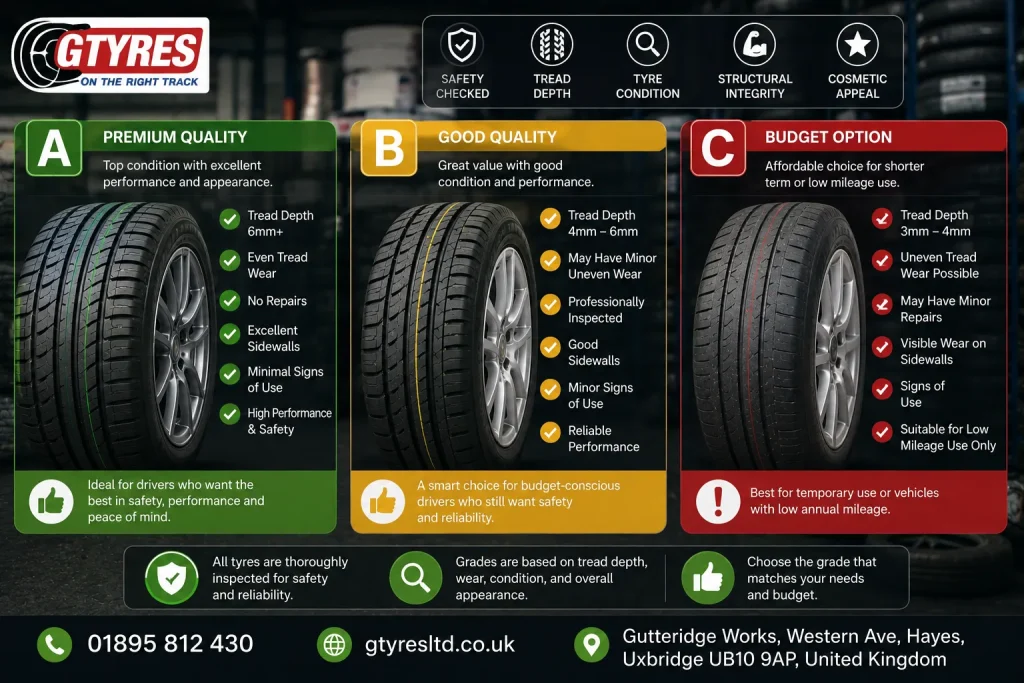
Grade A Pallets: The Gold Standard for Your Business
Grade A pallets represent the pinnacle of part worn inventory. These tyres are typically in the 4mm to 6mm+ tread depth range, often originating from lease returns or high-maintenance vehicle fleets where tyres are replaced well before the legal limit. For your shop, these are the easiest tyres to sell. They provide a “near-new” experience for your customers at a fraction of the cost, making them the perfect upsell opportunity. When a customer comes in for a budget tyre, showing them a premium brand Grade A tyre with substantial tread depth often closes the deal immediately. It is a visual and tactile sell; the depth is clear, the rubber is supple, and the brand pedigree speaks for itself.
Beyond the tread, Grade A tyres in our pallets are inspected for even wear and pristine sidewall condition. You will find that these tyres are free from excessive scuffs, dry rot, or uneven patches caused by poor wheel alignment. This is critical for you as a fitter because it makes the wheel balancing process smoother. A well-maintained Grade A tyre from G Tyres LTD seats perfectly on the rim, requiring minimal weights and providing a vibration-free ride for the driver. This reliability reduces the time your technicians spend on each vehicle, allowing you to increase your daily throughput. By stocking Grade A, you are signaling to your local market that your shop is a source of premium solutions, which significantly boosts your professional reputation.
Why G Tyres LTD Sets a 4mm Tread Depth Standard
You might notice that while the legal limit for part worn tyres in the UK is 2mm, G Tyres LTD holds a strict business standard of 4mm tread depth. This is a deliberate choice rooted in our commitment to our partners’ long-term success. While 2mm is technically legal, it provides very little margin for error, particularly in the wet, rain-prone conditions we experience throughout the year. If you sell a tyre with exactly 2mm of tread, the customer will be back at your shop in a few thousand miles, and if they have a poor experience or worse, a safety scare during that time, they are unlikely to return. By setting our benchmark at 4mm, we provide your customers with a tyre that has significantly more “life in the tank,” which translates into higher customer satisfaction and trust.
From a business perspective, this 4mm standard acts as a quality filter. It ensures that the casings we source are generally younger and less abused. Tyres that wear down to 2mm are often near the end of their design life, sometimes showing signs of heat cycling or structural fatigue. By focusing on stock that still has a healthy 4mm of tread, we are effectively skimming the top tier of the available market. For you as a wholesaler or retailer, this means fewer customer complaints and a higher conversion rate. We have found that our partners who adopt this 4mm standard as their own selling point enjoy a level of customer loyalty that budget-focused garages simply cannot replicate. It turns your shop from a “tyre shop” into a “tyre safety partner,” which is a far more powerful position in a competitive local economy.
Grade | Tread Depth | Ideal Business Use |
Grade A | 4mm – 6mm+ | Premium Retail & Repeat Customers |
Grade B | 3mm – 4mm | Value-Oriented Retail / Fleet Sales |
Grade C | Legal Limit (2mm) | Export Markets / Heavy-Duty Budget |
Legal Requirements for Selling Part Worn Tyres in the UK
Operating within the UK tyre market demands a rigorous adherence to the laws set forth by the Department for Transport and monitored by Trading Standards. Selling part worn tyres is a perfectly legitimate business model, provided that the items you are supplying are explicitly compliant with the Road Vehicles (Construction and Use) Regulations. As a professional, your compliance is not just about avoiding legal trouble; it is about building a foundation of integrity that defines your business reputation. When you source pallets from a reputable wholesaler like G Tyres LTD, you are ensuring that the fundamental legal benchmarks are met, which allows you to focus on the operational side of your shop without the constant worry of regulatory scrutiny.
The law requires that any tyre sold as a part worn product must be permanently and legibly marked with the words “PART-WORN” in letters at least 4mm high. This marking must be embossed into the sidewall, ensuring that the customer is fully aware of the nature of the product they are purchasing. Furthermore, the legislation stipulates that tyres must have a minimum tread depth of 2mm across the entire circumference. While this is the absolute legal floor, we at G Tyres LTD advocate for our 4mm standard to keep our partners safely above the regulatory threshold, protecting them from any ambiguity should a customer return for an inspection shortly after a purchase. By keeping your inventory clean, marked correctly, and strictly inspected, you turn compliance into a competitive advantage.
Compliance Checklist for Tyre Retailers
Maintaining compliance is a daily operational habit rather than a one-time check. For every pallet that arrives at your garage, your technicians should have a systematic process to verify that each tyre meets the essential criteria. Firstly, check for the “PART-WORN” branding; if a tyre has been buffed or is missing this label, it simply cannot be sold for road use in the UK, and it should be earmarked for recycling. Secondly, perform a thorough inspection of the entire surface area. The law mandates that tyres must be free from any cut, tear, or bulge that is greater than 25mm or 10% of the section width, whichever is greater, and that the ply or cord must not be exposed.
In addition to visual checks, every part worn tyre must undergo an inflation test. This is non-negotiable. A tyre that appears perfect on the rack can show hidden structural failures the moment it is subjected to operational pressure. By running an inflation test on every unit before it is mounted on a customer’s vehicle, you eliminate the risk of internal air leaks or sudden failures that could occur under load. We recommend keeping a simple logbook or digital record for your pallet intake, noting the inspection date and the condition of the stock. This level of professional record-keeping is what separates a fly-by-night operation from a serious, growth-oriented tyre business. It provides you with an audit trail that proves your commitment to safety, which is invaluable if you are ever questioned by local authorities.
How Professional Inspection Protects Your Business Reputation
Your reputation is the most expensive asset your garage owns, and in the tyre retail industry, it is remarkably fragile. A single failure, a tyre that loses pressure shortly after fitting or a casing that reveals a hidden defect on the motorway can lead to negative reviews, loss of trust, and potential legal headaches. Professional inspection is your primary defense against these outcomes. When you partner with G Tyres LTD, we take the heavy lifting out of this process by pre-inspecting our pallets. However, we encourage every garage owner to maintain their own secondary inspection routine. This redundancy ensures that no tyre ever reaches a customer’s vehicle without being double-checked by a professional technician.
Consider the analogy of a pilot conducting a pre-flight check. Even with a ground crew, the pilot inspects the aircraft because the responsibility sits with them. Similarly, your technicians are the final line of defense for the driver. By training your staff to look for the nuances of casing fatigue, such as uneven “scalloping” on the shoulders or heat-cracking in the grooves, you are doing more than just selling a product; you are providing a safety service. This proactive approach turns your customers into your best marketers. When a customer knows that your shop refuses to fit sub-par or questionable tyres, they feel a sense of security that keeps them returning to you for years. It is this trust that makes your business resilient against low-cost online competitors who offer no professional oversight.
How to Inspect Your Pallet Stock: A Step-by-Step Guide
The transition from receiving a pallet to selling its contents is a critical phase in your business workflow. When you source your wholesale stock from G Tyres LTD, you are starting with a solid foundation of inspected tyres, but maintaining that quality through your own internal inspection process is what builds true expertise. Think of this process as your shop’s “Quality Gate.” By implementing a systematic inspection, you ensure that every single unit is “fit for the road,” which dramatically lowers the risk of returns and elevates your garage’s standing in the local automotive community. A professional inspection should be swift, thorough, and methodical, ensuring no detail is overlooked before the rubber hits the tarmac.
Start your inspection by clearing a dedicated space in your workshop where lighting is bright and uniform. Natural light or high-intensity LED shop lighting is best for identifying subtle sidewall flaws that can be missed under dim fluorescent bulbs. Begin by checking the date of manufacture (the DOT code) on the sidewall, as even a tyre with great tread can lose its elasticity if it has been sitting in storage for an excessive period. While you check the DOT, rotate the tyre slowly, scanning for any deformities. A tyre that has been stored under a heavy stack for too long may develop a “flat spot” or, more seriously, internal belt deformation that is only visible when the tyre is rotated under inspection. This rigorous focus on detail is what ensures your customers receive only the best.
Identifying Sidewall and Internal Damage
Sidewall damage is the most common reason for tyre failure in the aftermarket, and it often hides in plain sight. During your inspection, run your hands along the inner and outer sidewalls. You are feeling for “lumps” or “soft spots” that suggest the internal structure, the fabric plies may have been stretched or severed by a high-impact event, such as hitting a curb or a deep pothole. Do not just look at the tyre; feel it. Many experienced technicians can detect a structural bulge with their hands long before it becomes visible to the naked eye. If you find any sign of exposed cords or a sidewall cut deeper than the surface rubber, the tyre must be rejected.
Inside the tyre, use a bright flashlight to inspect the liner. You are looking for signs of “run-flat” damage, which appears as a dusty or powdery residue inside the casing. This occurs when a tyre has been driven on while under-inflated, causing the sidewalls to flex and overheat, which effectively destroys the internal bond between the rubber and the structural belts. Even if a tyre looks fine from the outside, internal damage caused by under-inflation makes it a ticking time bomb. By identifying these issues before the tyre is mounted, you avoid the potential nightmare of a tyre failure on the road. Remember, G Tyres LTD prioritizes casings that have not been subjected to this type of abuse, as we know our partners’ reputations rely on absolute reliability.
The Importance of the Inflation Test
The inflation test is the final and most decisive step in your inspection protocol. It is the only way to simulate the stresses a tyre will face on a vehicle. Mount the tyre on a spare rim and inflate it to its recommended pressure. Once inflated, leave it for a few minutes while you inspect the sidewall and tread area one last time. If there is a puncture or a slow leak caused by a hidden nail or a bead deformity, the inflation test will reveal it immediately through a hiss of air or a visible drop in pressure gauge levels. It is also common to see “hidden” bulges expand significantly under inflation, which confirms that the tyre is unsafe.
This step serves two purposes: safety and efficiency. By weeding out faulty units during the inflation test, you prevent your technicians from wasting time mounting an unsafe tyre on a customer’s vehicle, only to have to remove it minutes later. It transforms your fitting process into a seamless, high-confidence operation. When your staff tells a customer, “We’ve pressure-tested this tyre to ensure it’s structurally perfect,” it adds a layer of professional transparency that few other shops offer. At G Tyres LTD, we encourage our wholesale partners to implement this test as a standard part of their fitting service. It confirms the quality of the stock we supply and reinforces the high standard of service that your garage is known for.
Why Choose G Tyres LTD for Your Wholesale Tyre Needs?
In the competitive landscape of the UK tyre market, your choice of wholesaler is a business-defining decision. You are not just buying pallets of rubber; you are choosing a partner who understands the pressures of running a busy garage, the importance of consistent quality, and the necessity of timely supply. G Tyres LTD has spent years refining the procurement and inspection process to ensure that our wholesale partners receive exactly what they need to grow their businesses. We understand that your profitability is tied to the quality of the tyres you stock, and our commitment to the 4mm tread depth standard is a testament to our focus on your success.
When you work with us, you benefit from a relationship built on transparency and professional service. We don’t just move volume; we move value. By providing stock that is vetted, graded, and consistently high-quality, we empower you to deliver a superior service to your local market. We know that your customers rely on your expertise to keep them safe, and we take pride in being the silent partner in that safety equation. Choosing G Tyres LTD means choosing a supplier that treats your inventory as if it were our own, ensuring that every pallet is an asset to your business, not a liability.
Final Words: Elevating Your Tyre Business with Strategic Procurement
As we wrap up this comprehensive guide, it is essential to reflect on the core mission of your business: providing reliable, safe, and cost-effective solutions to your customers. Navigating the world of part worn tyre pallets does not have to be a gamble. By understanding the nuances of the grading system, prioritizing structural integrity, and adhering to strict legal standards, you turn a commodity product into a powerful business asset. At G Tyres LTD, we have seen time and again how garages that transition from “price-first” to “quality-first” procurement see a direct increase in customer trust and long-term profitability. Your inventory is a reflection of your professional standards, and when you choose to stock premium part worn tyres, 4mm-depth tyres, you are signaling to your local community that your garage stands for quality.
The tyre industry is evolving, and the businesses that thrive in the coming years will be those that view their wholesalers as partners rather than just vendors. Consistency, transparency, and a relentless focus on inspection, these are the pillars of a resilient tyre retail business. Whether you are a long-standing garage owner or a new entrant to the market, the ability to source reliable bulk stock is your most significant competitive advantage. We invite you to experience the G Tyres LTD difference, where our commitment to your success drives every pallet we prepare and every shipment we send. Your journey toward a more efficient, profitable, and highly-regarded workshop starts with the quality of the rubber you provide. Let us help you set the standard for excellence in your area, one pallet at a time.
Need Reliable Part Worn Tyre Pallets at Wholesale Prices?
Get premium, quality-inspected tyres with a guaranteed 4mm tread depth delivered nationwide within 48 hours.
Frequently Asked Questions
Yes, it is legal to sell part worn tyres in the UK if they meet government safety standards. This includes being marked "PART-WORN," having a minimum of 2mm tread depth, and passing a thorough inflation test to ensure they are free from structural defects like bulges or cuts.
Grade A pallets represent the highest quality part worn stock, typically featuring 4mm to 6mm+ of tread depth. These tyres are carefully inspected for even wear and pristine casing integrity, making them the most reliable option for retail shops and professional fitters.
While 2mm is the legal minimum, we maintain a 4mm tread depth standard to provide your customers with superior wet-weather grip and longer performance life. This quality buffer helps reduce customer returns and builds long-term trust in your shop’s professional reputation.
Internal damage often cannot be seen from the outside. Always perform an inflation test to detect hidden leaks, and inspect the inner liner for powdery residue, which indicates "run-flat" damage caused by driving under-inflated. Never fit a tyre with exposed cords or sidewall bulges.
You can source consistent, high-quality pallets by partnering with a trusted wholesaler. At G Tyres LTD, we provide curated, inspected stock. Simply contact our team through our website or call us directly to discuss your specific size requirements and get a custom wholesale quote.