
Part worn tyres for motorway driving can be safe only when the tyre is legal, roadworthy, correctly fitted, and suitable for the journey. The phrase “part worn” is not the real problem. The real issue is condition. A used tyre with low tread, cracking, sidewall damage, a poor repair, wrong size, incorrect load rating, or repeated pressure loss should not be trusted for high-speed driving.
Motorway journeys place more demand on tyres than short town driving. The tyre runs hotter, rotates faster, carries load for longer, and has to stay stable through lane changes, rain, spray, and sudden braking. That means the tyre must be judged as a safety component, not just a cheaper replacement. A second-hand tyre with useful remaining tread, clean sidewalls, even wear, correct fitment, and no visible defects may be considered. A tyre with uncertain condition should be rejected.
A common example in the tyre trade is inner-edge wear. From the outside, the tread can look acceptable, but the inside shoulder may be badly worn because the previous vehicle had alignment or suspension issues. Another realistic warning sign is slow pressure loss after fitting. That can point to a puncture, rim issue, valve problem, or weak repair. These are exactly the kinds of issues that should be found before a long journey, not after the car is already travelling at speed.
For drivers, the safest answer is simple: do not judge a tyre by price alone. Judge it by tread depth, pressure, condition, age, rating, fitment, and visible damage. For trade buyers, the same logic applies at stock level. If a tyre cannot be explained clearly and fitted with confidence, it is not the right stock for customers who regularly use UK motorways.
Quick Answer: Can You Use Used Tyres on Motorways?
Yes, used tyres can be used on motorways if they meet UK legal requirements and are in safe, roadworthy condition. They must have legal tread depth, correct pressure, safe sidewalls, no serious defects, suitable repairs, and the correct load and speed ratings for the vehicle. They should also be fitted properly and checked before long-distance driving.
The UK legal minimum tread depth for cars, light vans, and light trailers is 1.6mm across the central three-quarters of the tread and around the full circumference, according to GOV.UK Highway Code tyre guidance. This is the legal minimum, not a comfort target for every motorway journey. Wet roads, fast traffic, spray, and emergency braking all demand more confidence than simply being just above the legal line.
So the practical answer is this: a part worn tyre may be suitable for a motorway journey if it has enough remaining tread, holds pressure properly, has no damage, and matches the vehicle correctly. It should not be chosen only because it is cheaper. If you are unsure about age, repair quality, sidewall condition, rating, or pressure loss, get the tyre checked before travelling.
For buyers comparing safer used tyre options, it is better to choose stock where condition and remaining value are clear. G Tyres LTD supplies quality part worn tyres for trade customers who need roadworthy stock that can be assessed properly before resale or fitting.
Why Motorway Driving Puts More Demand on Tyres
Motorway driving puts more demand on tyres because the vehicle travels at higher speeds for longer periods. A tyre used for a five-minute local journey may not show a weakness straight away. On a long drive, heat, load, and speed can make small faults more noticeable. That is why drivers often feel vibration, pulling, humming, or instability more clearly once they reach higher speeds.
This does not mean every second-hand tyre is unsafe. It means the tyre has to be suitable for the type of driving. A clean tyre with strong remaining tread and the right rating is very different from a cheap tyre with unknown damage. The condition story matters. Has the tyre worn evenly? Does it hold pressure? Are the sidewalls clean? Is the repair, if any, suitable? Does the load rating match the vehicle?
High-speed driving also makes fitment more important. A tyre may fit the wheel but still be wrong for the car if the profile, load index, or speed rating does not match the vehicle’s requirements. This is especially important for vans, SUVs, taxis, estate cars, family cars loaded for trips, and drivers who cover long distances every week.
The safest habit is to check before speed. Do not wait until the car is already on the motorway to find out that a tyre vibrates, pulls, or loses pressure. A few minutes of checking before a journey can prevent stress, delay, and risk later.
Higher Speeds Create Heat and Pressure Stress
Higher speeds create heat and pressure stress because the tyre flexes repeatedly as it rotates. A healthy tyre with the right pressure is designed to handle that. A tyre that is underinflated, overloaded, damaged, old, or badly repaired may not cope as well under sustained use.
Tyre pressure should be checked when the tyres are cold. If the car has already been driven for a while, the reading may be affected by heat. The correct pressure is usually listed in the vehicle handbook, fuel flap, or door frame. If the vehicle is carrying passengers, luggage, tools, or stock, check whether the manufacturer gives a separate loaded pressure setting.
Do not ignore repeated pressure loss. A tyre that needs topping up again and again may have a slow puncture, valve issue, rim leak, or repair problem. That does not belong on a long motorway journey until the cause has been found.
For part worn tyres, this pressure discipline is even more important because the tyre has already been used before. Previous underinflation, pothole damage, poor alignment, or heavy loading can leave signs that are not always obvious at first glance.
Long Journeys Need a Fuller Tyre Check
Long journeys need a fuller tyre check because the tyre has to perform consistently from start to finish. A quick look at the outer tread is not enough. Drivers should check tread depth, pressure, sidewalls, visible repairs, age, uneven wear, speed rating, and load rating before travelling.
The inner shoulder deserves special attention. Many problem tyres look acceptable from the outside but show heavy wear on the inside edge. This can happen when a vehicle has had poor alignment, suspension wear, or incorrect pressure. If that tyre is then used at speed, the weak area can become a bigger concern.
A tyre should also be checked for cracks, cuts, bulges, exposed cord, and old repair marks. Bulges are especially serious because they can suggest internal damage. Deep cracking or exposed cord should never be ignored. If any of these signs are present, the tyre should not be used for high-speed or long-distance driving.
For UK drivers, the best mindset is condition first, price second. A used tyre can offer value only when it is clean, suitable, correctly rated, and roadworthy. If the tyre needs excuses before fitting, it is not the right choice for motorway use.
Legal Rules for Part Worn Tyres in the UK
Part worn tyres are legal in the UK when they meet the required roadworthiness and supply standards. Buying or fitting a used tyre is not illegal by itself, but the tyre must be safe, suitable for the vehicle, and free from serious defects. For drivers, the important point is simple: legality is the starting line, not the full safety answer. A tyre may meet the minimum tread rule but still be a poor choice for long-distance driving if it is old, badly repaired, unevenly worn, or mismatched to the vehicle.
The legal tread rule for cars, light vans, and light trailers is 1.6mm across the central three-quarters of the tread and around the full circumference. This is confirmed in the official GOV.UK Highway Code tyre guidance. For second-hand tyres sold in the UK, there are also supply rules, including correct marking and safety requirements. That matters because a tyre should be safe before it reaches the vehicle, not only after fitting. Drivers should choose tyres from suppliers who understand condition, fitment, remaining tread, and roadworthiness clearly.
Motorway Tyre Safety Checklist
A motorway tyre safety checklist should focus on the whole tyre, not just the tread depth. Tread matters, but pressure, sidewalls, visible repairs, age, load rating, speed rating, and wear pattern all affect whether a tyre is suitable for high-speed or long-distance use. This is especially important with second-hand tyres because they already have a previous road history. A tyre may look acceptable on the outer face but still show inner-edge wear, old repair marks, or cracking in the grooves.
Use this checklist before a long journey, especially if the tyre is used, recently fitted, or showing any change in handling. If anything feels uncertain, get the tyre inspected before travelling. A short check before leaving is much better than dealing with vibration, pressure loss, or instability on the road.
Check | What to Look For | Why It Matters |
Tread depth | Legal tread with useful remaining depth | Helps water clearance and wet grip |
Tyre pressure | Correct cold pressure for normal or loaded use | Reduces heat, poor wear, and instability |
Sidewalls | No cracks, cuts, bulges, or exposed cord | Sidewall weakness is a serious safety risk |
Repairs | Suitable professional repair only | Poor repairs can lead to air loss or weakness |
Tyre age | No deep cracking or hardened rubber | Older rubber may lose flexibility |
Wear pattern | Even wear across the tread | Uneven wear can affect stability |
Load rating | Correct for the vehicle weight | Important for vans, SUVs, and loaded cars |
Speed rating | Suitable for the vehicle | Needed for sustained higher-speed driving |
Tread Depth and Wet Road Confidence
Tread depth is important because it helps the tyre clear water and maintain contact with the road. On wet UK roads, especially during heavy rain or spray, shallow tread can reduce confidence and make braking feel less secure. The legal minimum is 1.6mm, but a tyre close to that point may not be the best option for regular motorway journeys. TyreSafe’s tyre tread depth guidance confirms the legal minimum and explains that tyre safety experts recommend replacing tyres at 3mm.
For used tyres, remaining tread should be judged as both safety margin and value. A tyre with useful tread and even wear is much easier to consider than one near the legal limit. However, tread depth alone is not enough. A tyre with good tread but sidewall damage, poor repair quality, or the wrong rating should still be rejected. For trade buyers comparing stronger stock options, G Tyres LTD supplies A grade part worn tyres where remaining tread and condition are key buying considerations.
Sidewalls, Bulges and Visible Damage
Sidewalls, bulges and visible damage should be treated as serious warning signs. A tyre may have enough tread but still be unsafe if the sidewall is cracked, swollen, cut, or damaged by impact. Bulges are especially concerning because they can suggest internal structural weakness. Deep cuts, exposed cord, and severe cracking should never be ignored. A low price cannot make a damaged tyre suitable for high-speed driving.
Drivers should check both the outer and inner sidewalls where possible. The inner side is easy to miss, but it can hide damage from potholes, kerbs, or previous poor alignment. Uneven shoulder wear is also important. If one edge is far more worn than the rest of the tyre, it may affect stability and should be checked before fitting. A clean sidewall, even wear, and stable pressure are all part of a sensible tyre decision.
Repairs, Age and Previous Use
Repairs, age and previous use matter because a second-hand tyre has already lived part of its life. A repair is not automatically unsafe, but it must be suitable, professional, and in the correct area. Poor repairs can cause slow pressure loss or weakness under load. This is why repair marks should be inspected carefully, especially before long journeys. If the repair looks questionable, the tyre should not be treated as a safe option.
Tyre age also deserves attention. Rubber can harden, crack, or lose flexibility over time, even when tread is still visible. A realistic example from used tyre supply is a tyre with strong centre tread but small cracks around the grooves or old shoulder wear from previous alignment issues. That tyre may not be the right choice for motorway use, even if it looks acceptable from a distance. The better approach is condition first, price second.
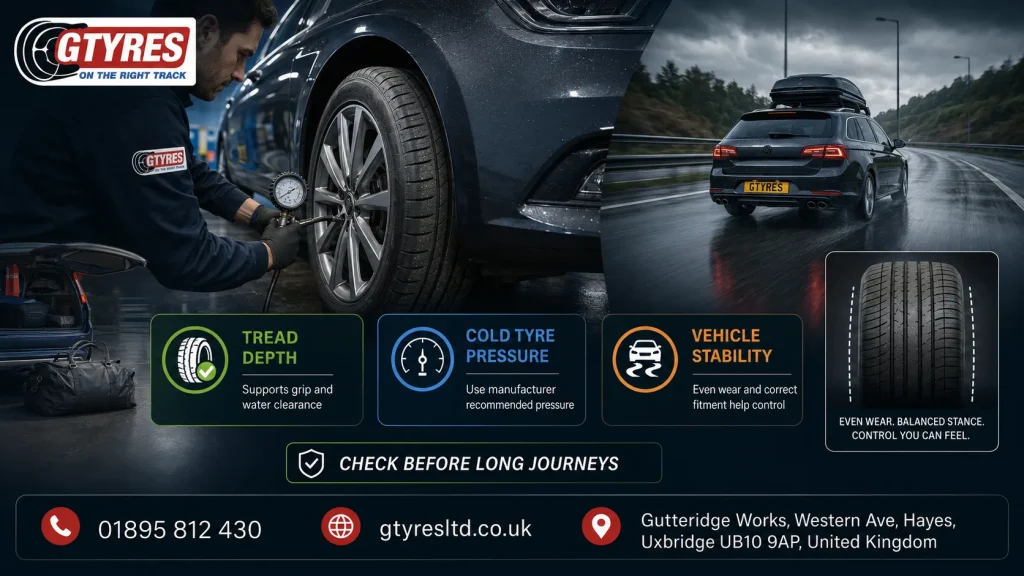
Tread Depth, Pressure and Vehicle Stability
Tread depth, pressure and vehicle stability work together. Tread supports grip and water clearance, pressure helps the tyre sit correctly on the road, and stability depends on correct fitment, balanced wear, and suitable ratings. If one of these is wrong, the whole driving feel can suffer. A tyre that is underinflated may heat up and wear unevenly. A tyre with low tread may feel weaker in heavy rain. A tyre with poor fitment may affect handling.
Before a long journey, pressure should be checked when the tyres are cold. Use the manufacturer’s recommended setting from the vehicle handbook, fuel flap, or door frame. If the vehicle is carrying passengers, luggage, tools, or stock, check whether loaded pressure guidance applies. This is one of the simplest checks, but it is often missed. A tyre that repeatedly loses pressure needs inspection before it is used for high-speed driving.
Speed Rating and Load Rating
Speed rating and load rating matter because the tyre must match the vehicle and the way it is driven. The speed rating shows the maximum speed capability of the tyre under correct conditions, while the load rating shows how much weight it is designed to carry. These markings are not just technical details. They help decide whether a tyre is suitable for sustained high-speed driving, especially on vans, SUVs, taxis, estate cars, and vehicles carrying passengers, luggage, tools, or stock.
A tyre can have good tread and still be wrong for the vehicle if the rating does not match. This is where many poor buying decisions happen. Drivers often look at size first because it is easy to see, but fitment includes width, profile, rim size, load index, speed rating, and vehicle use. If you are unsure, check the vehicle handbook, door sticker, fuel flap, or ask a qualified tyre fitter. For long-distance journeys, the right tyre is the one that fits the vehicle properly, not simply the one that fits the wheel.
Risks of Poor Used Tyres on Long Journeys
Poor used tyres can become a serious concern on long journeys because speed, heat, load, and distance expose weaknesses faster. A tyre with low tread, sidewall damage, a weak repair, old rubber, or repeated pressure loss may feel acceptable on short local trips but become less reliable during extended driving. This is why price should never be the main deciding factor. A cheap tyre is not good value if it creates vibration, instability, early wear, or a return visit soon after fitting.
The biggest mistake is assuming all second-hand tyres are the same. One tyre may have useful remaining tread, clean sidewalls, even wear, and correct ratings. Another may hide inner-edge wear, cracking, impact damage, or old repair marks. A realistic supplier observation is that tyres removed from vehicles with poor alignment can look fine on the outer edge but show heavy wear on the inner shoulder. That is the difference between a tyre that may offer value and one that should be rejected.
Blowout Risk and Pressure Loss
Blowout risk can increase when a tyre is damaged, underinflated, overloaded, badly repaired, or already weakened by age and wear. A blowout is not something drivers should treat as random bad luck. Many tyre failures are linked to maintenance, condition, pressure, or damage issues that were already present before the journey. At higher speeds, the result can be more serious because reaction time is shorter and the vehicle is harder to control.
Used tyres do not automatically cause blowouts, but poor examples can increase risk if they are fitted without proper checks. Look for bulges, exposed cord, cracking, deep cuts, repeated pressure loss, and heavy uneven wear. These signs should not be explained away because the tyre is affordable. If a tyre keeps losing pressure, do not keep topping it up and hoping for the best. Find the cause first. A tyre that cannot hold pressure consistently should not be trusted for long-distance driving.
In our experience supplying tyres for UK seasonal demand, autumn is when many drivers become aware of tyre condition because the car starts to feel different. They may notice longer stopping feel in rain, less confidence through roundabouts, or wheelspin on damp surfaces. These signs should not be ignored. They can point to worn tread, unsuitable tyres, incorrect pressure, or uneven wear. If you are buying part worn tyres before autumn, make sure they have useful tread depth and clean condition. Do not buy part worn tyres that are close to the minimum just because they are cheaper. A tyre heading into wet months should have enough remaining life to make sense. Value is only real when the tyre can perform safely in the season ahead.
Wet Grip and Braking Confidence
Wet grip matters because UK roads can change quickly from dry to heavy rain, spray, and standing water. At speed, tyres need to clear water while keeping contact with the road. If tread is shallow, uneven, or worn close to the limit, the car may feel less settled in wet conditions. This does not mean every used tyre is unsafe in rain, but it does mean the tyre must have enough remaining tread and a clean wear pattern before being trusted.
Braking confidence is just as important. Sudden braking can happen because of lane changes, congestion, debris, weather, or accidents ahead. A tyre with low tread, poor pressure, weak repairs, or wrong fitment may not give the same reassurance when the driver needs it most. For drivers or trade buyers comparing stronger options, G Tyres LTD supplies premium part worn tyres where brand quality, usable tread, and condition can support better stock choices. Still, condition must always come before the badge on the sidewall.
Tyre Age and Rubber Condition
Tyre age matters because rubber changes over time, even when there is tread left. Older tyres can harden, crack, or lose flexibility, especially if they have been stored poorly or exposed to changing temperatures. A tyre may look acceptable from a distance but show small cracks around the grooves or sidewall when checked closely. Deep cracking, dry rubber, or visible deterioration should be treated as a warning sign before any long journey.
Drivers should check the tyre date code where possible and inspect the whole tyre, not just the centre tread. A second-hand tyre with decent tread but old rubber may not be the right choice for regular high-speed use. This is where condition-first judgement matters. If the tyre looks aged, brittle, cracked, badly repaired, or unevenly worn, avoid it. A tyre should give confidence before it is fitted. If it needs too many excuses, it is not the right tyre for demanding journeys.
When Used Tyres May Be Suitable for Long-Distance Driving
Used tyres may be suitable for long-distance driving when they have useful remaining tread, clean sidewalls, even wear, correct fitment, and suitable load and speed ratings. They should hold pressure properly and show no serious signs of damage, ageing, or poor repair work. A good second-hand tyre should not feel like a gamble. It should feel like a sensible, checked option with enough remaining life to justify fitting.
The safest approach is to compare condition and suitability, not just price. A tyre with low tread and uncertain history is not a strong choice. A tyre with clear remaining value, safe sidewalls, correct ratings, and even wear is different. Brand can help, but it should never override condition. A premium-brand tyre with a bulge is still a bad tyre. A clean, correctly matched tyre with useful tread is the better decision.
Useful Tread and Even Wear
Useful tread and even wear are two of the strongest signs that a second-hand tyre may still offer practical value. Tread depth supports water clearance and remaining life. Even wear suggests the tyre has not been heavily affected by poor alignment, incorrect pressure, or suspension problems. If one shoulder is much lower than the other, the tyre may have come from a vehicle with tracking issues. If the centre is more worn than the edges, it may have been overinflated.
Drivers should check tread in more than one place across the tyre. Do not judge the tyre from the centre only. The inner and outer shoulders can tell a different story. If one tyre is much more worn than the others on the car, handling may feel uneven. Good long-distance tyre safety comes from balance across the vehicle. A single weak tyre can affect the whole driving feel, especially at speed.
Correct Fitment for the Vehicle
Correct fitment is essential because a tyre must suit the vehicle, not only the wheel size. The right choice includes tyre width, profile, rim size, load index, speed rating, and the type of driving the vehicle does. This matters more for heavier cars, vans, SUVs, taxis, and vehicles that regularly carry passengers or luggage. A nearly correct tyre is still wrong if it does not meet the vehicle’s requirements.
Poor fitment often happens when buyers focus only on availability or price. A cheap used tyre in the wrong rating may look like a quick fix, but it can create handling, wear, and safety problems later. If the correct tyre is not available, it is better to wait or choose another suitable option than compromise on fitment. A tyre for long-distance driving should feel right before it is fitted, not after problems appear.
When You Should Avoid Second-Hand Tyres
You should avoid second-hand tyres for high-speed or long-distance driving if there is any clear sign of damage, weakness, poor repair, low tread, pressure loss, old rubber, wrong rating, or uncertain condition. A tyre that needs too many excuses is not a safe choice. If it has bulges, exposed cord, deep cuts, heavy cracking, uneven wear, or visible repair concerns, it should be rejected before fitting.
This is especially important before long journeys because speed and heat can make existing problems worse. A tyre that feels acceptable around town may become noisy, unstable, or uncomfortable at higher speeds. If the tyre loses pressure repeatedly, do not keep topping it up without finding the cause. Slow pressure loss can point to a puncture, valve issue, rim problem, bead leak, or poor repair. These are not issues to test on a busy UK motorway.
Drivers should also avoid tyres that do not match the vehicle properly. The size, load index, speed rating, and vehicle use all matter. A tyre that nearly fits is still wrong if it does not meet the vehicle’s requirements. This matters for vans, SUVs, taxis, estate cars, and family cars carrying passengers or luggage. If the correct tyre is not available, it is better to wait or choose a safer option than compromise on fitment.
The safest buying decision is sometimes to walk away. A cheap used tyre is not good value if it creates vibration, handling problems, early replacement, or safety concerns. Price should only matter after condition, fitment, rating, and roadworthiness have been checked. For motorway use, confidence matters. If the tyre makes you uncertain before the journey, get it inspected or choose another tyre.
Common Red Flags Before Motorway Journeys
Common red flags before motorway journeys include vibration, humming noise, pulling to one side, repeated pressure loss, uneven shoulder wear, sidewall cracks, bulges, exposed cord, and visible cuts. These signs suggest the tyre, wheel, alignment, or pressure may need attention before travelling. They should not be ignored just because the car still drives.
Vibration at higher speed can be linked to balancing issues, uneven wear, tyre damage, wheel problems, or poor fitment. Pulling to one side may point to alignment, suspension, pressure difference, or uneven tread. Repeated pressure loss should always be investigated because a tyre should hold pressure consistently. If it cannot, it should not be trusted for long-distance driving.
Look carefully at the inner edge of the tyre where hidden wear often appears. A tyre can look acceptable from the outside but be heavily worn on the inside shoulder. This is one of the most common reasons a tyre looks better than it really is. If you cannot check the inner edge properly, ask a qualified fitter to inspect it.
The key rule is simple: inspect before speed. Do not wait until the car is already travelling at higher speeds to find out that something feels wrong. A few minutes of checking can prevent stress, delay, and risk. For used tyres, this check matters even more because the tyre already has a previous road history.
Separate Note for Trade Buyers
Trade buyers need to approach motorway-suitable used tyre stock differently from everyday local-use stock. Garages, tyre shops, mobile fitters, and resellers serve customers with different vehicles, budgets, mileage, and journey types. Some customers only drive locally. Others commute daily on the M1, M6, M25, M62, or other busy routes. Those customers need tyres that can be explained clearly and fitted with confidence.
For motorway-focused customers, stock should have useful remaining tread, clean sidewalls, even wear, correct sizes, suitable load and speed ratings, and no visible defects. A fitter should be able to explain why a tyre suits the vehicle and the journey. If the only selling point is price, the recommendation is weak. Customers trust businesses that give honest, practical safety advice.
Reliable stock also protects the business. A tyre that creates vibration, early complaints, pressure issues, or return visits costs more than the sale is worth. Trade buyers should avoid random stock that cannot be checked or explained properly. Stronger stock decisions come from matching tyres to real customer use, not simply buying the cheapest available batch.
For garages, tyre shops, mobile fitters, and resellers that need regular supply, G Tyres LTD provides wholesale part worn tyres for UK trade buyers looking for customer-ready stock with practical remaining value. The aim is not to oversell used tyres. The aim is to supply stock that can be assessed, matched, and recommended responsibly.
Stock That Can Be Explained Confidently
Stock that can be explained confidently is better than stock that is only cheap. When a customer asks whether a used tyre is suitable for long-distance driving, the fitter should be able to talk through the tread depth, wear pattern, sidewall condition, rating, size, and fitment. That explanation builds trust. It also helps the customer understand why one tyre may be suitable while another should be avoided.
A typical trade scenario is a customer arriving before a long journey with low tread or a puncture. They want a quick answer, but the answer still needs to be safe. If the garage has clean, suitable stock available, it can respond faster without rushing the recommendation. If stock is poor or mismatched, the business either loses the sale or risks fitting the wrong tyre.
Good stock also helps with repeat customers. Drivers remember when a tyre feels stable, holds pressure, and solves the problem without hassle. They also remember when a tyre creates vibration or needs replacing too soon. For trade buyers, condition standards are part of reputation. The better the stock, the easier it is to sell responsibly.
Used tyres can support budget-conscious customers when chosen carefully. But they should never be presented as risk-free or suitable for every driver. The right stock is the stock that matches the vehicle, the journey, and the customer’s real use. That is especially important for customers who regularly drive at speed or cover long distances.
Final Words on Motorway Tyre Safety
Part worn tyres can be safe for motorway driving when they are legal, roadworthy, correctly fitted, properly checked, and suitable for the vehicle. They should never be treated as a shortcut or sold as risk-free. The safest answer is not a blanket yes or no. The safest answer depends on the actual tyre in front of you.
For UK drivers, the best approach is to check the tyre before long journeys. Look at tread depth, pressure, sidewalls, repairs, age, speed rating, load rating, and wear pattern. Pay attention to how the car feels too. Vibration, pulling, humming, or repeated pressure loss are signs that something needs attention. If anything feels uncertain, ask a qualified fitter before travelling.
For trade buyers, the same principle applies at stock level. Supply tyres that can be explained, fitted, and sold with confidence. A tyre should be recommended because it suits the customer’s vehicle and journey, not simply because it is available. That kind of advice protects the customer and the business.
The right tyre is not always the cheapest tyre or the newest tyre. It is the tyre that suits the vehicle, the journey, the load, and the conditions ahead. When condition, fitment, and remaining tread all make sense, a used tyre may offer practical value. When those checks fail, it should be avoided.
Motorway-Suitable Used Tyre Supply for Trade Buyers
If your customers include motorway commuters, long-distance drivers, van users, taxi drivers, delivery drivers, or families preparing for long journeys, G Tyres LTD can help you plan stock with condition, fitment, and remaining value in mind. Having the right stock available helps your business respond faster, recommend more confidently, and avoid rushed decisions when customers need urgent replacements.
To request motorway-suitable used tyre stock, check current availability, or discuss bulk supply, contact G Tyres LTD today.
Reliable supply helps your business offer safer choices, better fitment options, and stronger customer advice before drivers start long motorway journeys. For trade buyers, the value is clear: better stock planning, fewer weak recommendations, and more confidence when customers ask for affordable tyre options that still make sense for their vehicle.
Motorway Tyres Need More Care
Choose part worn tyres with safe tread, correct pressure, clean sidewalls, and proper ratings before long UK journeys.
FAQs About Part Worn Tyres and Motorway Driving
Part worn tyres for motorway driving can be safe if they are legal, roadworthy, correctly fitted, and suitable for the vehicle. The key is tyre condition, not simply whether the tyre is new or used.
Yes, you can drive on the motorway with second-hand tyres if they meet UK legal requirements and are in safe condition. Before long-distance driving, pay attention to how the car feels at speed, including vibration, pulling, or unusual road noise.
Yes, part worn tyres are legal in the UK when they meet roadworthiness and supply requirements. They must be safe, suitable for the vehicle, and correctly marked when sold.
The UK legal minimum tread depth for cars, light vans, and light trailers is 1.6mm across the central three-quarters of the tread and around the full circumference. For motorway journeys, many drivers prefer more remaining tread for better wet-road confidence.
A tyre with 4mm tread usually offers more remaining tread than one close to the legal minimum. However, tread depth should still be judged alongside tyre condition, age, fitment, and how evenly the tyre has worn.
Used tyres can be safe for long journeys if they are roadworthy and suitable for the vehicle. A useful extra check is the inner shoulder, because hidden wear can be missed when only the outer tread is inspected.
Used tyres do not automatically cause blowouts. The risk increases when a tyre is damaged, underinflated, overloaded, badly repaired, old, or already weakened by wear.
Check tread depth, tyre pressure, sidewalls, cracks, bulges, exposed cord, visible repairs, tyre age, uneven wear, speed rating, and load rating. If anything looks uncertain, get the tyre inspected before driving.
You should buy all-season tyres if you want year-round convenience and mostly drive in mild, wet, and mixed UK weather. Winter tyres may be better if you regularly drive in colder, icy, snowy, rural, or hilly conditions. The right choice depends on your location, mileage, vehicle type, and winter driving risk.
New tyres may be better if you want full tread and no previous-use history. Used tyres may still be suitable if they are carefully checked, correctly rated, roadworthy, and in strong condition.
Motorway drivers should check tyres at least once a month and before every long journey. High-mileage drivers should check more often, especially if they notice pressure loss, vibration, pulling, or uneven wear.