
Choosing between part worn tyres and budget new tyres is not as simple as saying “new is always better” or “used is always cheaper.” That kind of advice sounds neat, but it is not honest enough for real drivers or trade buyers. A budget new tyre gives you a fresh starting point, full tread, and no previous road history. A quality part worn tyre can offer strong value when it has useful tread depth, clean condition, correct fitment, and a reliable supplier behind it. The better choice depends on the actual tyre, not only the label. Think of it like choosing between a brand-new budget jacket and a used premium jacket in excellent condition. One gives you newness, the other may give you better material and build. With tyres, the decision matters more because grip, braking, comfort, and road confidence are involved.
For drivers, garages, tyre shops, and mobile fitters, the real question is not only “Which tyre is cheaper?” The sharper question is, “Which tyre gives safer, better value for the vehicle and driving style?” A small city car doing low weekly mileage may not need the same tyre choice as a heavy SUV, a motorway commuter, or a performance vehicle. Budget new tyres can make sense when the buyer wants no previous-use uncertainty. Part worn tyres can make sense when the tyre has strong remaining tread, good visible condition, and the right fitment. At G Tyres LTD, the focus is on wholesale part worn tyre supply for buyers who need practical stock value, not random worn-out tyres with little life left. This guide compares both options honestly, so you can choose based on safety, value, tread life, and real-world use.
The better question is not “Which tyre is cheapest?” The better question is “Which tyre gives the safest and most sensible value for my vehicle and driving style?” That is the angle this guide will follow. G Tyres LTD supplies wholesale part worn tyres for garages, tyre retailers, and trade buyers, so this topic matters for both everyday drivers and businesses that sell tyres to customers. A budget new tyre can be useful because it has full new tread and no previous road use. A part worn tyre can also make sense when it has useful remaining tread, correct ratings, safe condition, and strong value. The choice depends on the actual tyre, not just the label.
Quick Answer: Are Part Worn Tyres Better Than Budget New Tyres?
Part worn tyres can be better than budget new tyres when they offer better overall value, but only if the condition is right. A part worn tyre with useful tread depth, safe sidewalls, correct fitment, and reliable supply can sometimes be a stronger choice than a weak budget tyre with poor wet grip or fast wear. But that does not mean every part worn tyre is a smart buy. If the tyre has hidden damage, poor repairs, cracking, uneven wear, or very low tread, it is not worth fitting. Budget new tyres have their own advantage because they start fresh. They have no previous road use and usually come with full tread from new. The downside is that budget tyre quality can vary heavily. Some are fine for light use, while others may feel noisy, wear quickly, or perform less confidently in wet conditions.
The honest answer is this: choose the tyre that gives the best mix of condition, tread, fitment, grip, and usable value. Do not choose part worn tyres just because they are cheaper. Do not choose budget new tyres just because they are new. Both decisions can be right, and both can be wrong. A good budget new tyre may be ideal for a low-mileage driver who wants a simple replacement. A quality part worn tyre may be better for someone who wants stronger brand value at a lower upfront cost. The key is to compare the real tyre in front of you, not a perfect version of one option against the worst version of the other. That is where many buyers make mistakes. A smart tyre choice is not emotional. It is practical, measured, and based on how the tyre will perform on the road.
Factor | Part Worn Tyres | Budget New Tyres |
Starting condition | Previously used | Brand new |
Tread depth | Depends on remaining tread | Full tread from new |
Previous history | Needs checking | No previous road use |
Value | Strong when condition and tread are good | Strong when quality and wear rate are acceptable |
Main risk | Hidden damage, age, or poor repairs | Weaker compound, grip, noise, or wear |
Best for | Buyers wanting better value from selected stock | Buyers wanting new-condition reassurance |
The Simple Buying Rule
The simple rule is this: buy the tyre that gives the safest usable value for your vehicle, not the tyre with the lowest price tag. A part worn tyre is worth considering when it has strong remaining tread, clean condition, no serious damage, and correct fitment. A budget new tyre is worth considering when you want full tread from new, less uncertainty, and a straightforward low-cost replacement. The problem starts when buyers focus on one factor only. If you only look at price, you may ignore tread life. If you only look at brand name, you may ignore condition. If you only look at newness, you may ignore performance quality. Tyres do not work on labels. They work through rubber compound, tread pattern, sidewall strength, pressure, fitment, and contact with the road. That is why the buying rule must stay practical.
For example, imagine two tyres on a workshop floor. One is a new budget tyre with full tread but basic performance ratings. The other is a part worn tyre with good remaining tread, clean sidewalls, and a stronger original build quality. Which is better? The answer depends on the buyer’s vehicle and use. For short city trips, the new budget tyre might be perfectly acceptable if it is suitable and legal. For a heavier or faster car, the quality part worn tyre may offer better comfort, grip, and road confidence if it has been properly checked. That is why a one-line answer is not enough. The better buying rule is: match the tyre to the vehicle, the road use, and the risk level. A tyre should never be bought like a random spare part. It should be chosen like a road safety component.
Why The Actual Tyre Matters More Than The Label?
The actual tyre matters more than the category because “new” and “part worn” only describe starting history, not complete quality. A new budget tyre may have full tread and no previous use, but that does not automatically mean strong wet grip, quiet driving, long wear, or confident braking. A part worn tyre may have been used before, but that does not automatically mean it is unsafe or poor value. The condition decides the story. You need to look at tread depth, age, wear pattern, repairs, sidewall condition, load rating, and suitability for the vehicle. Tyres are like shoes on a wet pavement. A brand-new cheap sole can still slip if the material is weak. A used high-quality sole can still grip well if it has enough tread and no damage. The label gives you a clue. The condition gives you the truth.
This is also why trade buyers need to be stricter than casual drivers. A private driver makes one tyre decision for one vehicle. A garage or tyre shop makes repeated tyre decisions that affect customers, reviews, repeat sales, and trust. If the wrong stock is fitted, the customer will not care that the tyre looked cheap at purchase. They will care if it wears quickly, feels noisy, or needs replacing too soon. For G Tyres LTD readers, this is where quality part worn tyres become relevant. Quality does not mean blindly trusting a used tyre. It means checking whether the tyre has useful tread, correct fitment, clean condition, and genuine resale value. A budget new tyre with weak performance and a part worn tyre with poor condition are both bad choices. The best choice is the tyre that makes sense after inspection.
What Are Part Worn Tyres?
Part worn tyres are tyres that have already been fitted or used before and still have remaining tread life. In everyday language, people often call them used tyres, second-hand tyres, or part worn tyres. The important point is that previous use alone does not make a tyre worthless. Every tyre becomes used as soon as it is driven on. The real question is how much safe, usable life is still left. A part worn tyre may come from a vehicle that changed tyres early, had a tyre set replaced, or was dismantled while the tyres still had tread remaining. Some part worn tyres can offer good value, especially when the original tyre quality is strong and the remaining condition is clean. But the buyer has to be realistic. A part worn tyre is not a magic discount. It is a tyre that needs proper judgement.
There are legal and safety expectations around part worn tyres, especially when they are supplied for sale. DVSA guidance explains that buying and fitting part worn tyres is not illegal, but there can be road safety risks if there is an underlying issue with the tyre. That is the balanced view. Part worn tyres should not be treated as automatically dangerous, but they should not be bought blindly either. The tyre must be checked for tread depth, damage, repair quality, sidewall condition, age, and suitability. A tyre with enough tread but a sidewall bulge is still a bad tyre. A tyre with a strong brand name but poor repair history is still a risk. A tyre with 4mm tread depth can offer better remaining value than one close to the legal minimum, but condition still matters. Good part worn buying is careful buying.
The Main Strength Of Part Worn Tyres
The main strength of part worn tyres is value when the tyre is in genuinely good condition. Buyers may be able to access better tyre quality, stronger original construction, or premium brand options at a lower upfront cost than buying new. This matters for drivers who want reliable road feel without paying full new-tyre prices. It also matters for garages and tyre shops that need stock customers can afford. A good part worn tyre can be especially attractive when it has useful tread depth, even wear, clean sidewalls, and correct vehicle fitment. For trade buyers, this is not only about cheap supply. It is about having tyres that can sell confidently and avoid customer complaints. The stronger the remaining tread and visible condition, the easier it is to justify the value. That is where part worn tyres can beat weak budget buying.
The best way to understand this is to think in terms of usable life, not only purchase cost. A part worn tyre with sensible tread, clean structure, and correct fitment may give a better value experience than a budget new tyre that wears quickly or feels poor in the rain. That does not mean part worn is always better. It means a good part worn tyre can be a smart option when the tyre itself proves it. For G Tyres LTD, this is where the 4mm tread depth point can be used naturally. It gives trade buyers a stronger remaining-value position than stock already sitting close to minimum limits. Still, the full tyre must be considered. Tread depth helps, but it does not replace checks for damage, age, repairs, and fitment. Value only exists when the tyre is still genuinely worth using.
The Main Risk With Part Worn Tyres
The main risk with part worn tyres is uncertainty. You are not only buying the tread you can see. You are also dealing with the tyre’s past life, and that past may not be obvious from a quick glance. The tyre may have been run underinflated, hit potholes, carried heavy loads, or had a repair that was not done properly. It may also have uneven shoulder wear, sidewall cracking, hidden casing damage, or age-related hardening. This is why part worn tyres should never be bought casually from an unknown source. A tyre can look neat from the front and still have a problem on the inner edge or sidewall. Think of it like buying a used laptop. A clean screen does not tell you whether the battery is weak or the charging port is loose. With tyres, those hidden details matter even more because they affect road safety.
This does not mean part worn tyres are automatically unsafe. That would be too simple and not fully fair. It means the buyer needs better checks before deciding. The DVSA guidance on buying part worn tyres makes the same basic point: buying and fitting part worn tyres is not illegal, but tyre condition matters. You should look for safe tread depth, clean sidewalls, no bulges, no exposed cords, no deep cuts, and correct fitment. Tyre age and repair quality also matter. For trade buyers, the risk becomes bigger because one weak tyre can create customer complaints, returns, and trust issues. A garage or tyre shop cannot afford to treat part worn tyres like random second-hand stock. The stock needs to be suitable, presentable, and worth fitting. The risk is not “part worn.” The risk is poor selection.
What Are Budget New Tyres?
Budget new tyres are brand-new tyres sold at a lower price point than mid-range or premium options. Their biggest appeal is simple: they are unused, they start with full tread, and the buyer does not have to worry about previous road history. For many drivers, that feels reassuring. You know the tyre has not been repaired before, driven underinflated, or removed from another vehicle. That alone can make budget new tyres attractive, especially for people who do not know how to inspect part worn tyres properly. They can also be a practical choice for low-mileage city driving, older vehicles, or drivers who need a simple legal replacement without spending heavily. The keyword here is practical. Budget new tyres can be useful, but they should not be treated as automatically equal to every other new tyre on the market.
The weakness is that budget new tyres can vary heavily in quality, grip, road noise, comfort, and wear rate. New condition is not the same as strong performance. A tyre can be brand new and still feel vague in wet braking, noisy at speed, or quicker to wear down than expected. That is why the comparison between part worn tyres vs budget new tyres has to be realistic. A new budget tyre gives you a clean starting point, but the rubber compound, tread design, rating, and build quality still matter. If the tyre is going on a small car used for local trips, a decent budget option may be enough. If it is going on a heavier vehicle, a motorway commuter, or a performance car, cheap can become a poor shortcut. Newness gives reassurance, but it does not remove the need for judgement.
The Main Strength Of Budget New Tyres
The main strength of budget new tyres is predictability at the starting point. You get full tread, unused rubber, and no hidden history from a previous vehicle. For buyers who do not feel confident checking part worn tyres, that is a real advantage. A new tyre has not already been driven over potholes, fitted to a misaligned vehicle, repaired after a puncture, or stored after removal. That gives many drivers peace of mind. It also makes the buying process simpler. You choose the correct size, confirm it suits your vehicle, and fit it as a fresh replacement. For low-mileage drivers, city cars, and basic daily use, this can be a sensible route when the tyre quality is acceptable. Not every driver needs high-performance rubber. Some simply need a safe, legal, affordable tyre for normal road use.
Budget new tyres also make sense when the buyer cannot properly assess a used tyre. If someone does not know how to check sidewall damage, exposed cord, age codes, repairs, and uneven wear, buying new can reduce that uncertainty. It does not guarantee best grip or longest life, but it removes the previous-use question. That is valuable for cautious drivers. Imagine choosing between a used mattress and a new basic mattress. The used one might be higher quality, but if you cannot inspect it properly, the new one feels safer emotionally. Tyres are more technical, but the psychology is similar. People often pay for certainty. The important point is to choose a budget new tyre that still suits your vehicle and driving needs. A low price should not be the only reason to buy it. Suitability still comes first.
The Main Risk With Budget New Tyres
The main risk with budget new tyres is assuming that “new” automatically means “better.” It does not. A budget new tyre has no previous road use, but it may still have weaker wet grip, more road noise, less comfort, or a faster wear rate than a better-quality tyre. Some budget tyres are perfectly acceptable for light driving, but others may not give the confidence a driver expects on wet roads, long motorway runs, or heavier vehicles. Tyres are not just rubber circles. They are engineered products made from compounds, tread patterns, sidewall structures, and performance designs. When costs are cut, something usually gives. It may be noise. It may be wear. It may be wet braking. The problem is that the buyer may not feel the difference until the road is cold, wet, or busy.
This is why budget new tyres should be judged by more than price and tread depth. Look at the tyre’s suitability, performance ratings, expected use, and the type of vehicle it is going on. A small hatchback doing short local drives is one thing. A heavy SUV, loaded van, or fast saloon is another. The tyre has to match the job. For customers who drive premium vehicles, it can also be worth looking at stronger vehicle-specific options rather than defaulting to the cheapest new tyre. Pages like BMW tyres UK help show why vehicle type and tyre fitment matter in the buying decision. A tyre that is technically new can still be the wrong tyre for the car. That is the key warning. Budget new tyres are not bad by default, but they must be chosen carefully.
Safety Comparison: Which Option Gives More Confidence?
Safety confidence depends less on whether the tyre is part worn or budget new and more on whether the tyre is suitable, legal, well-made, and in good condition. A budget new tyre gives confidence because it has no previous road history. A quality part worn tyre gives confidence when it has useful tread depth, clean sidewalls, correct fitment, and no signs of damage or poor repair. The wrong way to compare them is to imagine the best version of one option and the worst version of the other. That creates biased advice. The right way is to compare real tyres in realistic conditions. How much tread is there? How does the tyre perform in rain? Is the sidewall clean? Is the tyre right for the vehicle? Will it wear sensibly? These questions decide safety more than the label does.
For UK driving, wet grip deserves special attention. Roads are often damp, cold, greasy, or covered with standing water, and tyres have to clear that water while keeping contact with the road. TyreSafe explains that the legal minimum tread depth for car tyres is 1.6mm, while tyre safety experts recommend replacement at 3mm. That tells you something important: legal minimum and confident safety margin are not the same thing. A budget new tyre starts with full tread, but its compound and tread design still matter. A part worn tyre starts with less tread than new, but if it has a strong remaining depth and better original quality, it may still feel more reassuring than a weak budget option. The safest choice is the tyre that matches the car, the road, and the driver’s use.
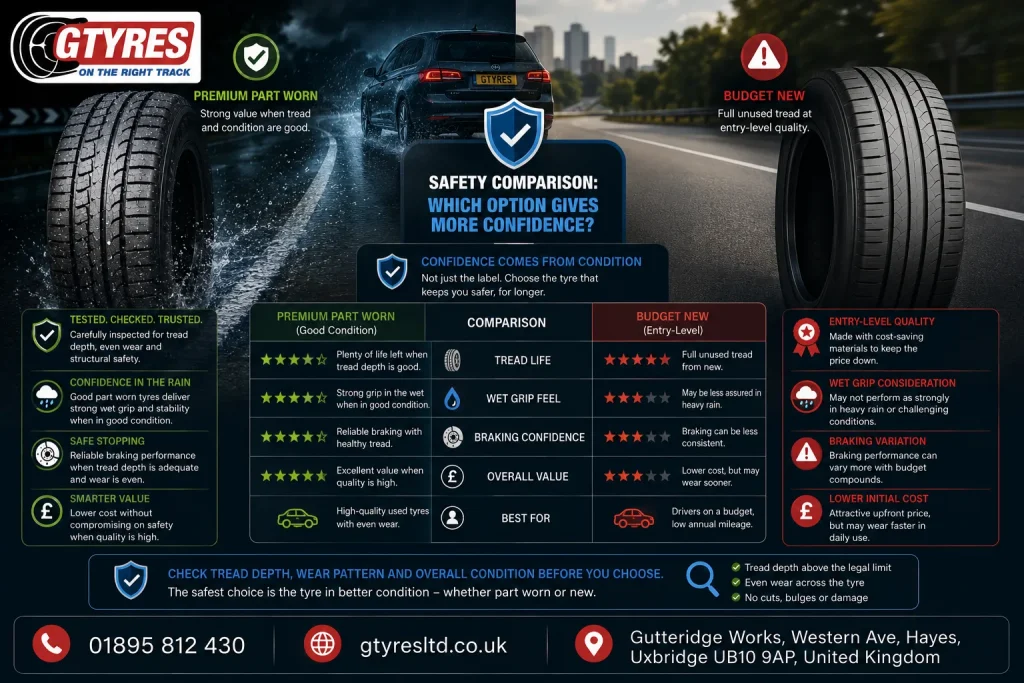
Tread Depth And Wet Grip
Tread depth plays a major role in wet grip because the grooves help move water away from the contact patch. When tread becomes shallow, the tyre has less space to clear water, and the car can feel less stable in heavy rain. This does not mean tread depth is the only safety factor, but it is one of the easiest to understand. A budget new tyre starts with full tread, which is a clear advantage. A part worn tyre needs closer attention because some of its tread life has already been used. That is why remaining tread depth matters so much when comparing part worn tyres vs budget new tyres. If a part worn tyre is already close to the legal minimum, it may not be good value. If it has stronger remaining tread and clean condition, the comparison becomes more balanced.
For G Tyres LTD readers, this is where 4mm tread depth becomes relevant, but it must be explained honestly. A tyre with 4mm tread depth usually gives more remaining value than one sitting close to the legal limit. That does not mean it automatically beats every budget new tyre. It means the part worn tyre has a stronger starting point than low-tread used stock. The rest of the tyre still needs checking. Sidewall condition, repair quality, age, fitment, and wear pattern all matter. If a tyre has decent tread but a damaged casing, it is not a smart buy. If a new budget tyre has full tread but weak wet performance, it may not be ideal for demanding driving. Tread depth is important, but it is part of the decision, not the whole decision.
Condition, Repairs And Unknown History
Condition is the biggest difference between a good part worn tyre and a risky one. With budget new tyres, you do not have to worry about previous road damage, old repairs, or how the tyre was used before. With part worn tyres, those questions matter. You need to check for bulges, cracks, exposed cords, deep cuts, uneven wear, poor puncture repairs, and signs of ageing. A tyre may look acceptable from the tread face but reveal problems on the sidewall or inner shoulder. That is why part worn tyre buying needs more attention than simply reading the size. A tyre’s past life can affect its future performance. If it has been abused, overloaded, underinflated, or badly repaired, the buyer may inherit the problem. The price may look attractive, but the risk is sitting inside the rubber.
This is also why supplier reliability matters. If a buyer cannot inspect tyres properly, they need a supplier that takes stock quality seriously. For trade buyers, that becomes even more important because every tyre fitted affects customer trust. The Business Companion guidance on part worn tyres explains that part worn tyres are subject to supply requirements, including marking and condition rules. That is not just legal detail. It is a reminder that used tyre supply needs standards. A budget new tyre reduces unknown history, but not all budget tyres perform equally. A part worn tyre may carry more inspection responsibility, but a properly selected one can still offer strong value. The safety comparison is not won by “new” or “used” alone. It is won by the tyre that proves it is suitable, safe, and worth fitting.
New Does Not Always Mean Better, Used Does Not Always Mean Worse
New does not always mean better, and used does not always mean worse. That is the line every tyre buyer needs to understand before comparing part worn tyres vs budget new tyres. A new budget tyre has a clear advantage because it starts unused and comes with full tread. But that does not automatically make it stronger in wet grip, road noise, comfort, braking, or wear rate. A part worn tyre has already been used, so it needs more checks. But if it has strong remaining tread, clean sidewalls, no damage, and better original build quality, it may still be a sensible choice. The danger comes from lazy thinking. Some buyers assume new is always safe. Others assume part worn always gives better value. Both assumptions can be wrong. Tyres should be judged like tools. A new weak tool can disappoint, while a well-kept used quality tool can still perform well.
The real answer sits in inspection and suitability. If a budget new tyre suits the vehicle, has acceptable ratings, and matches the driver’s use, it can be a good choice. If a part worn tyre has useful tread depth, safe condition, and correct fitment, it can also be a good choice. But neither option should be trusted blindly. The tyre has to make sense for the car, the roads, the mileage, and the buyer’s expectations. A city driver may be happy with a decent budget new tyre. A garage supplying a customer with a larger or heavier vehicle may prefer a stronger part worn option with better remaining value. That is why this comparison cannot be reduced to a slogan. The smarter buyer asks better questions: how much life is left, how safe is the condition, how suitable is the fitment, and how confident will it feel on the road?
Cost And Value: Why The Cheapest Tyre Is Not Always The Best Deal
The cheapest tyre is not always the best deal because price is only one part of value. A tyre also has usable tread life, grip, comfort, road noise, wear rate, and suitability to consider. A budget new tyre may look attractive because the price is clear and the tread is full from the start. But if it wears quickly, feels weak in the rain, or becomes noisy after a short time, the saving starts to shrink. A part worn tyre may cost less upfront, but if it has low tread or hidden damage, it may need replacing sooner than expected. That is not value. That is delayed cost. Real tyre value comes from what you get after fitting, not only what you pay at the counter. A cheap tyre that fails your expectations is still expensive in practical terms.
This matters even more for garages, tyre shops, and mobile fitters. A private driver might make one poor choice and learn from it. A trade buyer can lose repeat customers if the stock does not perform well or wears too quickly. Customers remember when a tyre feels noisy, loses confidence in the wet, or needs replacing sooner than expected. They may not understand tread compounds or casing quality, but they understand disappointment. This is why trade buyers should think beyond upfront cost and ask whether the tyre offers customer-ready value. G Tyres LTD’s A Grade part worn tyres are relevant here because remaining tread and stock quality matter when a buyer wants tyres that are not sitting close to the end of useful life. But even with better stock, the tyre still needs correct fitment and condition checks.
Cost Factor | Part Worn Tyres | Budget New Tyres |
Upfront price | Often lower | Usually predictable but varies |
Starting tread | Depends on remaining depth | Full tread from new |
Performance | Depends on brand, condition, and age | Depends on build quality and compound |
Risk | Previous history must be checked | Quality level must be checked |
Value test | Price vs usable tread and condition | Price vs wear rate and grip |
Upfront Price vs Usable Life
Upfront price is what you pay today, but usable life is what you actually receive after the tyre is fitted. This difference is where many buyers get caught. A cheap tyre with poor usable life is not truly cheap. It is simply cheaper at the start. A part worn tyre with weak tread may cost less, but if it needs replacing soon, the total cost becomes higher than expected. A budget new tyre with full tread may look better, but if its compound wears quickly or it performs poorly in wet conditions, the buyer may still feel short-changed. Usable life includes tread depth, wear pattern, tyre quality, driving style, vehicle weight, and pressure habits. If any of those factors are poor, the tyre may not deliver the value the buyer expected. This is why tyre buying should not be rushed.
A practical example makes this easier. Imagine one tyre costs less but only gives a short period of confident use. Another costs a little more but gives longer, steadier performance. The second tyre may actually be cheaper over time. This applies to both part worn and budget new tyres. A good part worn tyre with proper condition and remaining tread can make sense. A weak part worn tyre close to replacement does not. A decent budget new tyre can make sense for simple driving. A poor budget tyre that wears fast does not. The buyer should always ask, “How much safe life am I buying?” not only “How much does it cost?” That question changes the whole decision. It turns tyre buying from a bargain hunt into a value calculation. And frankly, that is how serious buyers should think.
Cost Per Usable Tread Explained
Cost per usable tread is a simple way to think about tyre value without getting lost in marketing. The idea is to compare the tyre price with the amount of useful tread and performance you can realistically expect. A tyre with more usable tread and better condition may justify a higher price. A tyre with less usable tread may only make sense if the price reflects that clearly. For part worn tyres, this is especially important because not every tyre starts from the same point. One part worn tyre may still have strong remaining depth and clean condition. Another may be close to the legal limit and poor value from day one. For budget new tyres, the full tread is a benefit, but tread life and grip quality still matter. Full tread on a weak tyre does not automatically mean strong value.
Think of it like buying a loaf of bread. A full cheap loaf looks like the better buy until you realise it goes stale quickly. A smaller but better-quality loaf may actually be more satisfying and waste less. Tyres are more serious, but the value logic is similar. You are not just buying rubber. You are buying safe use, grip, braking confidence, and time before replacement. That is why part worn tyres with useful remaining tread can compete well when they are properly selected. It is also why budget new tyres can win when the buyer values full tread and lower uncertainty. The point is not to crown one winner for every situation. The point is to measure value properly. Price divided by useful life is a sharper question than price alone. That is the kind of thinking buyers need.
When A Cheap Tyre Becomes Expensive
A cheap tyre becomes expensive when it wears too fast, performs poorly, creates noise complaints, feels weak in wet weather, or needs replacing sooner than expected. That can happen with a poor part worn tyre or a weak budget new tyre. The problem is not always obvious at fitting. A tyre can look acceptable in the workshop and disappoint later on the road. For example, a driver may notice longer braking feel on wet surfaces, less comfort at motorway speed, or quicker shoulder wear after a few weeks. Trade buyers may see the cost in another way: returns, complaints, lost trust, and customers who do not come back. The cheapest option only works if it still does the job properly. If it creates a second purchase too soon, the saving disappears.
This is where honest tyre advice beats sales talk. If a budget new tyre is suitable for the vehicle and driving style, there is nothing wrong with choosing it. If a part worn tyre is clean, correctly fitted, and has useful remaining tread, there is nothing wrong with choosing that either. But if either tyre is being chosen only because it is the cheapest available, the buyer is asking for trouble. Tyres affect braking, steering, load carrying, and wet-road confidence. They are not the place for blind shortcuts. The TyreSafe tread depth guidance explains why tread checks matter, especially because the legal minimum is not the same as the best safety margin. A serious buyer should look at total value, not just today’s invoice. Cheap is good only when it stays sensible after fitting.
Premium Part Worn Tyres vs New Budget Tyres
The comparison between premium part worn tyres and new budget tyres is one of the most common real-world debates. Buyers often ask whether a used higher-quality tyre is better than a brand-new low-cost tyre. The honest answer is that it depends on condition, tread, fitment, and driving needs. A premium part worn tyre may offer stronger original engineering, better comfort, improved grip, and better road feel than some budget options. But that only matters if the tyre is still in good condition. If it is old, damaged, repaired badly, or worn unevenly, the premium name means very little. A new budget tyre has the advantage of being fresh and unused, but it may not match the same level of performance or refinement. This is why the winner cannot be chosen by category alone.
For garages and tyre shops, this is also a customer-expectation issue. Some customers want the lowest possible price. Others want a better-known tyre option without paying full new prices. A trade buyer needs stock that fits both needs without sacrificing trust. That is where premium part worn tyres can sit naturally in the conversation. They can offer a value route for customers who want better tyre quality but still need a cost-conscious option. However, the same rule applies: condition beats label. A premium tyre with weak tread, damage, or poor fitment is not premium in any useful sense. A new budget tyre that suits the vehicle and driving style may be the smarter option in some cases. The best recommendation is not emotional. It is based on the tyre’s real condition and the driver’s real needs.
When Brand Quality Matters?
Brand quality matters most when the vehicle, mileage, and driving style place higher demands on the tyre. A driver doing short local trips in a small car may not notice the same differences as someone driving long motorway routes, carrying weight, or using a higher-performance vehicle. Tyres affect braking, steering feel, wet grip, road noise, and comfort. Better original construction can make a visible difference in how planted the car feels, especially in poor weather or at speed. This does not mean every driver needs the most expensive tyre available. It means the tyre should match the job. A heavy SUV, executive saloon, or performance car puts more pressure on tyre quality than a low-mileage city runaround. In those cases, a carefully selected premium part worn tyre may be worth considering if the condition is genuinely strong.
This is also why vehicle-specific fitment matters. The same tyre logic does not apply equally to every car. A family hatchback, luxury SUV, and performance saloon all place different demands on tyres. Load rating, speed rating, tread pattern, and size all need to make sense. For trade buyers working with premium and performance vehicles, internal fitment pages like Mercedes tyres UK can naturally support buyers who want tyre options aligned with vehicle type. The key is not to overstate brand power. A better brand can be valuable, but only if the tyre still has healthy tread, clean structure, and correct fitment. If those boxes are not checked, brand quality becomes a distraction. The tyre must prove itself in condition first. Then the brand value can actually mean something.
Why Condition Still Beats Brand Name?
Condition beats brand name because the road does not care what is written on the sidewall if the tyre is damaged, old, poorly repaired, or nearly worn out. A premium logo cannot fix a sidewall bulge. It cannot restore missing tread. It cannot undo poor storage, cracking, or internal casing damage. Buyers sometimes make the mistake of trusting a well-known tyre name too much, especially when the price looks attractive. That is dangerous. A strong brand in poor condition is still a poor tyre. The correct way to judge a part worn tyre is to check condition first, then brand, then value. If the tyre passes the condition test and offers useful tread, the brand may become a genuine advantage. If it fails the condition test, the brand should not save the sale.
This is where a clear inspection mindset matters. Look at the tyre as if you are trying to protect the customer, not just complete the purchase. Check the sidewalls. Check the shoulders. Check the tread pattern. Check for repairs and signs of uneven wear. Ask whether the tyre suits the vehicle and the driving style. Budget new tyres also need judgement, but their weakness is usually performance variation rather than previous-use damage. Part worn tyres need more physical inspection because their history matters. The best tyre choice is the one that passes the right checks for its category. For budget new tyres, that means quality, rating, and suitability. For part worn tyres, that means tread, condition, age, repairs, and fitment. Brand names help only after the tyre itself is worth trusting.
Which Tyres Should You Choose For Your Driving Style?
Your driving style should heavily influence whether part worn tyres or budget new tyres make more sense. A driver doing short city trips has different tyre needs from someone doing motorway miles every day. A family car doing school runs, supermarket trips, and occasional weekend travel does not face the same demands as a heavy SUV, van, or performance saloon. This is why one-size-fits-all tyre advice is weak. The tyre has to match the job. Budget new tyres may work well for basic local driving if the quality is acceptable and the vehicle is not demanding. Quality part worn tyres may make more sense when the buyer wants stronger original build quality, better brand value, and practical remaining tread. The better choice depends on mileage, road type, vehicle weight, speed, load, and how much confidence the driver needs.
Think about tyres the way you think about shoes. You would not wear thin casual trainers for a long hike in wet weather. You would not wear heavy boots just to walk across the street either. The right choice depends on use. Tyres are the same. A low-mileage driver may value simple affordability and new-condition reassurance. A motorway driver may need stronger grip, better wear, and confidence at higher speeds. A trade buyer may need stock that fits many customer situations without causing complaints. When comparing part worn tyres vs budget new tyres, the smartest question is not “Which one is cheaper?” It is “Which one suits the way this vehicle is actually used?” That question stops buyers from making emotional decisions and pushes them toward practical tyre value.
Low Mileage And City Driving
For low-mileage and city driving, budget new tyres can be a sensible choice when the tyre quality is acceptable and the vehicle is used gently. These drivers usually face lower speeds, shorter trips, and less sustained motorway heat. A new budget tyre gives full tread and removes previous-use uncertainty, which can feel reassuring for people who do not know how to inspect part worn tyres properly. If the car is a small hatchback used for school runs, shopping, and local errands, a decent budget option may be enough. But even here, do not buy blindly. Wet grip, braking confidence, and suitability still matter. City roads can be greasy, full of potholes, and packed with sudden stops. A cheap tyre still needs to perform when a pedestrian steps out or traffic brakes sharply.
A quality part worn tyre can also work for low-mileage driving if the condition is strong and the price makes sense. The key is not to buy a tyre that already has weak remaining life. If the part worn tyre has useful tread, clean sidewalls, correct size, and no repair concerns, it may offer good value. However, low-mileage drivers should be careful with tyre age. A car that does few miles may take longer to wear tread down, but rubber can still age, harden, and crack over time. This is why condition and age checks matter. If a buyer wants simple reassurance and cannot inspect properly, budget new may be easier. If a buyer trusts the supplier and the part worn tyre has strong remaining value, part worn can still be a smart option.
Motorway And High Mileage Driving
Motorway and high-mileage driving demand more from tyres. The tyres run for longer periods, build more heat, deal with higher speeds, and need steady braking and lane-change confidence. In this situation, the cheapest option is often not the best option. A budget new tyre may start with full tread, but if it wears quickly, feels noisy, or lacks wet-road confidence, the driver may regret the choice. A quality part worn tyre may offer stronger original performance, but only if it has enough remaining tread and clean condition. This is where usable life becomes important. A high-mileage driver will quickly expose a weak tyre. What looks like a saving in the workshop can feel like a mistake after a few thousand miles of motorway use.
For motorway drivers, tread depth, wet grip, tyre pressure, load rating, and wear pattern should all be taken seriously. TyreSafe’s tread depth guidance is useful here because it reminds drivers that legal minimum tread and a better safety margin are not the same thing. A tyre close to the minimum may not be the best choice for heavy rain or long journeys. A part worn tyre with useful tread can still make sense, especially if it offers better quality than a weak budget option. But it must be inspected properly. If the sidewall is damaged, tread is uneven, or age is questionable, avoid it. For high-mileage drivers, tyres are not occasional purchases. They are ongoing running-cost decisions. The best tyre is the one that stays dependable after the first week.
SUVs, Vans And Performance Cars
SUVs, vans, and performance cars need more careful tyre selection because they place higher demands on load, grip, speed rating, and stability. A heavy SUV needs tyres that can handle weight confidently. A van may carry tools, stock, or equipment, which puts extra stress on the tyres. A performance car needs grip and response, especially under braking and cornering. In these cases, choosing the cheapest budget new tyre can be a weak decision if the tyre does not match the vehicle’s needs. A part worn tyre can be useful if it offers stronger original quality and enough remaining tread, but again, condition must come first. A premium name or larger size does not fix damage, low tread, poor repairs, or wrong rating. Vehicle suitability should be treated as non-negotiable.
This is where vehicle-focused internal linking becomes useful for readers who need more specific tyre relevance. For example, larger SUV buyers may find Range Rover tyres UK useful when thinking about fitment, size, and premium vehicle tyre needs. The reason is simple: not every tyre suits every vehicle. A small-car budget tyre and an SUV tyre are not doing the same job. Garages and tyre shops should be especially careful here because customers with heavier or higher-value vehicles expect a better fitment conversation. The wrong tyre can create poor road feel, quick wear, and trust issues. For these vehicles, the decision between part worn and budget new should be based on load rating, tread quality, condition, vehicle fitment, and expected use. Price matters, but suitability matters more.
Part Worn Tyre Buying Checklist Before You Choose
A checklist is essential before choosing part worn tyres because a used tyre needs more inspection than a new budget tyre. The buyer should check tread depth, sidewall condition, exposed cord, bulges, repairs, tyre age, size, load rating, speed rating, and wear pattern. These checks help separate a useful part worn tyre from a risky one. Do not rely only on the tread face. The inner edge, shoulder, and sidewall can reveal problems that the front view hides. A tyre with decent centre tread but heavy inner wear may not be good value. A tyre with a clean pattern but a sidewall bulge should be rejected. A tyre with a poor repair may create future air loss or safety concerns. Good buying means looking at the whole tyre, not the best-looking part of it.
For budget new tyres, the checklist is different but still important. Check the tyre is the right size, suitable rating, and appropriate for the vehicle’s use. Look at wet grip, expected wear, and whether the tyre suits the driver’s mileage and road type. A new tyre removes previous-use history, but it does not remove performance differences. For part worn tyres, Business Companion’s part worn tyre guidance is a useful reminder that supplied part worn tyres have legal condition and marking requirements. This matters for both private buyers and trade buyers. A garage should not fit a tyre just because it is cheap, and a driver should not buy one only because the price looks good. The checklist below keeps the decision practical, not emotional.
Check | Why It Matters |
Tread depth | Shows remaining usable life |
Sidewall condition | Reveals cracks, cuts, and bulges |
Exposed cord | Serious safety warning |
Repairs | Poor repairs can create risk |
Tyre age | Old rubber can harden or crack |
Load and speed rating | Must suit the vehicle |
Wear pattern | Reveals alignment or pressure issues |
Supplier reliability | Reduces unknown-risk problem |
Checks Drivers Should Make
Drivers should start with the basics: size, tread depth, and visible condition. The tyre size must match the vehicle’s requirements, and the load and speed rating should be suitable. Then check the tread across the tyre, not only in the centre. Uneven wear can suggest alignment, suspension, or pressure issues. Look carefully at the sidewall for cuts, cracking, swelling, or impact damage. Any exposed cord or visible structural damage should be treated as a hard no. Also check whether the tyre looks old, dry, or perished. Age matters because rubber changes over time, even when tread remains. If the tyre has been repaired, the repair should look professional and suitable. If you are unsure, do not guess. Tyres are too important for guesswork.
For budget new tyres, drivers should not stop at “it is new.” They should still check suitability, ratings, and expected use. A basic budget tyre may be fine for low-speed local driving, but less ideal for heavy motorway use or larger vehicles. Ask how the tyre will be used every week. Is the car doing school runs, motorway commutes, delivery work, or long family trips? Those situations are not the same. A driver who regularly faces rain, speed, or heavy loads should care more about wet grip, wear rate, and stability. The final decision should feel boring and confident. Correct size, suitable rating, decent grip, fair value, no visible defects, and no forced compromise. If a tyre choice makes you uneasy before it is even fitted, that is usually your sign to step back.
Checks Garages And Tyre Shops Should Prioritize
Garages and tyre shops need a stricter checklist because they are not only buying tyres. They are protecting their reputation. A customer might not understand technical tyre ratings, but they understand when a tyre wears quickly, feels poor, or needs replacing too soon. Trade buyers should prioritize consistent tread depth, clean visible condition, common fitments, reliable supply, and stock that matches customer demand. They should also avoid tyres that are too close to minimum limits, heavily aged, badly repaired, or poorly matched to local vehicle needs. Stock that looks cheap but creates complaints is not profitable. It is a reputation leak. A good tyre business needs stock that moves well and satisfies the customer after fitting, not just at the point of sale.
This is where wholesale part worn tyres become relevant for garages, tyre shops, and mobile fitters. Trade buyers need more than random availability. They need useful tread, vehicle variety, reliable supply, and stock that can support repeat business. If a garage keeps disappointing customers with poor tyre choices, the damage goes beyond one sale. Reviews, referrals, and repeat visits all suffer. The better approach is to treat part worn stock like a quality-controlled category, not a bargain bin. A tyre should have a reason to be fitted: the right size, the right condition, the right remaining value, and the right customer use case. Budget new tyres can still be part of a garage’s offering, but quality part worn stock gives trade buyers another useful route when selected properly.
Which Option Is Better For Garages And Tyre Shops?
For garages and tyre shops, the better option is the one that customers can trust and the business can stand behind. Budget new tyres may be useful for customers who want a simple, unused, low-cost replacement. Quality part worn tyres may be useful for customers who want better value, stronger brand options, or a more cost-conscious route for premium sizes. The right stock mix depends on customer demand, local vehicles, fitment range, and how much risk the business wants to manage. A garage should not choose stock only because the purchase price is low. Poor tyre stock leads to slow movement, complaints, and awkward conversations. Good stock gives fitters confidence and gives customers a reason to return. That is the real commercial difference.
Part worn tyres can be especially useful for tyre shops and mobile fitters when the supply is consistent and the condition is strong. Customers often need practical solutions, especially when replacing tyres unexpectedly. A well-selected part worn tyre can solve that problem without pushing the customer into the cheapest new tyre available. But the business must be disciplined. It should avoid damaged tyres, very low tread, poor repairs, odd sizes with weak demand, and stock that does not match customer vehicles. Budget new tyres still have their place, especially for buyers who want new-condition reassurance. But quality part worn tyres can help a trade business offer more flexible pricing and better perceived value. The better option is not fixed. It depends on the stock standard and the customer’s need.
Stock That Customers Can Trust
Trustworthy stock is stock that a business can fit without nervous explanations. It has useful tread, clean condition, correct fitment, and a clear reason to be recommended. If a customer asks why this tyre is a good choice, the fitter should be able to answer plainly. “It is cheap” is not enough. A stronger answer is: “It suits your vehicle, has good remaining tread, and is in clean condition.” That is how trust is built. Customers often remember how a tyre feels after fitting. If it grips well, rides quietly, and lasts sensibly, they are more likely to return. If it wears quickly or feels poor, they remember that too. Tyre shops should build stock decisions around long-term trust, not short-term margins.
For part worn tyres, this means being selective. A good-looking tyre still needs proper checks. A strong brand still needs good condition. A popular size still needs safe structure. For budget new tyres, trust means choosing products that suit customer use, not just products that hit the lowest price point. A customer driving long motorway routes should not receive the same advice as someone doing short local trips. A van owner carrying heavy tools should not be treated like a small city car owner. The more a garage understands customer use, the better the tyre recommendation becomes. This is what separates a professional tyre business from a basic tyre seller. Customers do not only buy rubber. They buy confidence that the person fitting the tyre knows what they are doing.
Why 4mm Tread Depth Helps Trade Buyers
For trade buyers, 4mm tread depth helps because it gives a stronger remaining-value position than tyres sitting close to the legal minimum. It is not a magic guarantee, and it should never be presented as one. A tyre with 4mm tread still needs safe sidewalls, correct fitment, clean condition, and no serious defects. But as a stock value point, it matters. A tyre shop does not want part worn tyres that look nearly finished before the customer has even driven away. Better remaining tread gives the customer more confidence and gives the seller a stronger explanation for the purchase. It also reduces the feeling that the buyer is paying for a tyre with very little life left. That matters for trust.
This is why trade buyers should treat tread depth as part of a wider quality standard. If a tyre has useful tread but poor condition, reject it. If it has clean condition but low remaining depth, question the value. If it has both clean condition and strong remaining tread, it becomes much easier to sell responsibly. G Tyres LTD’s 4mm tread depth point should sit exactly here in the conversation: as a practical value signal, not as a promise that every tyre will suit every vehicle or pass every situation. For garages and tyre shops, the aim is not just to buy stock. It is to buy stock that customers feel good about after fitting. Stronger remaining tread helps that conversation, but the full tyre still has to be worth trusting.
Why Supplier Reliability Matters
Supplier reliability matters because part worn tyre buying depends heavily on trust. A trade buyer needs to know that stock will be consistent, relevant, and suitable for customer demand. Random, poor-quality stock creates friction. Fitters waste time sorting through weak tyres, customers get fewer useful options, and the business carries more risk. Reliable supply helps garages plan better, maintain stock levels, and serve customers faster. It also supports better internal processes because staff know what kind of stock they are working with. In tyre retail, speed matters, but speed without quality creates problems. A reliable supplier helps reduce that risk by giving trade buyers a more dependable route to stock.
This is where bulk part worn tyres make sense for garages and tyre shops that need regular stock rather than one-off purchases. Bulk buying can support better availability, but only when the stock quality and fitment range make sense. A garage does not need a pile of tyres that customers do not want. It needs useful sizes, practical tread depth, clean condition, and reliable delivery. That is why supplier choice should be treated as a business decision, not only a price decision. The cheapest supply route can become expensive if it creates sorting problems, customer complaints, or dead stock. A dependable tyre supplier gives the trade buyer more control, and control is valuable in a busy tyre business.
Final Words: Part Worn Tyres Or Budget New Tyres?
The final answer is simple: choose budget new tyres if you want full tread, new-condition reassurance, and no previous-use history. Choose quality part worn tyres if you can verify tread, condition, fitment, and supplier reliability, especially when you want better value or stronger brand access. Neither option wins automatically. The wrong budget new tyre can feel weak, wear fast, or suit the vehicle poorly. The wrong part worn tyre can carry hidden damage, poor repairs, or limited remaining life. The right choice comes from judging the actual tyre and the actual use case. If the car is low mileage and used gently, budget new may be enough. If the buyer wants better original quality and practical tread value, part worn may be stronger. The tyre itself has to earn the decision.
For G Tyres LTD readers, especially garages, tyre shops, and trade buyers, the decision should be based on value that survives after fitting. A tyre that looks cheap but causes complaints is not good stock. A tyre that offers useful tread, clean condition, correct fitment, and customer-ready value is far more useful. Part worn tyres can be a smart commercial option when sourced properly and sold responsibly. Budget new tyres can also play a role where customers want unused tyres at a low price. The strongest businesses understand both. They do not push one option blindly. They match the tyre to the vehicle, the customer, and the use case. If you need trade-focused part worn tyre supply with practical remaining value, you can contact G Tyres LTD to discuss current stock and bulk order options.
Choose Part Worn Tyres If
Choose part worn tyres if the tyre has useful tread depth, clean sidewalls, correct size, suitable load and speed rating, no visible damage, and a trusted supply route. This option can make sense when the buyer wants better brand access or stronger value than a very basic budget new tyre. It can also work well for trade buyers who need flexible stock for customers who want affordable tyre options without automatically choosing the cheapest new tyre available. The tyre must still be checked carefully. Do not choose a part worn tyre with cracking, bulges, exposed cord, poor repairs, severe uneven wear, or questionable age. The condition decides whether the tyre is value or risk.
A good part worn tyre should feel like a sensible used purchase, not a desperate shortcut. It should have enough remaining life to justify fitting, and it should suit the vehicle properly. For garages, the tyre should also be easy to explain to a customer. If you cannot confidently explain why it is a good fit, it probably is not the right tyre. Part worn tyres work best when the buyer is selective, not when the buyer simply chases the lowest possible price. The strongest use case is clear: useful tread, clean condition, correct fitment, reliable supply, and a customer who wants value. When those pieces line up, part worn tyres can be a smart choice.
Choose Budget New Tyres If
Choose budget new tyres if you want a fresh tyre with full tread and no previous-use history. This option can make sense for low-mileage drivers, small cars, simple city use, or buyers who do not feel confident inspecting used tyres. Budget new tyres also give emotional reassurance because the tyre has not been fitted before. There is no past puncture repair to question, no previous alignment wear to inspect, and no unknown road impact history. For many buyers, that simplicity has value. But the tyre still needs to be suitable. It should match the vehicle’s size, rating, and use. A low-cost new tyre that does not suit the vehicle is not a smart buy.
Budget new tyres are not automatically the safest or longest-lasting option, but they can be practical when expectations are realistic. If the driver wants basic transport, drives gently, and does not cover heavy mileage, a decent budget new tyre may do the job. The risk comes when buyers ask budget tyres to perform like stronger tyres in demanding conditions. Heavy vehicles, long motorway use, fast driving, or regular wet-road journeys need more careful selection. Full tread is useful, but compound quality and performance still matter. The right budget new tyre is one that fits the vehicle and the use case, not just the cheapest listing available. Buy it for suitability, not just for the word “new.”
Avoid Either Option If
Avoid part worn tyres if they have low tread, sidewall bulges, cracking, exposed cord, poor repairs, severe uneven wear, or unknown condition from an unreliable source. Avoid budget new tyres if they are unsuitable for the vehicle, have weak performance expectations, poor ratings, or are being chosen only because they are the cheapest possible option. Bad tyre buying happens on both sides of the comparison. A used tyre is not automatically risky, and a new tyre is not automatically excellent. The weak choice is the one that ignores condition, fitment, value, and real driving needs. That is the simple truth many buyers avoid because they want a quick answer.
The smartest buying rule is to reject any tyre that does not make sense after inspection. If the tyre does not suit the vehicle, walk away. If the tread or condition is poor, walk away. If the price looks attractive but the tyre feels like a compromise, walk away. Tyres are not the place to save money blindly. They affect how the car brakes, grips, steers, carries weight, and handles rain. Whether you choose part worn tyres or budget new tyres, the goal is the same: safe, suitable, and sensible value. A good tyre should make the driver feel confident before the journey starts, not worried after the tyre has already been fitted.
Choose Tyres That Make Sense
Compare part worn tyres and budget new tyres by tread depth, condition, safety, and real value before you buy.
Frequently Asked Questions
Part worn tyres can be better value when they have useful tread depth, clean condition, correct fitment, and reliable supply. Budget new tyres can be better when you want full tread, new condition, and no previous-use history. The smarter choice depends on the actual tyre, not just the label.
Budget new tyres reduce the risk of unknown previous use, but they are not automatically safer in every situation. Safety also depends on wet grip, build quality, tread design, vehicle suitability, and driving style. A clean, well-checked part worn tyre can sometimes offer better value than a weak budget tyre.
Part worn tyres can be safe if they are roadworthy, properly checked, correctly fitted, and free from serious defects. Buyers should check tread depth, sidewalls, exposed cords, bulges, repairs, tyre age, and wear pattern before fitting them.
Cheap new tyres can be worth buying for light use, low mileage, and simple city driving if they suit the vehicle. The problem is that budget tyre quality can vary, especially in wet grip, road noise, comfort, and wear rate. New condition is useful, but it does not guarantee strong performance.
Budget new tyres usually start with more tread because they are unused. However, lifespan also depends on tyre quality, driving style, road conditions, pressure, alignment, and vehicle weight. A poor budget tyre may wear quickly, while a quality part worn tyre with good remaining tread can still offer useful life.
A used premium tyre can be better if it has strong tread, clean condition, no damage, and correct fitment. A new budget tyre can be better if you want full tread and no previous-use uncertainty. Brand name alone is not enough. Condition, suitability, and value decide the better tyre.
Check tread depth, sidewall condition, cracks, bulges, exposed cord, repairs, tyre age, size, load rating, speed rating, and uneven wear. Also check whether the supplier is reliable. If the tyre looks damaged, badly repaired, or too close to the legal minimum, avoid it.
Yes, budget new tyres can become false economy if they wear quickly, feel weak in wet conditions, create road noise, or need replacing sooner than expected. A low purchase price only makes sense if the tyre still offers safe, suitable, and reasonable performance after fitting.
Yes, part worn tyres can be false economy if they have low tread, hidden damage, old rubber, poor repairs, or uneven wear. The tyre may look cheap at first, but if it needs replacing soon, the saving disappears. Good value depends on usable tread and safe condition.
For motorway driving, tyre quality, tread depth, wet grip, pressure, and load rating matter more than simply choosing new or part worn. A decent budget new tyre may work if it suits the vehicle, but a quality part worn tyre with strong remaining tread may also be a sensible option. Avoid weak, damaged, or poorly matched tyres.
Garages and tyre shops should choose tyres that customers can trust after fitting. Quality part worn tyres can be a strong option when they offer useful tread, clean condition, correct fitment, and reliable supply. Budget new tyres also have a place for customers who prefer unused tyres, but stock should be chosen for value, not just low price.