
When you find yourself staring at a worn-out set of tyres and a thinning bank account, the question of longevity becomes your top priority. Determining exactly how long a part-worn tyre will last on the unpredictable roads of the UK is not just about counting miles; it is about understanding the remaining life hidden within those rubber grooves. At G Tyres LTD, we often hear customers ask if a used tyre can really go the distance or if it is just a temporary fix for a looming MOT test. The truth is that a high-quality wholesale part-worn tyres, especially one that meets our strict 4mm tread depth standard, can often provide a surprisingly robust lifespan that rivals even mid-range new tyres. You are not just buying a circular piece of rubber; you are investing in a specific number of safe rotations, and knowing how to calculate that “mileage runway” is the first step toward smart vehicle maintenance.
Many drivers harbor the fear that a second-hand purchase is a gamble that might end in a roadside breakdown within weeks. However, real-world experience from the UK car community tells a different story of resilience and value. As one contributor on a popular UK automotive forum recently shared, “I switched to premium part-worn Michelins three years ago, and I have consistently seen them outlast the cheap budget new tyres I used to buy from the big chains.” This sentiment highlights a crucial industry secret: a premium tyre with 4mm of tread often features superior compound engineering compared to a brand-new, low-end economy tyre. By choosing a reputable source like G Tyres LTD, you are accessing high-end manufacturing at a price point that respects your budget. The longevity of your tyre depends on the synergy between the original manufacturer’s quality and the careful inspection process we conduct to ensure every millimetre of tread is ready for the British weather.
Understanding Tyre Longevity: What Determines the Lifespan of a Used Tyre?
Understanding what makes one tyre last ten thousand miles while another fails in three thousand requires a look under the hood of tyre physics. The primary factor in this equation is the starting tread depth. While the legal minimum in the UK is a mere 1.6mm, driving on such thin rubber is akin to walking on ice with smooth-soled shoes. This is why we have established the 4mm tread depth as our non-negotiable benchmark at G Tyres LTD. This specific depth provides a generous “safety buffer” that allows the tyre to effectively displace water on rainy motorways while still offering enough thickness to resist the heat buildup that naturally occurs during long summer drives. When you start with more rubber, the friction of the road takes significantly longer to reach the danger zone, giving you a predictable timeline for your next replacement rather than a stressful surprise during a routine check.
Beyond the physical depth, the internal health and history of the tyre play a massive role in its remaining life. A tyre that has spent its life properly inflated and shielded from extreme UV rays will retain its flexibility and grip far longer than one that has been neglected. We treat every tyre in our inventory with the scrutiny of a forensic investigator, looking for subtle signs of uneven wear or sidewall fatigue that a casual observer might miss. It is about more than just the “legal” status; it is about the structural integrity of the rubber compounds. For instance, a premium tyre from a brand like Continental tyres or Bridgestone tyres is built with advanced silica-rich mixtures designed to wear down slowly and evenly. When we source these premium options and verify their 4mm status, we are providing you with a product that has been engineered for endurance from day one. You can explore more about these standards on the TyreSafe official website, which remains a leading authority on UK road safety.
The Role of Initial Tread Depth: Why 4mm is the Gold Standard
In the world of part-worn tyres, the difference between 2mm and 4mm might seem small on a ruler, but on the road, it is a world of difference. Most budget-conscious sellers will push tyres with 2mm of tread because they are legally allowed to do so, but this often leads to what experts call a “false economy.” At G Tyres LTD, we champion the 4mm tread depth because it represents the “sweet spot” of value and safety. When you hit a puddle at 60mph, those extra two millimetres are what prevent your vehicle from aquaplaning. They act as deep channels that pump water away from the contact patch, ensuring your steering remains responsive. By setting our standard at 4mm, we ensure that our customers are not just “legal” for today, but safe for the thousands of miles of British rain and grime that lie ahead.
Furthermore, starting your journey with 4mm of tread offers a psychological peace of mind that a thinner tyre simply cannot provide. You aren’t constantly glancing at your wheels or worrying about a “Pass with Advisory” on your next MOT certificate. A tyre with 4mm of depth is robust enough to handle the occasional pothole or rough gravel road without immediate fear of structural failure. As one of our regular clients in High Wycombe noted, “I used to buy 2mm tyres every few months, but since switching to G Tyres’ 4mm stock, I only see the garage once a year.” This longevity is the direct result of our commitment to quality. For more technical details on how tread depth affects braking distances, you can refer to our G Tyres LTD technical guides to see how we compare against standard industry benchmarks.
Premium vs. Budget Brands: Does the Manufacturer Matter?
The name embossed on the sidewall of your tyre is far more than just a marketing label; it is a blueprint of the tyre’s expected lifespan. When you choose a premium part-worn tyre from manufacturers like Michelin, Pirelli, or Dunlop, you are benefiting from millions of pounds in research and development. These brands use sophisticated rubber polymers that are designed to resist “scrubbing”, the process where rubber is lost during cornering and braking. A premium brand tyre with 4mm of tread will often stay “in round” and maintain its balance much longer than a brand-new budget tyre made from cheaper, softer compounds. At G Tyres LTD, we prioritize sourcing these top-tier brands because we know that a used Michelin at 4mm will almost always outlive a brand-new “no-name” tyre in terms of both mileage and wet-weather performance.
Conversely, budget tyres are often designed with a “one-size-fits-all” approach, using materials that can wear down prematurely under the weight of modern SUVs or high-torque electric vehicles. While they may look great when brand new, their rate of wear is often significantly higher. By opting for a premium part-worn tyre from our collection, you are essentially getting “Grade A” engineering at a “Grade C” price. It is the ultimate hack for the savvy motorist: why pay full price for an inferior new product when you can have a superior used product that still has 4mm of high-performance rubber ready to go? This approach not only saves you money but also keeps high-quality materials in use, contributing to a more sustainable automotive cycle. Whether you are a local commuter or a wholesale partner, the manufacturer’s quality remains the backbone of the longevity we promise.
Tyre Longevity Comparison Table
Tyre Condition | Starting Tread | Est. Mileage Remaining | Safety Rating |
Brand New (Premium) | 8mm | 20,000 – 25,000 Miles | Excellent |
G Tyres LTD Part-Worn | 4mm | 8,000 – 12,000 Miles | Very Good |
Standard Part-Worn | 2.5mm | 2,500 – 4,000 Miles | Caution |
Legal Limit (UK) | 1.6mm | 0 Miles (Needs Replacement) | Dangerous |
The Math of Miles: Estimating Your Mileage Based on Tread Depth
Calculating the remaining life of a tyre is part science and part observation. For the average UK driver, the general rule of thumb is that 1mm of rubber equates to approximately 2,000 to 3,000 miles of road use. However, this is not a static number; it is a flexible estimate that depends heavily on the weight of your vehicle and the type of roads you frequent. When you choose a tyre with 4mm tread depth from G Tyres LTD, you are essentially securing a “mileage runway” of roughly 8,000 to 12,000 miles before you even hit the legal limit of 1.6mm. This calculation is vital for drivers who want to plan their maintenance budgets without the fear of sudden, unexpected failures. By starting with a healthy 4mm, you are ensuring that your car is equipped for at least a full year of average commuting, something a 2mm tyre simply cannot offer.
The beauty of the 4mm standard is the exponential safety it provides as the tyre wears down. As rubber thins, it generates more heat, which can actually accelerate the rate of wear. By starting with a thicker layer of high-quality rubber, the tyre stays cooler and maintains its structural integrity longer than a tyre that is already hovering near the legal limit. As one of our long-term clients recently shared in a review, “I used to think all part-worn tyres were the same until I realized that the 4mm tyres from G Tyres actually lasted me through two full seasons, whereas the cheap ones I bought elsewhere were bald within four months.” This real-world feedback validates the mathematical advantage of choosing quality over the absolute lowest price. It is about maximizing the “cost per mile,” and at 4mm, that cost is lower than almost any other tyre option on the market today.
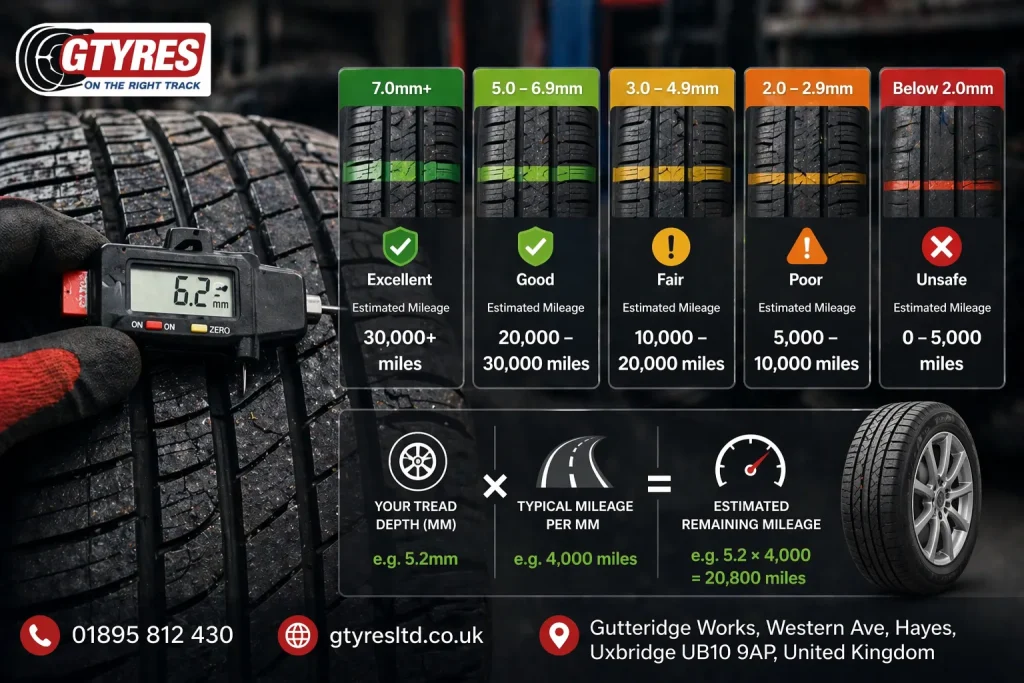
How Many Miles Can You Get from 1mm of Tread?
To truly master your vehicle’s maintenance, you need to look at each millimetre of rubber as a literal distance marker. While the 2,000-mile-per-millimetre average is a solid baseline, premium brands often stretch that efficiency further. A high-end Michelin tyre or Continental tyre is engineered with advanced polymers that resist the “scrubbing” effect of the asphalt, often giving you up to 3,500 miles per millimetre if you drive conservatively. This means that a 4mm tread depth tyre from a premium brand is not just a used product; it is a high-performance tool that still has a vast majority of its useful life ahead of it. At G Tyres LTD, we focus on sourcing these high-durability brands because we want our customers to feel every bit of value in their purchase, knowing that each millimetre is working harder for them.
It is also important to consider that not all miles are created equal. 1mm of tread will disappear much faster during stop-and-go city driving in London or High Wycombe than it will during steady motorway cruising. The constant friction of turning the steering wheel at low speeds and the heat generated by frequent braking can eat through rubber quickly. However, because our tyres start at a robust 4mm, they have the “meat” required to handle these high-stress environments. You aren’t constantly on the edge of legality; you have the freedom to drive without checking your tyres every week. For those looking for deeper technical insights into rubber compounds and wear rates, the British Tyre Manufacturers’ Association provides excellent resources on how modern engineering has improved the longevity of even second-hand rubber.
Comparing 4mm G Tyres LTD Stock vs. 2mm High Street Alternatives
When you walk into a standard part-worn tyre shop, you will often see stacks of tyres with 2mm or 2.5mm of tread. While these are technically legal to sell, they represent a significant risk to your wallet. A 2mm tyre only gives you 0.4mm of “legal” driving before you hit the 1.6mm limit. That is less than a thousand miles of safe travel in many cases. In contrast, the 4mm tread depth standard at G Tyres LTD provides you with 2.4mm of usable, legal rubber. This isn’t just a 50% increase in depth; it is a massive increase in actual road time. You are essentially getting three to four times the usable life for a price that is usually only a few pounds more. Choosing the 2mm option is a classic example of “false economy”, you save £5 today but end up spending another £40 in two months when the tyre fails its MOT.
The visual difference is striking when you see them side-by-side. A 4mm tyre still has deep, clear grooves that can easily swallow a 20p coin, ensuring that water is pumped away from the road surface. A 2mm tyre looks almost “slick” by comparison, offering very little protection against aquaplaning. We take pride in the fact that our stock looks and performs more like a new tyre than a used one. This commitment to the 4mm standard is what has built our reputation in the wholesale and retail markets. Our customers know that when they buy from G Tyres LTD, they are skipping the “junk” tier of the market and moving straight into high-value, long-term solutions. Internal links to our Wholesale Tyre Services can provide more info for businesses looking to stock these high-grade options.
Factors That Can Cut Your Tyre’s Life Short (And How to Avoid Them)
Even the best 4mm part-worn tyre can meet a premature end if it isn’t cared for properly. The road is a harsh environment, and several external factors can “rob” you of the mileage you’ve paid for. The most common culprit is improper inflation. If your tyres are under-inflated, the sidewalls flex too much, causing the edges of the tread to wear down rapidly. Conversely, over-inflation causes the center of the tyre to bulge, wearing out the middle of the tread while the edges stay untouched. To get the full 10,000+ miles out of your G Tyres LTD purchase, checking your pressures once a month is the simplest and most effective “hack” you can perform. It ensures the weight of your car is spread evenly across that 4mm tread depth, allowing the rubber to wear down at a natural, slow pace.
Another silent killer of tyre life is poor wheel alignment. If your car is “toeing in” or “toeing out,” your tyres are essentially being dragged sideways across the road as you drive forward. This creates a “feathering” effect on the rubber that can destroy a perfectly good tyre in just a few hundred miles. We always recommend that after fitting your quality part-worn tyres, you have a professional check your tracking. This small investment protects the 4mm of tread you’ve just acquired, ensuring you get every single mile promised by the manufacturer. By being proactive, you transform a budget-friendly purchase into a long-term success story. As the saying goes in the automotive world, “Take care of your tyres, and they will take care of you.”
Quick Maintenance Checklist for Maximum Longevity
✅ Check Pressure: Once a month and before long trips to ensure even wear.
✅ Inspect Alignment: If the car pulls to one side, get your tracking checked immediately.
✅ Rotate Tyres: Move front tyres to the rear every 5,000 miles to balance the wear.
✅ Visual Scan: Look for stones or debris trapped in the 4mm grooves that could cause punctures.
Is It a False Economy? Calculating the True Cost Per Mile
When you are standing at a tyre shop, the price tag on the rack is only half the story. Many drivers fall into the trap of “upfront cost” without considering the “cost per mile,” which is where the true value lies. A brand-new budget tyre might cost £60, while a 4mm tread depth premium part-worn tyre from G Tyres LTD might cost half that. However, if that budget new tyre is made of soft, inferior rubber that disappears in 6,000 miles, you are paying a massive premium for a mediocre experience. By choosing a high-grade, inspected used tyre from a legendary manufacturer like Michelin or Pirelli, you are paying for superior engineering that is designed to endure. You get the grip, the fuel efficiency, and the quiet ride of a luxury tyre at a fraction of the cost. It is about being “street smart” with your money, investing in remaining quality rather than just “newness.”
The real danger to your wallet comes from the 2mm “bargain” tyres found in less reputable corners of the market. If you buy a tyre with only 2mm of tread, you are essentially buying a product that is already 80% exhausted. You will be back at the garage in a matter of weeks, paying for fitting and balancing all over again. At G Tyres LTD, our 4mm standard effectively doubles or even triples the usable life of the tyre compared to these low-end alternatives. As one local delivery driver recently told us, “I used to buy the cheapest used tyres I could find, but I was replacing them every two months. Since I started getting the 4mm stock from G Tyres, I’ve saved hundreds in fitting fees alone because they actually last the season.” This is the definition of smart budgeting: reducing the frequency of replacements by insisting on a higher initial standard.
Part Worn vs. New Tyres: A Long-Term Financial Comparison
To truly visualize the savings, you have to look at the “usable millimetre” cost. A new premium tyre typically comes with 8mm of tread, but you pay a massive “showroom” premium for those first few millimetres. By the time that tyre reaches 4mm, it has already lost its initial retail value, yet it still possesses 100% of its high-speed stability and wet-weather engineering. This is where G Tyres LTD steps in. We provide you with that “second half” of a premium tyre’s life, the most cost-effective half. When you compare the cost of four of our 4mm premium tyres against a set of four brand-new premium tyres, the savings can often exceed £200. That is money that stays in your pocket for fuel, insurance, or family expenses, all while you enjoy the exact same safety benefits on the road.
Furthermore, we must consider the environmental “tax” of always buying new. Manufacturing a single new tyre requires gallons of oil and significant energy. By opting for a high-quality part-worn tyre, you are participating in a circular economy that reduces waste. You are getting the financial benefit of a “pre-owned” price while the planet benefits from one less tyre being manufactured and shipped across the globe. It is a win-win scenario that many UK motorists are now embracing as the cost of living continues to rise. For more information on how we vet these tyres to ensure they meet financial and safety expectations, check out our G Tyres LTD Quality Assurance page. We don’t just sell tyres; we sell a more intelligent way to maintain your vehicle.
Why G Tyres LTD 4mm Standard Offers the Best ROI for Your Vehicle
Return on Investment (ROI) isn’t just a term for stockbrokers; it is a vital concept for car owners. When you purchase a tyre from our inventory, your ROI is measured in “trouble-free miles.” Because we strictly adhere to a 4mm tread depth minimum, we are essentially guaranteeing that your investment won’t “evaporate” after a few rainy commutes. Most part-worn sellers in the UK are happy to trade in the 2mm to 3mm range, which leaves the customer hovering just above the legal limit. Our 4mm standard is a statement of confidence. It means we have rejected the lower-grade tyres that don’t meet our longevity benchmarks, ensuring that every pound you spend with us works twice as hard. This commitment to a higher baseline is why we have become a trusted name for both individual drivers and wholesale partners alike.
This ROI also extends to the safety of your vehicle. A tyre with 4mm of tread has significantly better braking performance in the wet than a 2mm tyre. In an emergency situation, those extra few millimetres could be the difference between a safe stop and an expensive insurance claim. When you factor in the “saved” cost of potential accidents or MOT re-tests, the value of a G Tyres LTD product becomes even clearer. We focus on the “Decision” stage of your journey by providing a product that leaves no room for doubt. As one Reddit user in the UK automotive community put it, “If you’re going part-worn, don’t go below 4mm. It’s the only way to ensure you aren’t just throwing your money away.” We couldn’t agree more, and our warehouse is built on that very philosophy of providing lasting, measurable value.
Safety Standards and MOT Compliance for Part Worn Tyres
The MOT test is the ultimate judge of a tyre’s worth in the UK. Every year, thousands of cars fail MOT due to “tyre tread depth below requirements,” often leading to stressful, last-minute repair bills. The legal limit is 1.6mm across the central three-quarters of the tyre, but passing with 1.7mm is a hollow victory, you’ll likely receive an “advisory” note, and you’ll be back at the garage within weeks. By choosing a tyre with 4mm tread depth from G Tyres LTD, you are ensuring an MOT pass with a massive safety margin. You won’t just scrape through; you will pass with flying colours, giving you peace of mind for the entire year ahead. This proactive approach to safety is what separates a responsible driver from one who is constantly gambling with their legal compliance.
Beyond the tread depth, British law (The Motor Vehicle Tyres Safety Regulations 1994) mandates that part-worn tyres must be free from large cuts, bulges, or exposed cords. At G Tyres LTD, our inspection process is actually stricter than the legal requirement. We look for “aging signs” such as sidewall cracking or “dry rot” that could compromise the tyre’s structural integrity at high speeds. Every tyre we stock is pressure-tested and visually scrutinized by experts who understand the nuances of rubber health. This means when you drive away on our tyres, you aren’t just MOT-compliant; you are driving on a product that has been vetted for the highest levels of road safety. For a deeper look at the legalities, you can visit the DVSA (Driver and Vehicle Standards Agency) website to see why maintaining a healthy tread depth is your primary legal responsibility as a driver.
UK MOT Tyre Standards At-A-Glance
Requirement | Legal Status | G Tyres LTD Standard |
Min. Tread Depth | 1.6mm (Across 75% of tyre) | 4.0mm (Across entire tyre) |
Sidewall Condition | No bulges, tears, or cords | Hand-inspected & Pressure Tested |
Markings | Must have “Part-Worn” label | Fully Compliant with 1994 Regs |
MOT Result | Pass (at 1.6mm+) | Guaranteed Pass with no Advisories |
Final Words: Making the Right Choice for Your Safety and Budget
As we have explored throughout this guide, the longevity of a part-worn tyre is not a matter of luck; it is a result of high standards and proper maintenance. Choosing a tyre with 4mm tread depth is the single best decision a budget-conscious motorist can make in today’s economy. It represents the perfect intersection of premium engineering, significant mileage potential, and absolute MOT compliance. By moving away from the “disposable” culture of 2mm bargain tyres and embracing the durability of the G Tyres LTD standard, you are protecting both your wallet and your passengers. You aren’t just buying “used” rubber; you are accessing the superior performance of world-class brands at a price that makes sense for your daily life.
The journey from awareness to decision is about finding a partner you can trust. At G Tyres LTD, we have built our reputation in High Wycombe and across the UK on the foundation of the 4mm rule. We reject what isn’t good enough so that you never have to settle for less. Whether you are looking for a single replacement to pass an MOT or you are a wholesale partner seeking thousands of high-grade units, our commitment to quality remains the same. The roads of the UK can be unpredictable, from sudden downpours to sharp potholes, but your tyres shouldn’t be. Make the smart choice today, prioritize depth and brand quality, and enjoy the thousands of safe, comfortable miles that a premium 4mm tyre provides.
Ready for a Safer, More Affordable Drive?
Experience premium safety and high mileage with our 4mm tyres.
Frequently Asked Questions
On average, 4mm of tread provides 8,000 to 12,000 miles. Since 1mm of rubber lasts roughly 3,000 miles, our 4mm standard ensures a long-lasting, safe "mileage runway" for most UK drivers.
Yes, provided they are professionally inspected. G Tyres LTD only stocks tyres that have passed rigorous pressure tests, ensuring they handle the heat and friction of motorway speeds safely.
Absolutely. The legal limit is 1.6mm. Passing with 4mm of tread gives you a massive safety margin, ensuring a clean MOT certificate without the common "near legal limit" advisory notes.
Look for the DOT code on the sidewall (e.g., 2224). The last four digits represent the week and year of manufacture. We ensure all our stock is within safe age limits.
Yes, 4mm is the "sweet spot" for water displacement. It allows the tyre to effectively pump water away, significantly reducing the risk of aquaplaning compared to thinner 2mm or 3mm tyres.