
Tyres are one of the most ignored safety components on a vehicle until something goes wrong. Many drivers only think about tread depth after an MOT advisory, a puncture, or that unsettling moment when the car slightly slides on a wet roundabout. The reality is simple. Your tyres are the only part of the vehicle touching the road, and even a small reduction in tread depth can affect braking, grip, steering response, and stability during heavy rain. That is why UK tyre laws exist in the first place. They are not there to create inconvenience. They exist because worn tyres increase accident risks, especially on wet roads where water can quickly reduce traction. The legal minimum tyre tread depth in the UK is 1.6mm across the central three quarters of the tyre around the entire circumference. Many people know the number, but very few actually understand what it means in real world driving conditions. Legal does not always mean safest, and that distinction matters more than most drivers realise.
A common mistake people make is assuming tyres are fine simply because they have not yet failed an MOT. In reality, tyre performance starts declining well before reaching the legal minimum. Wet grip weakens, braking distances increase, and aquaplaning risks become more noticeable during motorway driving or sudden rainfall. According to road safety campaigns from organisations like TyreSafe, tyre condition plays a major role in vehicle safety, especially during poor weather conditions. This is one reason why many drivers now pay closer attention to tread depth instead of waiting until tyres become borderline legal. At G Tyres Ltd, quality wholesale part worn tyres are supplied with a minimum 4mm tread depth, which provides a stronger safety margin compared to tyres approaching the legal limit. That extra tread can make a noticeable difference in wet road handling and braking confidence. Think of tyre tread like the grooves on a hiking boot. Once those grooves wear down too much, grip becomes unreliable, especially on slippery surfaces.
Before going deeper into UK tyre laws and safety concerns, it helps to understand how tread depth impacts real driving performance. A tyre with strong tread depth can push water away from the road surface more effectively, helping maintain contact between the tyre and the tarmac. Once tread becomes too low, water clearance weakens and the tyre begins riding on a thin layer of water instead of gripping the road properly. That feeling can be subtle at first, especially for drivers who mainly travel short distances around town. However, on motorways or during sudden braking in rain, the difference becomes very noticeable. Many drivers on UK driving forums describe the steering feeling “light” or “floaty” during wet weather once tyres wear down significantly. These are not small issues. They are warning signs. This is why understanding the minimum legal tread depth in the UK is not only about avoiding fines or MOT failure. It is about understanding how tyre condition affects everyday driving safety.
What Is the Legal Tyre Tread Depth in the UK?
The legal tyre tread depth in the UK is 1.6mm across the central three quarters of the tyre, measured around the entire circumference. This law applies to most passenger vehicles and light vans weighing up to 3.5 tonnes. Many people hear the “1.6mm” figure repeatedly, but the central three quarters rule often causes confusion. UK law does not simply check one small section of the tyre. The tread must meet legal requirements consistently across the majority of the tyre’s contact area. If large areas are worn below the legal limit, the tyre can still be considered illegal even if some grooves appear deeper elsewhere. This is why uneven tyre wear is such an important issue. A tyre may look acceptable from one angle while being dangerously worn from another. In practical terms, if your tyres are approaching the legal limit, you should not rely on visual guesswork alone. Proper inspection matters.
The easiest way to understand this is to imagine walking on wet tiles while wearing shoes with almost no grip left on the soles. You may technically still be wearing shoes, but the safety level is completely different compared to footwear with deeper tread patterns. Tyres work the same way. Their grooves are designed to clear water, maintain traction, and support controlled braking. Once those grooves become shallow, performance begins deteriorating quickly in wet conditions. According to guidance from Halfords Tyre Advice, tyres below the legal limit significantly increase stopping distances and accident risks. This is one reason police and MOT testers take tyre condition seriously. Drivers can receive fines of up to £2,500 and three penalty points per illegal tyre. If all four tyres are illegal, penalties can become severe very quickly. Beyond the legal consequences, low tread depth creates practical safety problems that many drivers underestimate until they experience reduced grip themselves.
What Does the Central Three Quarters Rule Mean?
The central three quarters rule means the tyre must maintain at least 1.6mm tread depth across the middle section of the tyre around its full circumference. Many drivers incorrectly assume only the centre groove matters, but the law focuses on the broader contact area where the tyre meets the road. This is important because tyres do not always wear evenly. Problems such as incorrect tyre pressure, wheel alignment issues, or suspension faults can wear down one side faster than the other. In some cases, the inner edge of the tyre becomes dangerously worn while the outer surface still appears acceptable. This is why mechanics and tyre specialists inspect multiple points across the tyre rather than checking one single groove. Drivers who only perform quick visual checks often miss these warning signs completely.
The central area of the tyre handles most of the water dispersion during wet driving. If that area becomes too smooth, water builds beneath the tyre more easily, increasing aquaplaning risks. Aquaplaning happens when the tyre cannot clear water fast enough and temporarily loses contact with the road surface. The steering can suddenly feel loose, and braking response becomes unpredictable. Many people only learn about aquaplaning after experiencing it during heavy rain on faster roads. Strong tread depth gives tyres more ability to channel water away effectively. This is one reason why quality part worn tyres with stronger remaining tread are becoming increasingly popular among drivers looking for value without compromising too heavily on performance. At G Tyres Ltd, maintaining a minimum 4mm tread depth helps ensure tyres still provide strong everyday usability rather than sitting close to the bare legal threshold.
Tyre Tread Depth | Legal Status | Wet Weather Performance |
8mm | Legal | Excellent |
4mm | Legal | Strong |
3mm | Legal | Reduced compared to new tyres |
1.6mm | Bare legal minimum | Significantly reduced |
Which Vehicles Must Follow the 1.6mm Rule?
The 1.6mm minimum tread depth rule applies to most passenger cars, SUVs, and light commercial vans under 3.5 tonnes in the UK. Motorcycles follow different tread requirements, and heavy commercial vehicles may have separate standards depending on their category and use. For everyday drivers, however, the 1.6mm rule is the standard legal benchmark. MOT inspections also include tyre condition checks, meaning tyres below the legal limit can cause immediate test failure. However, tread depth is not the only concern during an MOT. Inspectors also look for cuts, exposed cords, sidewall damage, bulges, and other structural defects. A tyre with acceptable tread can still fail if other safety issues are present. This is why routine inspection matters far more than waiting until MOT day arrives.
Many drivers search online asking whether 2mm tyres are still legal. Technically they are. However, legality and optimal safety are two different conversations. Road safety organisations consistently explain that tyre performance drops noticeably as tread depth approaches the minimum limit. This becomes especially important for drivers regularly travelling in heavy rain, on motorways, or carrying family passengers. A tyre may pass legal inspection while still offering reduced wet grip compared to one with deeper tread. That is why many experienced drivers choose replacement before reaching 1.6mm. In practice, stronger tread depth simply provides more margin for unexpected road conditions. It is similar to using brakes that technically work but no longer perform sharply in emergency situations. They may still function, but the safety reserve is smaller. Understanding this difference helps drivers make smarter decisions rather than relying only on minimum legal compliance.
Why Tyre Tread Depth Is Important for Road Safety
Most drivers do not notice how important tyre tread is until they experience reduced grip firsthand. It usually happens during a rainy evening, sudden motorway braking, or a tight bend where the car feels less stable than normal. The strange part is that many tyres causing these issues are still technically legal. This is why understanding tyre tread depth goes beyond simply following UK regulations. Tread depth directly affects how your vehicle grips the road, clears water, brakes under pressure, and maintains stability during unpredictable weather. Think about how a sponge absorbs water through its grooves and texture. A tyre works in a similar way. The grooves channel water away from the contact surface so the rubber can maintain grip with the road underneath. As tread depth wears down, that water clearing ability becomes weaker. Once tyres approach the minimum legal tread depth in the UK, wet road performance can decline rapidly. This is especially important in Britain where rain, standing water, and damp road conditions are common throughout much of the year.
One of the biggest misconceptions among drivers is assuming dry road driving tells the full story about tyre condition. In reality, tyres with lower tread depth may still feel acceptable in dry conditions while performing far worse during rain. Wet roads expose the weaknesses of worn tyres very quickly. Water builds between the tyre and road surface, reducing direct contact and increasing stopping distances. According to safety guidance from RAC Tyre Safety Advice, worn tyres can significantly affect vehicle handling and braking in wet conditions. Drivers often describe the steering feeling delayed or less responsive once tread depth becomes too low. That subtle feeling matters because emergency reactions depend heavily on grip levels. At higher speeds, even a small reduction in traction can affect braking distance enough to increase accident risks. This is one reason many experienced drivers prefer replacing tyres earlier rather than waiting until they become borderline legal. Stronger tread depth provides more safety margin when weather conditions suddenly change.
Another factor many people overlook is how tyre condition affects confidence behind the wheel. Good tyres make driving feel planted and controlled, especially during rain or motorway journeys. Worn tyres often create the opposite feeling. Drivers may unconsciously slow down more, avoid sharp steering inputs, or feel nervous during standing water conditions. These are signs the tyres are no longer performing optimally. Quality tyres with stronger tread depth help maintain predictable vehicle behaviour. At G Tyres Ltd, supplying part worn tyres with minimum 4mm tread depth provides drivers with stronger remaining performance compared to tyres close to the legal limit. That extra tread can improve water evacuation and wet grip substantially. While no tyre can eliminate all driving risks, stronger tread depth helps maintain better road contact during difficult conditions. Tyres are often treated like simple rubber circles, but in reality they are one of the most important safety systems on the vehicle. Ignoring tread depth is similar to ignoring brake performance. Everything may feel fine until the moment maximum control is suddenly needed.
How Tyre Tread Helps Maintain Grip on Wet Roads
When rainwater covers the road surface, tyres rely on their grooves to push water away and maintain contact with the tarmac. Without sufficient tread depth, water begins building beneath the tyre faster than it can escape. Once this happens, grip levels reduce quickly and the tyre struggles to maintain stable traction. This process becomes especially dangerous at higher speeds where tyres must clear larger volumes of water every second. New tyres with deeper grooves handle this much more effectively because they have more space available to channel water outward. As tyres wear down, those grooves become shallower, reducing their ability to disperse water efficiently. Drivers often notice this first during heavy rain when steering feels lighter or braking takes longer than expected. These are not imaginary sensations. They are physical signs that tread performance is declining.
Wet grip becomes increasingly important in the UK because rain is such a regular part of driving conditions. Motorways, rural roads, and urban streets can all become slippery very quickly after rainfall begins. Fresh rainwater also lifts oil and dirt from the road surface, creating especially slick conditions during the first few minutes of rain. Tyres with reduced tread depth struggle more in these situations because the water layer becomes harder to clear effectively. According to tyre safety studies discussed by TyreSafe, stopping distances on wet roads increase significantly as tread depth decreases. This is one reason many tyre experts recommend considering replacement before reaching the legal minimum. A tyre may still meet legal requirements while no longer providing strong wet weather confidence. This difference between “legal” and “safe” is where many drivers become confused.
There is also a psychological side to wet grip that people rarely discuss. Drivers naturally feel more relaxed and confident when the vehicle responds consistently during rain. Strong tread depth supports that confidence because the tyres maintain more predictable contact with the road surface. Worn tyres often create uncertainty. You may notice slight slipping while accelerating, reduced steering precision, or longer braking response during traffic situations. These small moments build tension, especially during long motorway journeys in heavy rain. This is why drivers increasingly pay attention to tread depth before winter seasons begin. Quality part worn tyres with stronger remaining tread can provide better real world usability than tyres sitting close to the minimum limit. At G Tyres Ltd, maintaining minimum 4mm tread depth helps ensure tyres still deliver reliable wet road performance rather than simply meeting bare legal standards.
Tread Depth | Water Dispersion Ability | Wet Grip Performance |
8mm | Excellent | Excellent |
4mm | Strong | Strong |
3mm | Moderate | Reduced |
1.6mm | Limited | Significantly reduced |
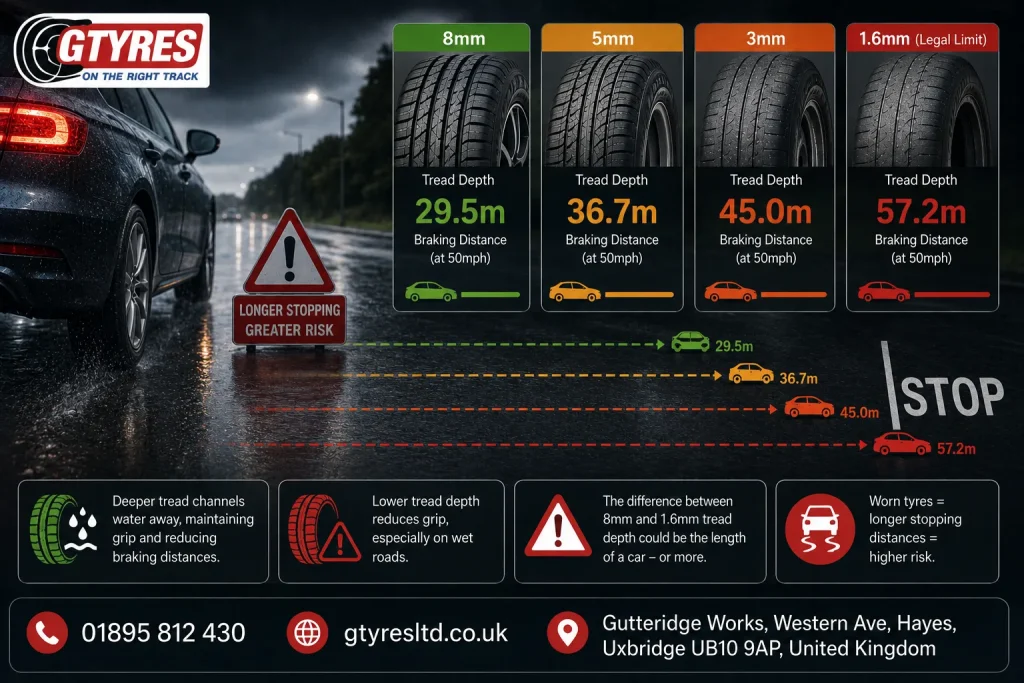
How Low Tread Depth Increases Braking Distances
Braking performance depends heavily on how effectively tyres maintain contact with the road surface. Even modern braking systems such as ABS cannot overcome the limitations of poor tyre grip. If tread depth becomes too low, tyres struggle to maintain traction during sudden braking, especially on wet roads. This means the vehicle travels further before coming to a stop. The difference may only be a few metres at first glance, but in emergency situations those extra metres matter enormously. They can determine whether a near miss stays a near miss or becomes an actual collision. Many drivers underestimate how quickly stopping distances increase as tread wears down because the change happens gradually over time rather than all at once.
Imagine trying to stop while running on a smooth tiled floor wearing worn trainers. You may still stop eventually, but the grip is weaker and your feet slide more easily. Tyres behave similarly on wet roads once tread depth becomes shallow. During emergency braking, water trapped beneath the tyre reduces direct road contact, making it harder for the vehicle to slow down effectively. This becomes especially noticeable during motorway driving where speeds are higher and water displacement becomes more demanding. Research shared by organisations such as Halfords Tyre Safety Advice consistently highlights how reduced tread depth affects stopping distances during wet conditions. Drivers often do not realise the impact until they experience a sudden braking moment themselves.
The danger is not limited to high speed driving either. Urban driving presents its own risks because sudden stops happen frequently around pedestrians, junctions, traffic lights, and roundabouts. A small increase in stopping distance can become critical in crowded traffic conditions. Stronger tread depth gives tyres more ability to grip during these moments. This is one reason why many experienced drivers avoid running tyres close to the legal minimum, even if they technically remain road legal. At G Tyres Ltd, supplying quality part worn tyres with minimum 4mm tread depth helps provide stronger braking confidence for everyday driving. Drivers searching for value often focus only on legality, but real world performance matters far more during emergency situations. Good tread depth acts like an extra safety cushion. You hope never to need it fully, but when conditions suddenly become difficult, it can make a major difference.
What Is Aquaplaning and Why Is It Dangerous?
Aquaplaning happens when a tyre loses direct contact with the road because water builds beneath it faster than the tread can clear away. Instead of gripping the road surface properly, the tyre begins riding on top of a thin layer of water. When this happens, steering, braking, and acceleration become unpredictable. Drivers often describe the sensation as the car “floating” briefly or feeling disconnected from the road. Even a few seconds of aquaplaning can be extremely dangerous, especially on motorways or during sudden manoeuvres. The risk increases significantly as tread depth becomes lower because shallow grooves cannot disperse water efficiently enough during heavy rain or standing water conditions.
One reason aquaplaning feels so frightening is how suddenly it happens. The steering wheel may feel light, braking response weakens, and the vehicle may drift unexpectedly. Drivers with little experience often react by braking harshly or steering abruptly, which can worsen control loss once grip returns. Good tyres with strong tread depth reduce aquaplaning risk because deeper grooves move water away from the tyre more effectively. This is particularly important during UK winter months where heavy rain and motorway spray are common. Even roads that appear relatively safe can develop hidden standing water patches capable of causing sudden traction loss. Drivers using worn tyres are far more vulnerable during these moments because their tyres have less capacity to manage water buildup.
A useful way to picture aquaplaning is imagining a speedboat lifting slightly onto water as speed increases. The tyre temporarily behaves similarly, losing full road contact because water pressure builds underneath. Strong tread depth helps prevent this by maintaining water channels that continue dispersing water outward. This is why tyre safety experts frequently recommend replacing tyres before reaching the legal minimum if wet weather driving is common. At G Tyres Ltd, maintaining minimum 4mm tread depth helps provide stronger water clearance capability compared to tyres approaching 1.6mm. Drivers often focus only on avoiding fines or MOT failure, but real safety comes from maintaining tyres capable of handling difficult road conditions confidently. Aquaplaning is one of the clearest examples showing why tyre tread depth matters long before legality becomes the issue.
Is 1.6mm Tyre Tread Actually Safe?
The legal minimum tyre tread depth in the UK is 1.6mm, but that does not automatically mean tyres at this level still provide strong real world safety. This is where many drivers become confused. UK law defines the minimum legal standard required for road use, not the ideal performance level for wet grip, braking, or motorway driving. A tyre sitting exactly at 1.6mm may still pass legal inspection, but its ability to clear water and maintain traction is significantly reduced compared to tyres with deeper tread. This difference becomes especially important during heavy rain, emergency braking, or high speed driving. Many drivers only realise this after experiencing poor wet weather handling themselves. The vehicle may feel less stable, stopping distances may increase, and steering response can become slower in standing water conditions. These changes usually happen gradually, which is why people often adapt to declining tyre performance without noticing immediately.
A good comparison is using a mobile phone battery that only holds 10 percent charge. Technically the phone still works, but the performance margin is tiny and reliability becomes questionable during important moments. Tyres close to the legal minimum operate similarly. They may still function legally, but their reserve safety capability is much smaller. Road safety organisations and tyre specialists regularly recommend considering tyre replacement before reaching 1.6mm because performance drops accelerate as tread depth decreases. According to information shared by TyreSafe, worn tyres contribute to increased stopping distances and reduced wet road grip. This is why many drivers prefer replacing tyres around 3mm rather than waiting until the absolute legal limit. The additional tread depth improves water clearance and maintains stronger traction during unpredictable weather conditions.
Another issue with driving on low tread depth tyres is unpredictability. Dry roads may still feel acceptable, which creates a false sense of security. Then heavy rain arrives and the tyres suddenly feel unstable or less responsive. Drivers often describe these situations as feeling like the car is “sliding slightly” or taking longer to stop than expected. These small differences matter more than people think because emergency situations happen without warning. Stronger tread depth provides more room for tyres to perform effectively under pressure. At G Tyres Ltd, quality part worn tyres are supplied with minimum 4mm tread depth to help provide stronger everyday usability and wet weather confidence. That additional tread can make a noticeable difference during braking and motorway driving. Legal compliance matters, but real safety depends on how tyres perform during difficult conditions rather than how they behave during ideal weather.
Why Many Experts Recommend Replacing Tyres at 3mm
Many tyre specialists recommend replacing tyres once tread reaches around 3mm because this is the point where wet weather performance begins declining more noticeably. While tyres may remain legal below this level, their ability to clear water efficiently weakens as the grooves become shallower. This affects grip, braking distance, and aquaplaning resistance. Drivers often assume tyre performance declines slowly and evenly, but research shows wet grip reduction accelerates as tread depth drops closer to the legal minimum. In simple terms, the final few millimetres matter more than most people realise. A tyre at 4mm behaves much differently in rain compared to one sitting near 1.6mm. That difference may not always be obvious during normal dry weather commuting, but it becomes extremely important during emergency manoeuvres or heavy rainfall.
One reason experts focus on 3mm is because UK weather conditions place constant demands on tyre performance. Roads frequently become wet, damp, or covered with standing water, especially during autumn and winter. Strong tread depth helps maintain predictable handling during these conditions. Once tyres wear down further, the vehicle becomes more vulnerable to slipping and aquaplaning. Imagine trying to sweep water away using a broom with worn bristles. It still works to some extent, but the effectiveness drops sharply. Tyres operate similarly. Deeper grooves move water more efficiently, helping maintain stable road contact. According to guidance from RAC Tyre Advice, replacing tyres before they become heavily worn can improve wet road safety significantly. This is why many experienced drivers do not wait until the legal minimum is reached.
Another practical reason for earlier replacement is avoiding sudden urgency. Drivers who delay tyre replacement until the minimum limit often end up rushing decisions after MOT advisories or poor weather experiences. Planning replacement earlier provides more flexibility and allows drivers to choose better options rather than reacting under pressure. Quality part worn tyres can also offer strong value when selected carefully. At G Tyres Ltd, supplying part worn tyres with minimum 4mm tread depth helps provide drivers with stronger remaining performance compared to heavily worn alternatives. This approach gives customers additional tread life while maintaining better wet weather usability. Many drivers today are becoming more aware that tyre safety is not simply about passing legal checks. It is about maintaining confidence, grip, and control during everyday driving situations where road conditions can change quickly.
Tread Depth | Legal Status | Wet Weather Confidence | Recommended Action |
8mm | Legal | Excellent | New tyre condition |
4mm | Legal | Strong | Good remaining usability |
3mm | Legal | Moderate | Consider replacement |
1.6mm | Bare legal limit | Reduced | Replace immediately |
Comparing 1.6mm, 3mm and 4mm Tyre Performance
The difference between 1.6mm, 3mm, and 4mm tyre tread may sound small numerically, but on the road the performance difference can feel surprisingly large. Tyres with 4mm tread still retain strong groove depth for water evacuation, helping maintain grip and stability during rain. At 3mm, tyres generally remain capable and road legal, but wet weather performance starts declining more noticeably. Once tread reaches 1.6mm, the tyre sits at the absolute legal minimum, meaning the safety margin becomes much smaller. Water clearance weakens, braking distances increase, and aquaplaning resistance drops significantly. Many drivers assume “legal” automatically means “safe enough,” but tyre specialists consistently explain that the final millimetres of tread play a major role in maintaining road contact during poor weather.
Think of it like running shoes. A brand new pair with deep grip patterns feels stable and secure on slippery surfaces. As the sole wears down, traction slowly weakens until eventually the shoes become unreliable in wet conditions. Tyres behave in exactly the same way. The grooves are there to maintain grip under pressure. Once they become shallow, road performance suffers. Drivers often notice this first during heavy rain where steering may feel vague or braking response less immediate. According to discussions across UK motoring forums and safety guidance from Halfords Tyre Advice, tyres close to the legal limit perform significantly worse during wet braking tests compared to tyres with stronger remaining tread depth. This is why many experienced drivers become uncomfortable running tyres below 3mm, especially during winter months.
The biggest advantage of 4mm tread depth is the additional performance reserve it provides. That extra tread helps tyres continue clearing water effectively while maintaining stronger grip during emergency situations. At G Tyres Ltd, supplying quality part worn tyres with minimum 4mm tread depth helps ensure customers receive tyres with meaningful remaining usability rather than tyres sitting near the end of their safe performance range. Many budget conscious drivers want affordable tyres, but affordability becomes pointless if wet weather confidence disappears. Strong tread depth supports safer braking, more stable motorway driving, and better overall traction during changing road conditions. Legal minimums exist as a baseline, but drivers who prioritise real world safety often choose tyres with significantly more remaining tread than the absolute minimum requirement.
How to Check Your Tyre Tread Depth Properly
Checking tyre tread depth is something many drivers know they should do, but surprisingly few perform regularly. Most people rely on quick visual checks while filling fuel or assume the MOT inspection will catch any serious issues. The problem with this approach is that tyre wear often develops gradually and unevenly, making it easy to miss until performance starts declining noticeably. Proper tyre inspection does not require advanced mechanical knowledge. In fact, a few simple checks can reveal whether tyres are approaching replacement level long before they become dangerous or illegal. Regular inspection also helps drivers spot uneven wear patterns caused by alignment problems, incorrect tyre pressure, or suspension issues. Catching these problems early can improve tyre lifespan and maintain safer handling.
A common mistake people make is checking only the outer edge of the tyre. In reality, wear can develop more severely on the inside edge where it is harder to see without turning the steering wheel fully or inspecting closely. This is why tyre specialists always check multiple areas across the tread surface. Imagine looking at only one corner of a worn shoe sole and assuming the entire shoe remains fine. Tyres require more thorough inspection because road contact varies across the full tread width. According to advice from TyreSafe, drivers should inspect tyre condition at least once every month and before long journeys. Regular checks help identify low tread depth, cuts, bulges, embedded objects, and sidewall damage before they become more serious safety concerns.
Tyre inspection also gives drivers greater awareness of how quickly tyres are wearing down. Some people are surprised by how rapidly tread can reduce during motorway driving or high mileage commuting. Others discover uneven wear caused by alignment problems they never realised existed. Checking tread depth consistently helps prevent these surprises. It also removes the uncertainty many drivers feel before MOT tests or long trips in poor weather. At G Tyres Ltd, quality part worn tyres with minimum 4mm tread depth provide stronger remaining usability compared to tyres nearing replacement level. However, even quality tyres still require routine inspection to ensure they continue performing safely over time. Tyres may not seem exciting, but they play a direct role in every steering, braking, and acceleration input made while driving.
How to Do the 20p Tyre Test?
The 20p tyre test is one of the quickest and easiest ways for drivers to check whether their tyres may be approaching the legal limit. It takes only a few seconds and requires no special tools. To perform the test, insert a 20p coin into the main tread grooves of the tyre. If the outer raised band of the coin remains visible above the tread surface, the tyre may be too worn and should be inspected more carefully using a proper tread depth gauge. If the outer band disappears beneath the tread, the tyre is generally above the legal minimum. The test should be repeated across multiple points of the tyre because uneven wear can affect different areas differently.
The reason this test became so popular is because it gives ordinary drivers a simple visual reference without needing technical knowledge. Many people find tyre measurements confusing, especially when trying to estimate millimetres by eye alone. The 20p coin creates an easy comparison point that almost anyone can use quickly at home or while parked. However, it is important to understand that the test provides only a rough guide rather than an exact measurement. Drivers should still inspect tyres properly if wear appears close to the limit or if unusual handling symptoms develop. Tyres can sometimes look acceptable externally while hiding severe inner edge wear that the coin test may not immediately reveal.
Many UK road safety campaigns promote the 20p test because it encourages drivers to pay attention to tyre condition more regularly. Simple habits like this can prevent people from unknowingly driving on dangerously worn tyres for long periods. According to tyre safety discussions on UK driving forums, many drivers first discovered severe tyre wear while performing quick 20p checks before MOT inspections or long journeys. This highlights how easily tyre condition can be overlooked during everyday driving routines. Strong tread depth remains one of the most important factors for wet road confidence and braking performance. Regular checks help ensure tyres continue delivering the grip and stability drivers expect during changing weather conditions.
What Happens If Your Tyres Are Below the Legal Limit?
Driving with tyres below the legal tread depth limit is not a small technical issue. It creates real safety risks and can also lead to serious legal consequences. Many drivers assume slightly worn tyres are harmless because the vehicle still feels “mostly normal” during everyday driving. The danger is that tyre performance often declines gradually, making it easy to adapt to worsening grip without noticing immediately. Then one day heavy rain arrives, sudden braking is required, or the car hits standing water on a motorway, and the reduced traction suddenly becomes obvious. Tyres below the legal limit struggle to clear water properly, reducing road contact and increasing stopping distances. This is one reason UK road laws take tread depth seriously. The legal minimum tyre tread depth in the UK exists because worn tyres directly affect vehicle safety, especially during wet conditions where grip becomes critical.
Many people focus only on avoiding MOT failure, but the consequences can extend much further than that. Police officers can issue fines of up to £2,500 and three penalty points for each illegal tyre found on the vehicle. If multiple tyres are below the legal limit, penalties can escalate quickly. In severe situations, drivers may even face disqualification risks depending on the circumstances. According to information shared by Gov.uk Vehicle Safety Guidance, maintaining safe tyre condition is a legal responsibility for all drivers. Insurance complications can also arise after accidents involving illegal tyres. Insurers may investigate whether tyre condition contributed to the incident, especially during wet weather collisions. This creates financial risks on top of the obvious safety concerns. Many drivers never think about tyre legality until penalties become involved, but preventative maintenance is always cheaper and safer than reacting afterward.
There is also a practical side to tyre safety that goes beyond fines and laws. Driving on heavily worn tyres simply feels worse. Steering response weakens, braking confidence drops, and motorway driving during rain becomes more stressful. Drivers often describe feeling nervous during standing water or noticing the vehicle wandering slightly during wet conditions. These are warning signs that tyres are struggling to maintain proper traction. Strong tread depth improves confidence because the vehicle behaves more predictably during difficult situations. At G Tyres Ltd, supplying quality part worn tyres with minimum 4mm tread depth helps provide drivers with stronger wet weather usability compared to tyres sitting close to the legal minimum. That additional tread depth offers a more comfortable safety margin during everyday driving. Tyres may not attract much attention when they are working properly, but once performance starts declining, the difference becomes very noticeable.
Issue | Possible Consequence |
Tyres below legal limit | Up to £2,500 fine per tyre |
Illegal tyre detected | 3 penalty points per tyre |
MOT inspection | Immediate failure risk |
Wet weather driving | Increased stopping distance |
Standing water | Higher aquaplaning risk |
Can Illegal Tyres Affect Insurance Claims?
Many drivers are surprised to learn that illegal tyres can potentially affect insurance claims after an accident. Insurance companies investigate vehicle condition when serious collisions occur, especially if poor weather or loss of control played a role. If tyres are found below the legal tread depth limit, insurers may argue that unsafe vehicle condition contributed to the incident. This does not automatically mean every claim becomes invalid, but it can complicate investigations significantly. In some situations, insurers may reduce payouts or dispute responsibility depending on the circumstances surrounding the accident. This becomes particularly important during wet weather crashes where tyre grip and braking performance are directly relevant factors.
Think of it like driving with faulty brakes while expecting insurance companies to ignore the issue afterward. Tyres are one of the vehicle’s core safety systems, so their condition matters during accident investigations. Police reports, MOT history, and tyre inspections may all become part of the assessment process. Many drivers never consider this until after a collision occurs. The financial consequences can quickly become much more serious than the original cost of replacing worn tyres earlier. According to discussions across UK motoring forums, some drivers only discovered their tyres were borderline illegal after post accident inspections revealed uneven or heavily worn tread areas. These situations create stress that could often have been avoided through routine checks and earlier replacement decisions.
The safest approach is maintaining tyres well above the minimum legal limit wherever possible, especially for drivers regularly travelling long distances or during poor weather conditions. Strong tread depth supports better braking and water evacuation, reducing accident risks in the first place. At G Tyres Ltd, providing premium part worn tyres with minimum 4mm tread depth helps customers access stronger remaining tyre performance without moving close to the legal threshold immediately. Drivers often focus only on legality, but maintaining better tread depth also protects overall driving confidence and reduces risk exposure during emergency situations. Insurance concerns are just another reminder that tyre condition affects much more than MOT compliance alone.
Are Part Worn Tyres Legal in the UK?
Yes, part worn tyres are legal in the UK when they meet specific safety regulations. However, many drivers misunderstand what “legal” actually means in this context. A legal part worn tyre must still meet tread depth requirements, remain free from dangerous structural damage, and comply with UK safety standards regarding markings and condition. Unfortunately, not all sellers maintain the same quality standards, which is why choosing a trusted supplier matters enormously. Some drivers hear the phrase “part worn tyres” and immediately assume unsafe or heavily used products. In reality, quality part worn tyres can still provide strong remaining performance when selected carefully. The key difference is tread depth, overall condition, and supplier reliability.
Part worn tyres have become increasingly popular because many drivers want affordable alternatives to brand new tyres without sacrificing too much safety or usability. Rising living costs mean people naturally look for ways to reduce vehicle expenses while still maintaining roadworthiness. Good quality part worn tyres can offer excellent value when they still contain strong remaining tread depth and no serious defects. The problem is that inexperienced buyers sometimes focus only on price instead of tyre condition. A cheap tyre sitting close to the legal minimum may technically remain legal but provide poor wet weather performance and limited lifespan. This is why tread depth matters so much when buying used tyres. The remaining tread directly affects grip, braking, and overall usability during everyday driving.
At G Tyres Ltd, supplying quality part worn tyres with minimum 4mm tread depth helps provide customers with stronger remaining tyre life and improved wet road capability compared to tyres close to replacement level. That extra tread depth offers practical value because drivers receive more usable performance rather than purchasing tyres already approaching the end of their effective lifespan. Think of it like buying a second hand phone with strong battery health instead of one barely holding charge. The remaining condition determines whether the product still offers dependable everyday performance. Quality part worn tyres should feel safe, stable, and predictable during normal driving conditions. Drivers should never feel like they are gambling on basic road safety simply to save money.
What to Check Before Buying Part Worn Tyres
Before buying part worn tyres, drivers should inspect tread depth, sidewall condition, wear patterns, and overall tyre age carefully. Tread depth is one of the most important factors because it determines how much usable performance remains. A tyre may technically be legal at 1.6mm, but very little effective lifespan or wet weather confidence remains at that stage. Stronger tread depth provides more value and better safety margin during difficult road conditions. Drivers should also inspect for cuts, bulges, cracking, exposed cords, or uneven wear because these signs may indicate underlying structural problems or poor vehicle maintenance from the previous owner.
Uneven wear patterns are especially important because they can reveal alignment or suspension problems. For example, excessive wear on one edge of the tyre often suggests wheel alignment issues. Centre wear may indicate overinflation, while shoulder wear can result from underinflation. These patterns matter because they affect how evenly the tyre will continue performing after installation. Many experienced buyers also check manufacturing dates because older tyres may harden over time even if tread depth appears acceptable. Rubber compounds naturally degrade with age and prolonged exposure to weather conditions.
Drivers should always buy from suppliers that prioritise tyre quality rather than simply selling the cheapest available stock. At G Tyres Ltd, maintaining minimum 4mm tread depth helps ensure customers receive tyres with meaningful remaining performance instead of tyres sitting close to legal replacement limits. This creates stronger long term value because the tyres remain usable for longer while also maintaining better wet weather grip. Part worn tyres can absolutely be a smart choice, but only when tread quality and condition are treated seriously rather than ignored in favour of low pricing alone.
Inspection Area | Why It Matters |
Tread depth | Determines remaining usability |
Uneven wear | Indicates possible alignment issues |
Sidewall condition | Helps identify structural damage |
Tyre age | Older rubber may harden |
Cracks or bulges | Safety risk warning signs |
Final Words: Prioritising Road Safety Over Minimum Legality
Understanding the minimum legal tyre tread depth in the UK is important for far more than avoiding fines or passing an MOT. Tyre tread directly affects grip, braking, steering response, and overall driving confidence, especially during wet weather conditions where road safety becomes far more demanding. The legal limit of 1.6mm exists as the minimum acceptable standard, but many drivers now recognise that stronger tread depth provides a more reliable safety margin during everyday driving. Wet roads, standing water, motorway travel, and emergency braking situations all place heavy demands on tyre performance. Once tread depth becomes too low, tyres struggle to maintain the same level of traction and stability they once provided.
Regular tyre inspection is one of the simplest ways drivers can improve vehicle safety without major expense. Simple habits such as monthly tread checks, the 20p test, and monitoring uneven wear patterns help identify issues before they become serious problems. Drivers should also remember that tyre quality matters just as much as legality. Choosing tyres with stronger remaining tread depth can improve wet weather confidence and extend usable lifespan significantly. At G Tyres Ltd, quality part worn tyres supplied with minimum 4mm tread depth help provide customers with stronger remaining usability and everyday road performance. Whether driving short urban journeys or long motorway distances, maintaining healthy tread depth remains one of the smartest investments drivers can make for both safety and peace of mind.
Need Quality Part Worn Tyres with 4mm Tread Depth?
Choose quality part worn tyres with 4mm tread depth for safer, confident everyday driving.
Frequently Asked Questions
The legal minimum tyre tread depth in the UK is 1.6mm across the central three quarters of the tyre around the entire circumference. This applies to most passenger cars and light vans under 3.5 tonnes.
1.6mm is the legal minimum, but many tyre experts recommend replacing tyres earlier because wet weather performance and braking grip decline significantly as tread depth approaches this limit.
The 20p test involves placing a 20p coin into the tyre grooves. If the outer band of the coin remains visible, tread depth may be too low and the tyre should be checked more carefully.
Yes, tyres at 2mm remain above the legal minimum and can still pass an MOT if no other tyre defects are present. However, wet grip performance may already be reduced.
Tyre tread helps clear water away from the contact surface between the tyre and road. Lower tread depth reduces water evacuation ability, increasing aquaplaning and braking risks.