
Part-worn tyres do not automatically reduce fuel efficiency. The result depends on the tyre’s original rolling-resistance rating, construction, inflation pressure, dimensions and present condition. For a garage or tyre retailer, the real question is whether the individual tyre offers predictable performance, suitable remaining tread and a credible resale proposition.
The Vehicle Certification Agency currently states that tyres account for 20% to 30% of a vehicle’s fuel consumption because of rolling resistance . It also reports a 7.5% loss in fuel economy between the best and worst rolling-resistance classes when a full set is fitted to an average car .
G Tyres supplies every tyre with at least 4mm of tread. UK rules permit a non-retreaded part-worn tyre to be sold with a minimum of 2mm across the full breadth and circumference, provided it also meets the required condition, testing and marking standards. A stronger tread starting point gives your customers more usable life and gives your business a clearer value argument.
What Determines Part-Worn Tyre Fuel Efficiency?
A part-worn tyre’s fuel efficiency is determined by how much energy it loses as it rolls. Its compound, casing design, tread pattern, dimensions, pressure and wear condition all contribute. Previous use only becomes relevant when that use has damaged the tyre, altered its shape or reduced its suitability for the vehicle.
The condition and specification of the individual tyre matter more than the label “part-worn”.
Trade buyers sourcing quality part-worn tyres should examine:
- Manufacturer, model and tyre size
- Original fuel-efficiency and wet-grip grades
- Load index and speed rating
- Tread measurements across the full width
- Consistency of the wear pattern
- Previous repairs and casing condition
- Compatibility with the opposite tyre on the axle
Rolling Resistance Connects Tyres With Fuel Use
Rolling resistance is the energy lost as a tyre flexes against the road. The engine must replace that lost energy to maintain speed. A tyre designed for lower rolling resistance therefore places less demand on the vehicle than an otherwise comparable high-resistance tyre.
This explains why two used tyres showing the same 5mm tread depth do not necessarily produce the same result. One may be a touring model designed around efficiency, while the other uses a heavier casing or performance-focused compound.
Tread Depth Does Not Reveal the Full Picture
Tread depth shows how much rubber remains. It does not reveal the original efficiency class, casing design, pressure history or internal condition.
A recognised premium second hand tyre may have a stronger original efficiency rating than a new budget tyre. That does not make it automatically superior. The tyre still needs suitable tread, even wear, sound repairs and the correct specification. For the complete resale rules, refer customers and staff to the guide covering UK part-worn tyre regulations.
Which Tyre Problems Increase Fuel Consumption?
Underinflation, irregular wear, poor alignment and incorrect fitment increase resistance or prevent the tyre from rolling cleanly. These faults have a greater effect on fuel use than the fact that the tyre was previously fitted to another vehicle. They also shorten its remaining life and increase complaint risk.
A tyre with strong tread can still perform poorly when its pressure, condition or specification is wrong.
Tyre problem | Commercial consequence | Trade check |
Underinflation | Higher resistance and accelerated shoulder wear | Check cold pressure and leakage |
Uneven tread | Reduced usable life and customer complaints | Measure inner, centre and outer grooves |
Poor alignment | Tyre scrub and rapid one-sided wear | Look for feathering and shoulder wear |
Mismatched tyres | Inconsistent handling and wear | Match model, size, construction and depth |
Wrong specification | Unsuitable load and rolling behaviour | Confirm load index and speed rating |
Underinflation Creates Extra Casing Movement
An underinflated tyre flexes more during every rotation. This produces heat, increases rolling resistance and wears the shoulders faster. A visually acceptable used tyre can still lose air through the valve, bead area or an old repair.
Cold pressure should be set to the vehicle manufacturer’s figures. The number moulded into the sidewall is normally a maximum tyre pressure, not the everyday setting for that vehicle. Garages should record the fitted pressure and advise customers to check it monthly.
When a customer reports lower MPG after fitting, check pressure, leakage and specification first. Blaming all part-worn tyres ignores the most common service-related causes.
Uneven Wear Usually Points to a Wider Problem
A 5mm reading in the centre means little if the inner shoulder is badly worn. Tread should be measured across the width and at several points around the circumference.
Feathering, cupping and one-sided wear often indicate alignment, suspension or pressure faults. Replacing the tyre without correcting the cause damages the replacement and leaves the customer paying twice.
Mismatched Tyres Make Performance Less Predictable
Tyres on the same axle should match as closely as possible in size, construction, model and tread depth. Two tyres can fit the same rim while behaving differently under braking, cornering and acceleration.
Access to A Grade part-worn tyres gives your business more scope to create appropriate pairs rather than fitting whatever size happens to be available.
Correct matching protects your margin and reduces return visits. G Tyres holds more than 50,000 tyres in stock, all supplied with a minimum 4mm tread, and many UK orders arrive within 48 hours. Call 01895 812 430 to check available pairs and sizes.
Part-Worn Tyres vs New Tyres for Fuel Efficiency
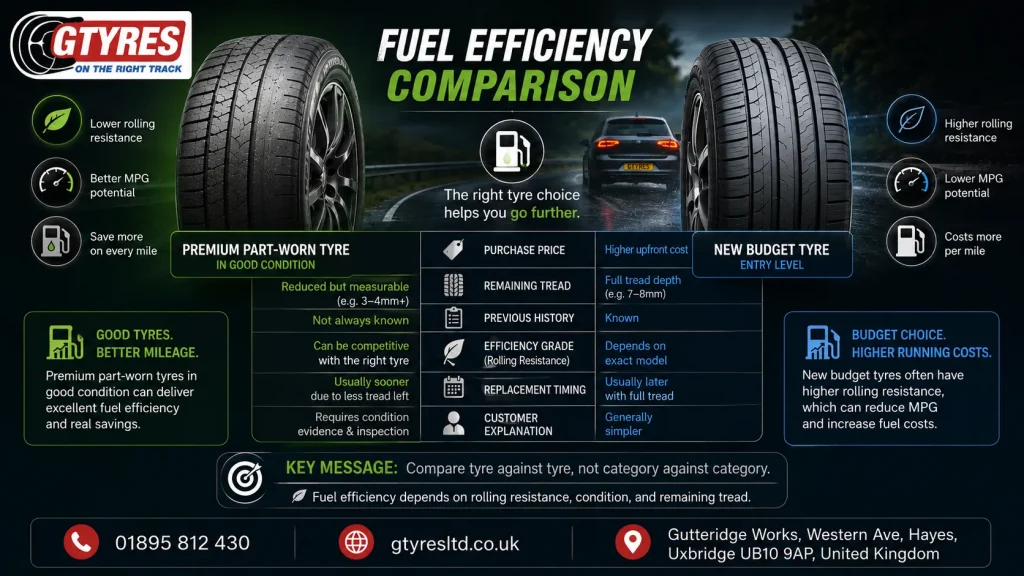
A part-worn tyre can have a stronger original efficiency grade than a new tyre from a poorer rolling-resistance class. The words “new”, “used”, “premium” and “budget” do not predict MPG by themselves. Trade buyers must compare exact models alongside condition, remaining tread and selling price.
The valid comparison is tyre against tyre, not category against category.
Comparison factor | Premium part-worn tyre | New budget tyre |
Purchase price | Usually lower | Usually higher |
Remaining tread | Reduced but measurable | Full tread |
Previous history | Not always known | Known |
Efficiency grade | Often competitive | Depends on exact model |
Replacement timing | Usually sooner | Usually later |
Customer explanation | Requires condition evidence | Generally simpler |
The full article on part-worn tyres versus budget new tyres covers the wider safety and ownership comparison. For this topic, rolling resistance and current condition remain the main fuel-efficiency factors.
Low Purchase Price Does Not Guarantee Better Value
A tyre that costs £25 less does not save the customer £25 when it requires replacement significantly earlier. The next visit brings another tyre charge, fitting, balancing and disposal.
Trade buyers should compare:
- Wholesale purchase price
- Remaining usable tread
- Expected retail price
- Fitting and balancing time
- Availability of a compatible matching tyre
- Likelihood of an early complaint or return
This cost structure explains why the long-term value of part-worn tyres cannot be calculated from the invoice price alone.
Premium Used Stock Needs Evidence, Not Assumptions
A premium brand strengthens the sales conversation only when the individual tyre supports the claim. The exact model, condition, age, tread and original efficiency grade should justify the price.
The brand name does not reveal previous pothole impacts, underinflation, poor storage or unsuitable repairs. Your customer is buying the casing in front of them, not the manufacturer’s reputation in isolation.
Sourcing premium part-worn tyres wholesale makes commercial sense when the stock allows your garage to offer recognised models, suitable pairs and meaningful remaining life without charging the full new-tyre price.
Trade Checklist for Fuel-Efficient Part-Worn Stock
Trade buyers should check the exact specification, condition and wear pattern before accepting a tyre for resale. A strong original efficiency grade is useful, but it cannot compensate for structural distortion, poor repairs or an unsuitable match.
Every tyre should justify its stock position through measurable condition and resale value.
Use this checklist:
- Confirm width, aspect ratio and wheel diameter
- Confirm load index and speed rating
- Identify the exact manufacturer and model
- Check the original fuel and wet-grip grades
- Measure tread across the full width
- Inspect the full internal and external casing
- Reject exposed cords, bulges and structural distortion
- Examine all previous repairs
- Create matching axle pairs where possible
- Compare wholesale cost with usable tread remaining
The DVSA guidance for operators buying part-worn tyres states that non-retreaded tyres offered for sale require at least 2mm tread across the full breadth and circumference, an inflation test and the relevant approval marking. It renders the required wording as “PART-WORN”, uppercase and hyphenated, in letters at least 4mm high .
TyreSafe’s part-worn tyre guidance uses the same hyphenated rendering and explains the wider structural and marking conditions.
Final Words: Do Part-Worn Tyres Affect Fuel Efficiency?
Part-worn tyres do not reduce fuel efficiency simply because they have already been used. Fuel performance comes from rolling resistance, correct pressure, construction, fitment and current condition. A properly selected used tyre can offer credible efficiency and resale value, while a distorted or mismatched premium tyre remains poor stock.
Consistent grading and correct matching protect your margin more effectively than chasing the lowest wholesale price.
Customers remember whether the tyre lasted, matched correctly and returned predictable performance. A weak casing that generates a complaint costs more than its purchase price through fitting time, replacement stock and damaged trust.
Call G Tyres Ltd on 01895 812 430 and send us the sizes your business needs. With 20 years of trade experience, 50,000+ tyres in stock and many UK orders delivered within 48 hours, G Tyres helps garages, tyre shops and mobile fitters source stronger resale stock. WhatsApp the London branch on +44 7399 988873 or email sales@gtyresltd.co.uk for a low-friction stock enquiry.
Fuel-Efficient Stock Starts Here
Source 4mm part-worn tyres with suitable ratings, consistent tread and reliable UK-wide trade delivery.
Frequently Asked Questions
Yes. Customers can search for the manufacturer, exact model, size, load index and speed rating to find its original tyre-label information. The rating describes the model when new, so it should be presented as a useful reference rather than proof of the individual used tyre’s current performance.
No. A 4mm tread measurement shows that the tyre has useful rubber remaining, but it does not measure rolling resistance. Fuel efficiency also depends on the tyre’s construction, compound, pressure, dimensions, wear pattern and condition. The 4mm standard strengthens usable life and resale value rather than guaranteeing a specific MPG result.
Matching pairs are preferable because similar models, construction and tread depths provide more consistent behaviour across an axle. A garage should avoid combining tyres solely because their printed size matches. Differences in tread pattern, remaining depth and intended performance can make handling, wear and customer satisfaction less predictable.
A non-retreaded part-worn tyre must have at least 2mm of tread across its full breadth and circumference, remain free from specified dangerous defects, pass an inflation test and display the permanent “PART-WORN” marking in uppercase letters at least 4mm high.
No. An MOT checks whether the tyre meets roadworthiness requirements at the time of inspection. It does not measure rolling resistance, confirm the tyre’s original efficiency grade or calculate its effect on MPG. Cars and light vans require at least 1.6mm across the central three-quarters of the tread for road use.
Yes. Wider tyres usually create a larger contact area and may increase rolling resistance, especially when they are heavier or use a performance-focused tread. Trade buyers should supply the vehicle manufacturer’s approved tyre size rather than recommending a wider option purely for appearance or availability.
Tyre age can affect performance because rubber gradually hardens and loses flexibility. However, age alone does not reveal the tyre’s efficiency or safety. Garages should check the manufacturing date alongside cracking, storage condition, tread wear, previous repairs and the overall state of the casing.
Severe wheel imbalance can create vibration, uneven wear and additional strain on suspension components, although its direct effect on MPG is usually smaller than underinflation or poor alignment. Correct balancing protects tread life, improves ride quality and helps the fitted tyre perform as predictably as possible.
You should buy all-season tyres if you want year-round convenience and mostly drive in mild, wet, and mixed UK weather. Winter tyres may be better if you regularly drive in colder, icy, snowy, rural, or hilly conditions. The right choice depends on your location, mileage, vehicle type, and winter driving risk.
Part-worn tyres can be suitable for electric vehicles only when their size, load index, speed rating and construction meet the vehicle manufacturer’s requirements. Electric vehicles are often heavier and deliver immediate torque, so incorrect or mismatched used tyres can wear faster and reduce driving range.
Customers should check cold tyre pressures at least once a month and before long journeys. They should also recheck pressure soon after fitting a part-worn tyre to identify a slow leak, valve issue or bead-sealing problem before underinflation increases rolling resistance and damages the tread.