
Maintaining your vehicle often feels like an endless cycle of checks and small repairs, but your tyres are the only point of contact between your car and the British asphalt. When you ignore the warning signs of tyre wear, you are essentially gambling with your traction and braking ability every time the weather turns sour. Many drivers in the UK wait until their MOT is due to even glance at their rubber, yet the signs of failure are usually screaming for attention long before a technician fails the car.At G Tyres LTD, we see many motorists who overlook subtle changes in how their vehicle handles or sounds, assuming it is just the road surface or a minor suspension quirk. However, a tyre that has reached the end of its life will not just impact your comfort but can lead to catastrophic blowouts at high speeds, particularly on motorways like the M25 or M6 during rush hour. Learning to identify these symptoms early on is not just a matter of saving money on emergency repairs but is a fundamental part of responsible ownership and road safety.
Most modern tyres are built to be incredibly resilient, but the combination of road debris, heavy braking, and the unpredictable UK climate eventually takes its toll on even the most premium brands. The emotional stress of a potential tyre failure is something many of our customers mention when they finally come in for a replacement. There is a specific kind of anxiety that settles in when you feel your steering wheel vibrate or when you notice your car sliding slightly while navigating a wet roundabout in the rain.One Reddit user in a UK car forum recently shared that they had been ignoring a slight pulling sensation for weeks until they realized their front passenger tyre was almost bald on the inside edge. This is a common story because tyre degradation is often gradual rather than a sudden event that stops you in your tracks immediately. You might notice that your braking distances are getting longer or that the road noise in the cabin has become a low, rhythmic thrumming that was not there before.These sensory clues are your car’s way of asking for help, and responding to them quickly can prevent a minor issue from becoming a dangerous MOT failure. By staying proactive and understanding that your tyres are a wear item with a finite lifespan, you can ensure that every journey is as safe and smooth as possible for you and your passengers.
Understanding Tyre Wear: Why the 1.6mm Legal Limit is Often a Dangerous Risk
The UK law is very clear about the 1.6mm minimum tread depth, but there is a massive difference between what is legal and what is actually safe on a rainy motorway. When a tyre wears down to that final sliver of rubber, its ability to displace water is almost entirely gone, which leads to the terrifying phenomenon known as aquaplaning. Many drivers assume that as long as they are above the legal limit, their car will perform exactly as it did when the tyres were new, but this is a dangerous misconception that leads to thousands of accidents every year.
We consistently advise our clients that waiting for that 1.6mm mark is like waiting for your fuel light to blink before looking for a petrol station while you are in the middle of the Highlands. The performance of a tyre drops off a cliff once it passes a certain point, particularly in wet conditions where the grooves are responsible for clearing litres of water every second. If those channels are too shallow, the water has nowhere to go, and your car effectively becomes a boat without a rudder, sliding over the surface of the road rather than gripping it.
The Science Behind Tread Depth and Water Displacement
A tyre’s tread pattern is engineered with precision channels and grooves that work together to evacuate water from underneath the contact patch. At motorway speeds of 70mph, your tyres need to displace approximately 5-8 litres of water per second during heavy rain. When tread depth drops below 3mm, these channels lose approximately 50% of their water-clearing capacity, drastically increasing your aquaplaning risk.At G Tyres LTD, we advocate for a 4mm tread depth standard because this is the safety sweet spot where you still have enough rubber to handle a heavy downpour with confidence. Research into braking distances shows that a car with 1.6mm of tread can take significantly longer to stop compared to one with 4mm or more, which can be the difference between a close call and a serious collision.
A real world example often cited by safety experts is that at 50mph in the rain, a tyre with 1.6mm of tread can take an extra 10 to 15 metres to come to a full stop compared to a tyre with plenty of tread depth remaining. This is why we focus our stock on premium wholesale part worn tyres that maintain this 4mm standard, ensuring that safety is never compromised for the sake of a bargain price.Many of our regular customers have switched to this mindset after realizing that the legal limit is really just a bare minimum requirement for passing an inspection, not a recommendation for peak performance. Choosing to replace your rubber at 4mm ensures that you always have a safety buffer, giving you much more peace of mind when the British weather inevitably takes a turn for the worse.
The Safety Gap: A Comparison of Tread Depth and Performance
To better understand why we emphasize the 4mm standard at G Tyres LTD, it helps to look at the actual data regarding how a tyre performs as it wears down. The following table illustrates the relationship between tread depth, safety risks, and the recommended action you should take to keep your vehicle in top condition.
Tread Depth | Safety Status | Road Performance & Risk Factors | Recommended Action |
8mm (New) | Excellent | Maximum water displacement and optimal grip. | Regular pressure checks only. |
4mm | The Safety Sweet Spot | High performance in wet conditions; very low risk of aquaplaning. | G Tyres LTD Recommended Replacement Point. |
3mm | Warning | Noticeable increase in braking distances; grip starts to degrade. | Start planning for a replacement soon. |
1.6mm | Legal Minimum | Significant risk of aquaplaning; poor braking in the rain. | Must replace immediately to avoid fines. |
Below 1.6mm | Illegal & Dangerous | Extreme risk of blowout; car is unroadworthy and illegal. | Do not drive; replace now. |
The 7 Critical Warning Signs You Need New Tyres Right Now
1. Tread Depth Below 4mm (The G Tyres Safety Standard)
While the legal minimum is 1.6mm, waiting until your tyres reach this point puts you at serious risk. Independent testing by MIRA (Motor Industry Research Association) shows that stopping distances increase by up to 44% when tread depth drops from 3mm to 1.6mm in wet conditions.
How to Check: Use the 20p test as a quick guide, but invest in a proper tread depth gauge for accuracy. Check at least three points across the tyre width and around the circumference, as wear is rarely uniform.
Cost of Ignoring: Beyond safety risks, driving on tyres below the legal limit carries a fine of up to £2,500 and 3 penalty points per tyre. That means you could face a £10,000 fine and 12 points (an instant ban) if all four tyres are illegal.
2. Uneven Wear Patterns Across the Tread
Tyres should wear evenly across their entire surface. If you notice one edge wearing faster than the other, or if there are bald patches in specific areas, this indicates serious underlying problems.
Common Uneven Wear Patterns:
- Centre Wear: Over-inflation causing the middle to bear all the weight
- Edge Wear: Under-inflation putting excessive pressure on the shoulders
- One-Side Wear: Poor wheel alignment (tracking off)
- Cupping/Scalloping: Worn suspension components or wheel imbalance
- Flat Spots: Emergency braking or locked wheels
What to Do: These patterns not only mean you need new tyres but also that you must fix the root cause. At G Tyres LTD, we always recommend getting your alignment and suspension checked when replacing tyres with uneven wear to prevent the new set from degrading prematurely.
Visible Cracks in the Sidewall or Tread (Perishing)
Rubber is an organic material that degrades over time through a process called “perishing” or “dry rot.” This appears as a network of fine cracks on the sidewall or between tread blocks and indicates that the rubber compound has lost its elasticity.
What Causes Perishing:
- Exposure to UV sunlight over extended periods
- Fluctuating temperatures (especially freeze-thaw cycles)
- Low-quality rubber compounds in budget tyres
- Infrequent use (tyres need regular flexing to stay supple)
- Incorrect storage (tyres stored flat for long periods)
The Danger: Perished rubber becomes brittle and can suddenly crack or separate from the internal structure, even at low speeds. This is particularly dangerous because the tyre may look acceptable from tread depth but is structurally compromised.
Real Case: One of our customers at G Tyres LTD had a caravan that sat unused for three winters. Despite the tyres having 6mm of tread, the sidewalls were covered in hairline cracks. During their first motorway journey, one tyre suffered a complete blowout at 60mph. Thankfully, they were in the slow lane and escaped unharmed, but the caravan sustained £3,000 in damage.
4. Bulges, Bubbles, or Deformities in the Sidewall
A bulge or bubble in your tyre sidewall is one of the most dangerous conditions you can encounter, and it demands immediate replacement. This occurs when the internal structure (steel belts and fabric cords) breaks down, allowing air pressure to push against the weakened outer rubber layer.
Common Causes:
- Hitting potholes at speed
- Mounting curbs aggressively
- Running over sharp debris that impacts the sidewall
- Manufacturing defects (rare but possible)
- Under-inflation causing excessive sidewall flexing
Why This is Critical: The sidewall is significantly thinner than the tread area and bears enormous stress during cornering and load-bearing. A bulge represents a weak point that can explode without warning, especially when tyres heat up during motorway driving.
No Repairs Possible: Unlike punctures in the tread area, sidewall damage cannot be repaired. Any professional garage will refuse to patch or plug a tyre with sidewall compromise because it violates safety regulations.
5. Exposed Cords, Wires, or Fabric Showing Through
If you can see metal wires, steel belts, or fabric cords poking through the rubber anywhere on your tyre, stop driving immediately. This is a legally unroadworthy condition that puts you at extreme risk of a catastrophic failure.
How This Happens:
- Driving on severely worn tyres beyond their usable life
- Sharp object penetration that cuts deep into the tyre structure
- Impact damage from road debris at high speed
- Continued driving after a puncture has destroyed the internal layers
Legal Implications: A tyre with exposed cords will fail an MOT inspection instantly and can result in roadside prohibition if spotted by police or DVSA enforcement. You could be fined and have your vehicle impounded until the tyres are replaced.
6. Embedded Objects: Nails, Screws, Glass, or Stones
Small stones lodged in tread grooves are usually harmless and can be removed, but nails, screws, and glass shards are different matters entirely. Even if the tyre is still holding air, embedded metal objects can work their way deeper with every rotation.
When to Repair vs Replace:
Can Be Repaired:
- Puncture in the central ¾ of the tread area
- Object diameter less than 6mm
- No damage to sidewall or shoulder
- Tyre has sufficient tread remaining (above 3mm)
Must Be Replaced:
- Puncture in the sidewall or shoulder area
- Multiple punctures in the same tyre
- Puncture larger than 6mm diameter
- Any damage to the tyre structure visible from inside
At G Tyres LTD, we follow the British Standard BS AU 159 for tyre repairs, which sets strict guidelines on what can be safely repaired. Many drivers try to use temporary repair kits or sealants, but these are emergency solutions only and not permanent fixes.
7. Tyres Over 6 Years Old (Check the DOT Code)
Age kills tyres regardless of tread depth or mileage. The rubber compounds contain oils and antioxidants that keep the material flexible, but these evaporate over time, leaving the rubber hard and brittle.
How to Check Tyre Age:
Every tyre has a DOT (Department of Transportation) code stamped on the sidewall. The last four digits tell you the manufacture date.
Example: DOT XXXX 2319
- 23 = Week 23 of the year
- 19 = Year 2019
- This tyre was manufactured in June 2019
Age Guidelines:
- 0-5 Years: Safe with regular inspection
- 6-7 Years: Requires professional inspection, consider replacement
- 8-10 Years: Strong recommendation to replace
- 10+ Years: Replace immediately, regardless of appearance
Important Note: This applies to ALL tyres, including:
- Spare tyres (especially the space-saver type)
- Caravan tyres that sit unused for months
- Classic/vintage car tyres with low mileage
- Tyres stored in garages or warehouses
Visible Physical Damage: Bulges, Cuts, and Cracks You Can't Ignore
While tread depth is the most talked-about aspect of tyre safety, the physical integrity of the tyre wall is just as critical for your daily commute. Physical damage often appears in the form of bulges or “bubbles” on the sidewall, which are essentially weak spots where the internal structure of the tyre has failed.This usually happens after hitting a deep pothole or curbing the wheel too hard, causing the internal cords to snap and allowing air pressure to push out against the outer rubber layer. A bulge is a ticking time bomb because the sidewall is much thinner than the tread area and cannot be repaired under any circumstances.If you notice even a small protrusion on the side of your tyre, you must replace it immediately because the heat and stress of motorway driving could cause it to fail. At G Tyres LTD, we frequently explain to our customers that a bulge is not just a cosmetic flaw but a sign that the tyre’s carcass is no longer capable of holding the vehicle’s weight safely. Ignoring these signs is one of the most common causes of high speed blowouts on UK roads today.
Beyond bulges, you should also be on the lookout for deep cuts, nicks, or exposed metal cords which are clear indicators that the tyre is no longer fit for purpose. Driving over sharp debris or scraping against sharp stones can leave gouges in the rubber that reach deep enough to compromise the safety layers underneath.If you can see any wire or fabric poking through the rubber, the tyre is legally unroadworthy and extremely dangerous to drive on. Another common issue in the UK is rubber perishing, which looks like a network of tiny cracks on the sidewall or between the tread blocks, often referred to as “dry rot.”This happens as the oils in the rubber dry out over time, usually due to age or prolonged exposure to the sun and cold. Even if your tread depth looks like it is still at 4mm, perished rubber is brittle and lacks the flexibility needed to grip the road or handle high cornering forces.One regular visitor to our wholesale warehouse recently shared how they nearly had a disaster when a perished tyre simply disintegrated while they were inflating it to the correct pressure. Checking for these visible defects takes less than a minute but can save you from a catastrophic failure during a journey.
Performance Red Flags: How Your Car Tells You It Needs New Rubber
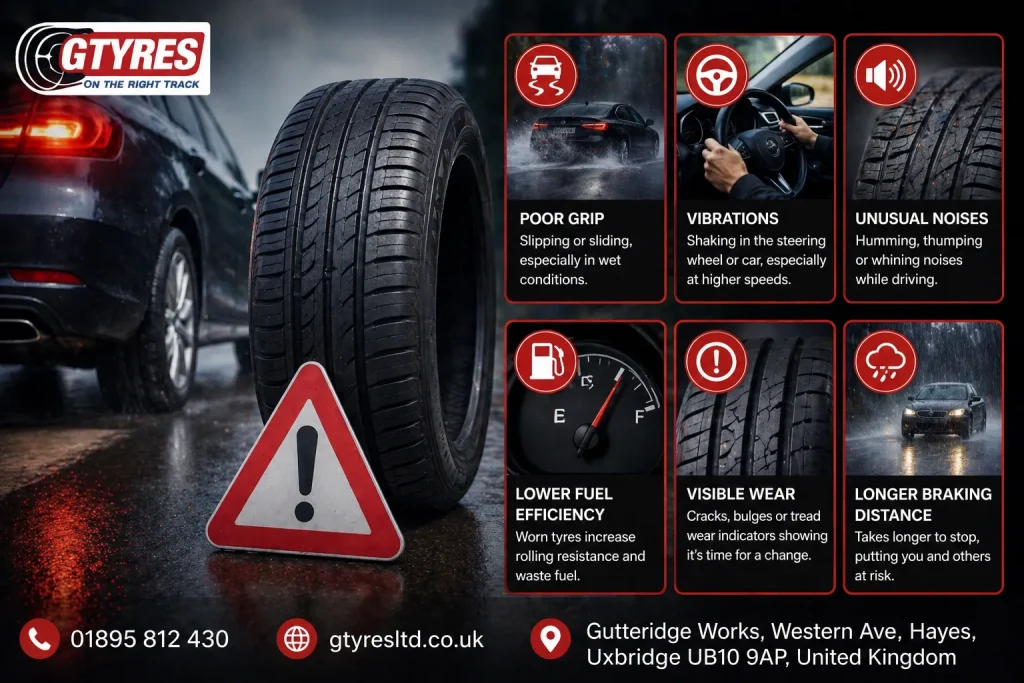
Sometimes the signs that you need to replace your tyres are not visible to the eye but are felt through the steering wheel and the seat of your car. If you notice that your steering wheel starts to vibrate or wobble once you reach speeds of 50mph or 60mph, your car is giving you a very loud warning.
While this can sometimes be a simple wheel balancing issue, it is often a sign of internal tyre failure where the belts inside the rubber have shifted or become distorted. This distortion causes the tyre to lose its perfectly round shape, creating a rhythmic thumping or vibration that gets worse the faster you go.
Specific Performance Symptoms to Monitor
Steering Wheel Vibration:
- At Low Speeds (20-40mph): Usually indicates wheel imbalance
- At High Speeds (50-70mph): Often points to tyre distortion or internal belt separation
- Constant Vibration: Check for flat spots from emergency braking
- Pulsating Vibration: May indicate tyre has developed irregular wear
Vehicle Pulling to One Side:
- Gradual Pull: Likely alignment issue or uneven tyre pressure
- Sudden Pull: Could indicate sudden tyre deflation or internal failure
- Pull During Braking: May be brakes, but also check for uneven tyre wear
Excessive Road Noise:
- Humming/Droning: Often from worn or incorrectly inflated tyres
- Rhythmic Thumping: Flat spots or separated tread
- Roaring Sound: Aggressive tread patterns wearing unevenly
- Squealing on Turns: Low tread depth or wrong tyre pressure
At G Tyres LTD, we always suggest that drivers pay close attention to these mechanical “messages” because they often precede a total tyre failure by several days or weeks. If your car feels like it is pulling to one side even when you are on a flat road, or if the steering feels “mushy” and unresponsive, your tyres may have developed flat spots or uneven wear patterns that are ruining your handling.Feeling connected to the road is essential for safety, and any change in that feedback should be treated as a priority for inspection. Another performance red flag is a sudden increase in road noise which can sound like a low drone or a constant humming coming from the wheel arches.As tyres wear down or become unevenly worn due to poor alignment, the way air flows through the tread grooves changes, often resulting in much louder cabin noise. You might also notice that your traction control light flashes more frequently during acceleration or that your car feels jittery when you are braking on a surface that isn’t perfectly dry.
This loss of traction is a direct result of the rubber compound losing its ability to bite into the road surface, which is especially noticeable when the tread is nearing that critical 4mm threshold. Many of our local clients in the UK report that their car feels “nervous” in the rain, which is a classic symptom of tyres that are struggling to clear water and maintain a solid footprint.If you find yourself having to grip the steering wheel tighter than usual just to keep the car straight in a breeze or on a damp road, it is a clear sign that your rubber is no longer providing the stability you need. Trusting your instincts as a driver is vital because you know how your car should feel when it is performing at its best.
The Impact of Aging: Why Old Tyres are Dangerous Regardless of Tread
It is a common myth among vehicle owners that as long as there is plenty of rubber on the tyre, the car is safe to drive. However, tyres have a shelf life just like the food in your pantry, and the chemical compounds in the rubber begin to break down the moment they leave the factory.Even a tyre that has been sitting in a garage for years with a full 8mm of tread can be a serious safety hazard because rubber is an organic material that loses its elasticity over time. As the oils and antioxidants within the tyre evaporate, the rubber becomes hard and brittle, a process often accelerated by the fluctuating UK temperatures and exposure to UV rays.When rubber hardens, it loses its ability to grip the road surface effectively, meaning your stopping distances will increase even if the tread looks brand new. At G Tyres LTD, we always advise our customers to check the manufacture date on the sidewall, which is indicated by a four digit DOT code.If your tyres are more than five or six years old, they require a professional inspection, and if they have reached the ten year mark, they should be replaced immediately regardless of their visual appearance.
Understanding Rubber Degradation Chemistry
Tyres are manufactured using complex rubber compounds mixed with carbon black, sulphur, and various chemical additives. These components work together to provide:
- Grip: Soft polymers that conform to road surface irregularities
- Durability: Hardening agents that prevent rapid wear
- Flexibility: Plasticizers that keep rubber supple
- UV Protection: Antioxidants and anti-ozonants
As tyres age, several chemical processes occur:
- Oxidation: Oxygen reacts with rubber polymers, making them brittle
- UV Degradation: Sunlight breaks down molecular chains
- Plasticizer Migration: Softening agents evaporate or migrate to the surface
- Cross-Linking: Rubber molecules bond together, reducing flexibility
The danger of aged tyres often manifests as “perishing,” where the rubber develops a network of fine cracks that can eventually lead to the tread separating from the internal carcass. One driver recently shared a story on a car forum about a vintage car they had purchased which had “perfect” looking tyres, only for the sidewall to disintegrate during a routine motorway journey.This happens because the internal structure of the tyre is no longer supported by flexible rubber, making it susceptible to heat buildup and sudden failure. This is particularly relevant for spare tyres or caravans that sit idle for long periods, as the lack of regular use prevents the internal oils from circulating and keeping the rubber supple.Many people do not realize that the structural integrity of the tyre is what keeps the vehicle upright, and once that rubber becomes “wooden” or petrified, it can no longer absorb the shocks of potholes or debris. We make sure that every tyre in our wholesale stock is checked for these signs of aging because we understand that a high tread count is meaningless if the rubber compound itself has lost its life.Investing in fresher rubber is an essential part of maintaining a vehicle that is truly roadworthy and predictable in an emergency.
The Simple Home Check: How to Accurately Inspect Your Tyres in Minutes
You do not need to be a qualified mechanic to perform a thorough safety check on your vehicle, and taking ten minutes every month can save you from a massive headache later on. The most famous method in the UK is the 20p test, which is a brilliant way to get a quick idea of your tread depth without any specialized tools.Simply place a 20p coin into the main tread grooves of your tyre; if the outer rim of the coin is hidden, your tyres are likely above the legal limit. However, at G Tyres LTD, we encourage our clients to go a step further because the 20p test only measures a small part of the tyre.
Complete Monthly Tyre Inspection Checklist
Step 1: Visual Inspection (2 minutes per tyre)
Walk around your vehicle and check each tyre for:
- Cracks or cuts in the sidewall
- Bulges or deformities
- Embedded objects (nails, screws, glass)
- Uneven wear patterns
- Signs of rubbing against bodywork
Step 2: Tread Depth Check (3 minutes per tyre)
You must check tread depth in at least three different places around the circumference and across the full width of the tyre. It is very common for tyres to wear unevenly due to incorrect wheel alignment or suspension issues, meaning you might have 4mm of tread on the outside but be dangerously bald on the inside edge where you cannot easily see.
Using a Tread Depth Gauge (recommended):
- Insert the probe into the main groove
- Press down until the shoulders touch the tread
- Read the measurement on the scale
- Record readings at three points around the tyre
- Check both inner and outer edges
Using the 20p Coin Method (quick check):
- Insert a 20p coin into the tread grooves
- If the outer band is visible, tread is below 3mm
- This indicates you should plan replacement soon
- Remember: this is a guide, not a precise measurement
Step 3: Pressure Check (1 minute per tyre)
Using a dedicated tread depth gauge is a much more accurate way to ensure you are meeting the 4mm safety standard we recommend for optimal wet weather performance. While you are checking the tread, you should also perform a visual and “tactile” inspection of the sidewalls and the valleys between the tread blocks.
Proper Pressure Checking Technique:
- Check when tyres are cold (before driving or 3+ hours after)
- Remove the valve cap
- Press gauge firmly onto valve stem
- Read pressure and compare to manufacturer’s recommendation
- Adjust if necessary using a pump or deflator
- Replace valve cap (prevents moisture and dirt entry)
Where to Find Correct Pressure:
- Door jamb sticker (driver’s side)
- Fuel filler cap
- Owner’s manual
- Vehicle manufacturer website
Run your hand carefully along the side of the tyre to feel for any unusual lumps, ripples, or bulges that might not be immediately visible to the eye in low light. Look closely for any stones, nails, or shards of glass that might be embedded in the rubber, as these can slowly work their way through the casing and cause a slow puncture.It is also vital to check your tyre pressures while they are “cold” because under-inflated tyres generate excessive heat and wear out much faster than those kept at the manufacturer’s recommended levels. Many modern cars have Tyre Pressure Monitoring Systems, but these often only alert you when a tyre is significantly low, so a manual check is still the gold standard for maintenance.One of our wholesale partners often tells their customers that a well-maintained tyre can last thousands of miles longer than a neglected one, simply by keeping the air pressure correct and the alignment straight. By making this simple inspection a part of your routine, you stay in control of your safety and ensure that your G Tyres LTD premium rubber continues to perform at its peak.
Understanding MOT Tyre Requirements: What Inspectors Check
An MOT test includes comprehensive tyre checks, and failure rates for tyre-related issues remain one of the highest categories. Understanding what inspectors look for can help you prepare and avoid the inconvenience of a failed test.
MOT Tyre Inspection Criteria
Tread Depth Requirements:
- Minimum 1.6mm across the central ¾ of the tread
- Must extend around the entire circumference
- Checked using a calibrated depth gauge
- Instant failure if below limit anywhere on tyre
Tyre Condition Checks:
- No cuts or damage exceeding 25mm or 10% of section width
- No bulges or lumps caused by separation or partial failure
- No exposed cords or fabric
- No large or deep cuts in the sidewall
- No mixing of radial and cross-ply tyres on the same axle
Correct Tyre Specifications:
- Load index must meet or exceed vehicle requirements
- Speed rating appropriate for vehicle’s maximum speed
- Correct size matching manufacturer specifications
- No space-saver spare used as a permanent tyre
Additional Checks:
- Valve caps present and secure
- No excessive air leakage from valves
- Wheels properly secured with all nuts/bolts present
- No fouling against bodywork or suspension
Common MOT Tyre Failures and How to Avoid Them
Failure Reason: Tread Depth Below Legal Limit
- Prevention: Check monthly, replace at 4mm as recommended
- Cost Impact: Retest fee plus tyre replacement
- Time Impact: Cannot drive vehicle until tyres replaced
Failure Reason: Tyre Damage (Cuts, Bulges, Cords Showing)
- Prevention: Regular visual inspections, avoid kerbing
- Cost Impact: Immediate replacement required
- Safety Risk: High risk of blowout
Failure Reason: Incorrect Tyre Size or Specification
- Prevention: Always verify fitment before purchase
- Cost Impact: Purchase correct tyres
Legal Risk: May affect insurance validity
Seasonal Considerations: How UK Weather Affects Tyre Wear
The United Kingdom’s variable climate puts unique demands on tyres throughout the year. Understanding seasonal effects helps you anticipate when replacements might be needed.
Winter Challenges (November-February)
Cold Temperature Effects:
- Rubber compounds harden, reducing grip
- Tyre pressure drops (approximately 1 PSI per 5°C decrease)
- Road salt accelerates rubber deterioration
- Ice and snow increase wear from wheelspin
Winter Tyre Recommendations: When temperatures consistently drop below 7°C, summer tyres lose significant performance. Consider:
- Dedicated winter tyres (marked with snowflake symbol)
- All-season tyres as a year-round compromise
- Increased tread depth checks during freeze-thaw cycles
Spring Issues (March-May)
Pothole Season:
- Freeze-thaw cycles create severe road damage
- Highest risk period for impact damage and bulges
- Increased kerb strikes from avoiding potholes
- More punctures from exposed road debris
Post-Winter Inspection Priorities:
- Check for sidewall damage from potholes
- Inspect for salt-induced cracking
- Verify pressure returns to normal with warmer weather
- Look for uneven wear from winter driving
Summer Concerns (June-August)
Heat-Related Issues:
- Higher road temperatures increase tyre pressure
- Over-inflated tyres wear centers faster
- UV exposure accelerates rubber aging
- Softer rubber compound in high-performance tyres wears faster
Holiday Driving Preparations:
- Check tread before long motorway journeys
- Account for additional load from luggage/passengers
- Increase pressure if carrying heavy loads
- Inspect spare tyre if equipped
Autumn Preparations (September-October)
Wet Weather Returns:
- Fallen leaves create slippery surfaces
- First rains bring oil to surface
- Aquaplaning risk increases dramatically
- Testing time for tread depth adequacy
Pre-Winter Checklist:
- Ensure minimum 4mm tread for winter safety
- Replace any tyres showing age-related cracking
- Consider switching to winter tyres
- Check all four corners for even wear
The Financial Cost of Delaying Tyre Replacement
Many drivers delay tyre replacement due to perceived cost savings, but this decision often backfires in multiple expensive ways.
Direct Costs of Worn Tyres
MOT Failure:
- Retest fee: £30-£40
- Replacement tyres: £50-£150 per tyre (budget to mid-range)
- Lost time: Half day at minimum
- Potential taxi/alternative transport costs
Traffic Penalties:
- Fine up to £2,500 per illegal tyre
- 3 penalty points per tyre (potential 12-point ban)
- Increased insurance premiums after conviction
- Criminal record for serious offences
Accident Costs:
- Insurance excess: £250-£500 typically
- Increased premiums for 3-5 years
- Potential injury costs if someone hurt
- Legal fees if negligence proven
Hidden Costs and Secondary Effects
Increased Fuel Consumption: Under-inflated or worn tyres increase rolling resistance by 10-15%, costing approximately:
- Extra £150-£200 annually in fuel
- Reduced MPG affecting long-term running costs
- Increased carbon emissions
Accelerated Wear on Other Components:
- Suspension components work harder
- Brake pads and discs wear faster
- Wheel bearings subjected to additional stress
- Alignment issues develop from uneven wear
Vehicle Depreciation:
- Service history gaps reduce resale value
- Evidence of poor maintenance deters buyers
- Failed MOT visible on vehicle history checks
- Overall impression of neglected vehicle
Cost-Benefit of the 4mm Standard
Replacing tyres at 4mm rather than 1.6mm might seem expensive, but consider:
Safety Benefits:
- 50% better wet braking performance
- Drastically reduced aquaplaning risk
- Maintained handling characteristics
- Peace of mind in emergency situations
Financial Benefits:
- Avoid accident costs
- No penalty points or fines
- Predictable maintenance scheduling
- Better fuel economy maintained longer
Practical Benefits:
- Pass MOT first time
- Plan replacement at convenient time
- Shop for best deals without urgency
- Maintain full control over tyre choice
Why Choose G Tyres LTD for Your Next Set of 4mm Premium Tyres?
Selecting a reliable supplier is just as important as identifying the signs of tyre wear, especially when you are looking for the perfect balance between safety and value. At G Tyres LTD, we have built our reputation on a strict 4mm tread depth standard because we refuse to compromise on the safety of our customers. While many part worn suppliers in the UK might sell tyres that are just barely above the legal limit, we understand that a tyre with only 2mm of tread has already lost the majority of its life and performance. By focusing on premium wholesale stock that meets our rigorous inspection criteria, we ensure that every tyre we provide offers a significant safety buffer for the unpredictable British weather. Our customers trust us because we treat every tyre as if it were going on our own family vehicles, checking for structural integrity, sidewall health, and rubber suppleness. Whether you are a local driver or a business looking for bulk wholesale options, choosing our 4mm standard means you are getting a product that is ready to handle heavy rain and emergency braking with total confidence.
The economic benefits of choosing our premium part worn tyres are clear, but the environmental impact is also a major factor for many modern motorists. Every year, millions of tyres are discarded prematurely, but by choosing high quality tyres that still have 4mm of usable tread, you are helping to reduce waste and the carbon footprint associated with manufacturing new rubber. We believe that providing a sustainable, safe, and affordable alternative to budget new tyres is the future of the automotive industry in the UK. Our team is dedicated to transparency, and we are always happy to explain the history and testing process behind our stock. We know that the tyre industry can sometimes feel overwhelming with its technical jargon and varying price points, which is why we keep our mission simple: providing premium safety at a fraction of the cost of new tyres. When you partner with G Tyres LTD, you are not just buying rubber; you are investing in a service that prioritizes your road safety and your budget through expert selection and an uncompromising commitment to quality.
Need Expert Advice on Your Tyres?
Get professional tyre safety checks and premium replacements today.
Frequently Asked Questions
Tyres have a chemical lifespan regardless of how much you drive. You can check the manufacture date by looking at the DOT code on the sidewall; if your tyres are over six years old, the rubber often becomes brittle and loses its essential grip. If you notice fine cracks (perishing) or the rubber feels "hard" to the touch, it is time to replace them to avoid a sudden failure.
Absolutely not. A bulge or bubble is a clear indicator of internal structural failure where the tyre's casing has been compromised. This is a critical safety risk because the weakened area can lead to a high-speed blowout at any moment. If you spot any protrusion on the side of your tyre, you should have it replaced immediately.
While 1.6mm is the absolute legal limit in the UK, it is often considered the "danger zone" for wet weather driving. At G Tyres LTD, we advocate for a 4mm standard because this depth allows for significantly better water displacement. Driving on 4mm of tread drastically reduces your braking distance and the risk of aquaplaning compared to the bare legal minimum.
Yes, persistent vibration in the steering wheel, especially at motorway speeds is often a warning sign. While it can sometimes be a simple balancing issue, it frequently indicates uneven tyre wear or a distortion in the tyre's internal belts. If your car feels like it is "thumping" or vibrating, you should have your tyres inspected to see if they are nearing the end of their life.
For the best safety and handling, it is highly recommended to replace tyres in pairs (both front or both rear). Replacing only one tyre can lead to an imbalance in grip and braking performance, which might cause the car to pull to one side during an emergency. We provide matching premium sets to ensure your vehicle remains balanced and predictable on the road.