
Part worn tyres can be safe for everyday driving, but only when they are legal, structurally sound, correctly fitted, and suitable for the vehicle. The honest answer is not a simple yes or no because every tyre has its own condition, age, tread depth, repair history, and previous use. A good part worn tyre can still offer practical value, while a damaged or badly worn tyre can become a serious road risk. Think of it like buying a used jacket for winter. If the fabric is strong, the zip works, and the lining is clean, it may still do the job well. But if it has hidden tears, weak stitching, and worn edges, the lower price does not make it a good buy. Tyres are more serious because they affect grip, braking, steering, and road confidence. That is why safety must come before savings every time.
Everyday driving puts tyres through constant pressure. A normal trip may include wet roads, potholes, kerbs, roundabouts, sudden braking, speed bumps, and motorway stretches. A tyre that looks acceptable while parked can behave differently when it is carrying vehicle weight, building heat, and gripping a wet surface. This is why buyers should never judge part worn tyres by appearance alone. The tyre should have usable tread, clean sidewalls, no exposed cords, no deep cuts, no bulges, and the correct size and rating for the vehicle. G Tyres LTD supplies wholesale part worn tyres for buyers who need practical value, but the key point is that value only matters when the tyre is safe enough for real road use. If a tyre creates doubt, the safest decision is to reject it. A cheaper tyre is not worth fitting if it compromises road safety, braking confidence, or daily driving reliability.
What Are Part Worn Tyres?
Part worn tyres are tyres that have already been used on another vehicle but still have remaining tread and may be suitable for reuse. They are not new tyres, but that does not automatically make them unsafe. Some part worn tyres may still have useful life left, especially when they have even wear, clean sidewalls, sound structure, and correct fitment. The problem starts when buyers assume all part worn tyres are the same. They are not. One tyre may be in strong condition, while another may have hidden damage, uneven wear, poor repairs, or rubber cracking. The label “part worn” only tells you the tyre has been used before. It does not tell you whether the tyre is safe, suitable, or worth fitting. That judgement comes from checking the tyre properly. For everyday driving, condition matters more than the category name.
A useful way to understand part worn tyres is to compare them with used walking boots. A lightly used pair with deep grip and strong support may still be reliable on wet pavements. But a pair with cracked soles, weak sides, and uneven wear would not be a smart choice. Tyres work in a similar way. Tread depth matters, but the sidewall, rubber condition, age, repair history, and structure matter too. A tyre with good tread but a damaged sidewall should not be trusted. A tyre with visible cracks may have lost some flexibility and strength. A tyre with uneven shoulder wear may suggest previous alignment or suspension problems. This is why a part worn tyre should always be judged as a complete safety part, not just a cheaper product. If the whole tyre is sound, it may be practical. If one serious safety area fails, it should be avoided.
Why Do Drivers Choose Part Worn Tyres?
Drivers often choose part worn tyres because they want a more affordable option when replacement tyres are needed quickly. Tyre problems rarely arrive at a convenient time. A driver may discover worn tread before an MOT, suffer a puncture during the week, or notice sidewall damage after hitting a kerb. In that moment, the cost of new tyres can feel heavy, especially when the vehicle has already needed repairs, servicing, or insurance payments. Part worn tyres can offer a practical route when the buyer needs a tyre that is usable, legal, and more budget friendly. But this is where the decision needs discipline. The lower price should never be the only reason to buy. The tyre must still be safe enough for the vehicle and the type of driving it will face. Saving money only makes sense when the tyre still has genuine usable life.
Another reason drivers consider part worn tyres is that they may want better value without choosing the cheapest possible option. Some buyers compare a quality part worn tyre with a lower priced new tyre and wonder which gives better real world use. The correct answer depends on condition, not assumptions. A part worn tyre with strong remaining tread, clean structure, and correct fitment may be a practical choice. A poor quality tyre with low tread or damage is not a good choice at any price. Real drivers often think, “I do not mind buying used, but I want to know what I am getting.” That concern is fair. Buyers want confidence, not just a discount. For G Tyres LTD, this is where education matters. A good tyre buying decision should consider tread, sidewall condition, age, repairs, size, rating, and supplier reliability. Cheap alone is weak. Safe value is stronger.
What Makes a Part Worn Tyre Safe or Unsafe?
A part worn tyre is safer when its key safety areas are in good condition. These areas include tread depth, tread evenness, sidewall condition, tyre age, repair history, load index, speed rating, and correct size. If these checks are positive, the tyre may be suitable for everyday driving. If one serious issue appears, the buyer should stop and question the tyre. A sidewall bulge is not a small cosmetic issue. Exposed cords are not acceptable. Deep cuts, cracks, suspicious repairs, and uneven wear can all point to risk. A tyre has to carry weight, handle pressure, grip the road, and react during braking. It cannot do that properly if its structure is weak. This is why buyers should avoid judging part worn tyres only by tread depth. Tread matters, but the whole tyre matters more. Safety comes from the complete condition, not one measurement.
Safe part worn tyre signs | Unsafe part worn tyre signs |
Even tread wear | Uneven shoulder wear |
Good usable tread | Very low tread |
Clean sidewall | Bulges, cracks, cuts, or swelling |
Correct tyre size | Wrong size for the vehicle |
Suitable load and speed rating | Missing or unsuitable rating |
No visible structural damage | Exposed cords or casing damage |
Clear repair condition | Suspicious or unsafe repairs |
This table should help readers make a faster decision before fitting part worn tyres. A tyre with even tread, clean sidewalls, correct fitment, and no visible damage may be worth considering. A tyre with bulges, exposed cords, deep cuts, cracked rubber, or unclear repairs should be rejected. That may sound strict, but tyre safety needs strict thinking. A vehicle can have strong brakes and a reliable engine, but weak tyres still reduce safety because they are the contact point with the road. Think of a chair with one cracked leg. The other legs may look fine, but the chair is still not dependable. A tyre works in the same way. One serious defect can make the whole tyre unsuitable. For everyday driving, the tyre must cope with rain, braking, potholes, steering, and load. If it cannot do that confidently, the saving is not worth it.
Are Part Worn Tyres Legal in the UK?
Part worn tyres are legal in the UK when they meet the correct safety and resale requirements. The law does not ban used tyres simply because they have been fitted before. The problem is unsafe supply, poor condition, and tyres that are not suitable for road use. A legal part worn tyre should be clearly sold as used, have enough tread, and be free from serious structural defects. It should not have exposed cords, dangerous cuts, sidewall bulges, or unsafe repairs. Buyers should understand that legality is the starting point, not the full safety answer. A tyre can meet a basic legal requirement but still be a poor choice if it is old, unevenly worn, badly repaired, or unsuitable for the vehicle. That is why the safest approach is to judge both legal condition and practical roadworthiness. A tyre should be legal, but it should also make sense for everyday use.
The UK legal tread minimum for tyres in use is 1.6 mm across the required central tread area and around the full circumference. However, drivers should not treat the minimum as the ideal target. Minimum means the tyre has reached the lowest allowed point, not the best point for wet grip, usable life, or driving confidence. For part worn tyres, buyers should look for stronger usable tread and clean overall condition. G Tyres LTD supplies part worn tyres with 4 mm tread depth, which gives buyers a clearer remaining tread point than tyres close to the legal minimum. Still, tread depth alone does not make a tyre safe. A tyre with good tread but a damaged sidewall should not be fitted. A tyre with good tread but the wrong rating is still unsuitable. The best approach is simple: legal first, safe structure second, correct fitment third, and usable tread throughout. That is how part worn tyres should be judged.
Why Tread Depth Matters for Everyday Driving
Tread depth matters because it affects grip, braking, water clearance, and usable tyre life. The grooves in a tyre are not just there for appearance. They help the tyre move water away from the road surface and maintain contact with the ground. When tread becomes shallow, the tyre has less space to clear water, especially in rain. That can affect braking confidence and increase the chance of slipping or aquaplaning on wet roads. For part worn tyres, tread depth is one of the first checks buyers should make because it gives a quick idea of remaining usable life. But tread should never be checked alone. A tyre with good tread can still be unsafe if the sidewall is damaged, the rubber is cracked, or the repair history is unclear. A safe everyday tyre needs both usable tread and sound overall condition.
For G Tyres LTD, the 4 mm tread depth point belongs naturally in this section because this is where buyers are thinking about usable life. A tyre with 4 mm tread generally offers more remaining use than one close to the legal minimum, but it should not be treated as the only safety factor. The tyre still needs correct size, clean sidewalls, suitable rating, and no major damage. Think of tread like the grip on a shoe sole. A shoe with deeper grip feels better on wet ground, but if the side is torn or the stitching is weak, the shoe is still not reliable. Tyres work in the same way. Strong tread helps, but the whole tyre has to be safe. Buyers should look for even tread across the tyre, not only depth in the middle. Uneven wear can suggest alignment issues, suspension problems, poor pressure habits, or heavy previous use.
Minimum Tread Depth vs Better Usable Tread
Minimum tread depth and better usable tread are not the same thing. This is a key point because many drivers only ask whether a tyre is legal. A legal tyre may still be close to the point where it needs replacing soon. The UK legal minimum tread depth for tyres in use is 1.6 mm, but that number should be understood as the lowest allowed point, not the best level for daily confidence. If a part worn tyre is already close to the minimum, it may not offer strong value because it can wear down quickly. This is where buyers should think practically. A tyre is not just bought for today. It should give safe use over time. For everyday driving, stronger remaining tread can help with wet roads, braking, and longer usable life. A tyre close to the limit may look cheap but become false economy.
Tread depth level | What it means for the driver |
1.6 mm | UK legal minimum for tyres in use |
Around 2 mm | Commonly linked with part worn tyre resale minimums |
Around 3 mm | Often treated as a stronger wet weather safety point |
4 mm | G Tyres LTD tread depth standard for supplied part worn tyres |
New tyre tread | Highest starting point and longest expected tread life |
This table helps explain why buyers should not focus only on the legal minimum. A tyre with more usable tread can make more sense for daily driving, especially in wet weather. Still, tread must be even and supported by good overall condition. A tyre with 4 mm in one area but heavy shoulder wear in another area is not automatically a good tyre. Buyers should inspect the full tread width, including inner and outer shoulders. If one edge is badly worn, the tyre may not give fair value or predictable performance. A tread gauge is useful because guessing by eye is not always reliable. For garages and tyre retailers, explaining tread depth clearly helps customers understand why the cheapest tyre is not always the smartest option. A good part worn tyre should offer safe structure, suitable tread, correct fitment, and genuine remaining value. That is the difference between a useful tyre and a short term patch.
Are Part Worn Tyres Safe in Rain?
Part worn tyres can be safe in rain when they have enough tread, sound rubber, correct pressure, and proper fitment. Rain is one of the biggest tests for any tyre because water reduces the contact between rubber and road. Tread grooves help move water away so the tyre can maintain grip. When tread is low, the tyre has less ability to clear water, which can increase braking distance and reduce steering confidence. This is why buyers should take wet weather performance seriously when choosing part worn tyres. A tyre may feel fine on a dry road, but rain quickly reveals weaknesses. Low tread, old rubber, uneven wear, poor repairs, and underinflation can all make wet driving riskier. For everyday drivers, this matters because rain is not rare. Wet junctions, roundabouts, motorway spray, and standing water are normal road conditions.
A simple way to understand this is to imagine walking across wet tiles in shoes with smooth soles. You might manage if you walk slowly, but the moment you turn quickly or stop suddenly, you feel the lack of grip. Tyres face the same challenge, but with far more weight and speed involved. A driver does not always choose when they need sudden grip. Traffic can stop quickly, a pedestrian can step out, or a bend can be wetter than expected. This is why part worn tyres safe for everyday driving must also mean safe enough for rain. A suitable tyre should have enough tread to clear water, rubber that has not hardened badly, and a clean structure with no bulges or cracks. If a tyre looks questionable in dry conditions, it should not be trusted in wet conditions. Rain does not create tyre problems from nowhere. It exposes weaknesses that were already there.
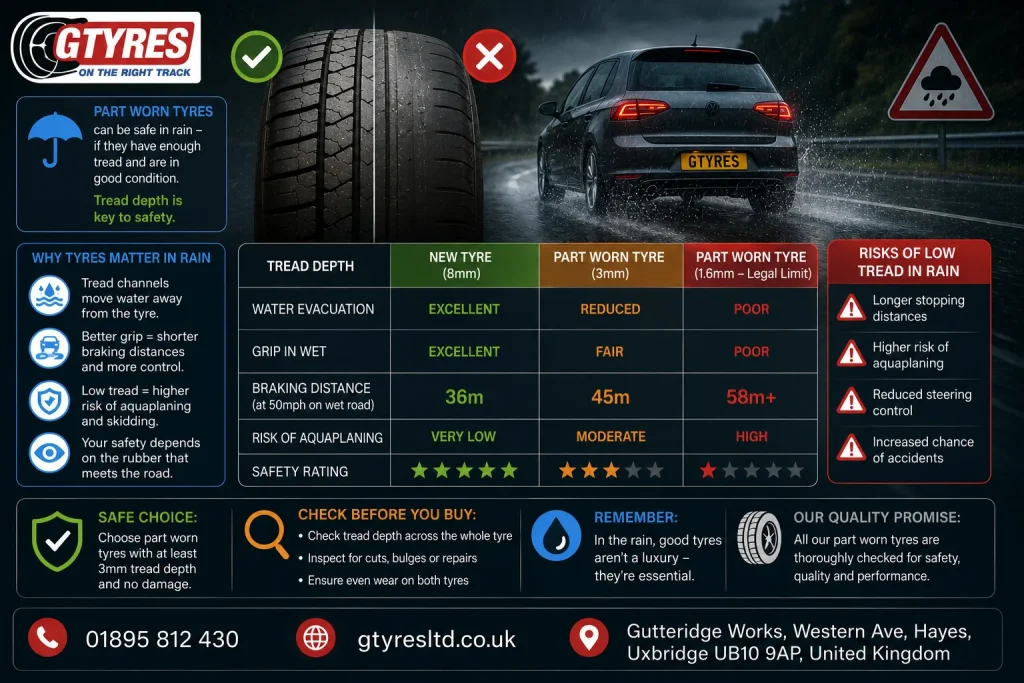
Tread Depth, Aquaplaning and Braking Confidence
Aquaplaning happens when a layer of water builds between the tyre and the road, reducing contact and control. Tread depth helps reduce this risk because deeper grooves can move water away more effectively. When tread is low, water has less space to escape, and the tyre may begin to ride over the water instead of cutting through it. That is why wet road safety is strongly linked to tread condition. For part worn tyres, this makes inspection even more important. A tyre with shallow tread, uneven shoulders, or old hard rubber may not give the driver enough confidence when roads are wet. Braking is also affected because the tyre needs strong contact with the road to slow the vehicle properly. If that contact is reduced, stopping distance can increase. Everyday drivers may not think about this until the moment they need to stop quickly.
Braking confidence is not about driving fast or aggressively. It is about normal safety margins. A family car approaching a crossing, a van slowing in traffic, or a commuter joining a wet roundabout all rely on tyre grip. Part worn tyres can support that grip if they are in good condition and have suitable tread. They should not be fitted if the tread is too low, the rubber is cracked, the sidewall is damaged, or the tyre has poor repair signs. Buyers should also check tyre pressure because incorrect pressure can reduce contact with the road and cause uneven wear. A tyre with good tread but poor pressure still cannot perform properly. This is why tyre safety should be treated as a full system. Tread depth, pressure, structure, fitment, and driving conditions all work together. If one area is weak, everyday confidence drops. Safe part worn tyres are not about luck. They are about proper selection.
Everyday Driving Conditions That Affect Part Worn Tyre Safety
Everyday driving includes more than smooth roads and short journeys. A normal vehicle may deal with potholes, kerbs, speed bumps, wet roads, heavy loads, motorway speeds, and sudden braking during the same week. These conditions all put different stress on tyres. A part worn tyre needs to be strong enough for the way the vehicle is actually used. A driver who mostly drives through town may face sidewall damage from kerbs and potholes. A motorway driver may place more heat and speed pressure on the tyre. A van or loaded family car may need stronger load suitability. This is why the same tyre is not right for every vehicle. Fitment matters. Load index matters. Speed rating matters. Pressure matters. Tread depth matters. A tyre that passes one basic check may still be unsuitable if it does not match the vehicle’s real use.
This is where buyers should think like practical drivers, not bargain hunters. If the vehicle is used daily, the tyre must be dependable in real conditions, not just cheap at the time of fitting. City roads can damage sidewalls. Motorways can expose heat related weakness. Heavy loads can strain tyres that are not rated correctly. Wet roads can reveal poor tread or hard rubber. Every part worn tyre should be judged against these conditions before it is trusted. For G Tyres LTD, the key message is that part worn tyres can be practical when they are chosen carefully and matched correctly. They should not be treated as a random cheap replacement. A safe tyre should suit the vehicle, the driver, and the road conditions it will face. If the tyre is for demanding daily use, the checks should be even stricter. The more pressure the tyre will face, the less room there is for compromise.
City Driving, Kerbs and Potholes
City driving can be tough on tyres because the impacts are frequent. Kerbs, tight parking spaces, potholes, speed bumps, broken road edges, and drain covers can all damage tyres over time. The speed may be lower than motorway driving, but the tyre still takes repeated knocks. A hard kerb impact can weaken a sidewall, and the problem may not be obvious straight away. A driver may hear a dull thud, feel a small bump, and carry on without realising the tyre has been stressed. This is why sidewall checks are important when buying part worn tyres. Look for swelling, cuts, cracks, scuffs, and areas that look uneven or distorted. A tyre with sidewall damage should not be fitted for everyday city driving. The sidewall carries load and flexes constantly, so weakness there is a serious concern.
City use also creates uneven wear because vehicles are constantly turning, braking, stopping, and starting. If a part worn tyre has one shoulder badly worn, it may suggest previous tracking or suspension problems. This can reduce value and affect handling. Buyers should check the full tread width, not just the centre. A tyre can look decent from one angle and still be poor on the inner or outer edge. Garages and tyre retailers should be especially careful here because many customers use vehicles mainly in urban areas. They need tyres that can handle practical daily conditions, not just look acceptable. A safe part worn tyre for city use should have even wear, clean shoulders, sound sidewalls, and suitable tread. If it already looks tired from rough road use, it may not be worth fitting again. City driving may look slow, but it is not gentle on tyres.
Motorway Driving, Heat and Speed Ratings
Motorway driving puts a different kind of pressure on tyres because speed, heat, and distance all increase the load on the tyre structure. A tyre at low town speed may hide weaknesses for a while, but sustained motorway speed can expose problems quickly. The tyre flexes repeatedly, builds heat, carries vehicle weight, and must stay stable while the driver changes lanes, brakes, or drives through rain and spray. This is why part worn tyres used for motorway driving need stricter checks. The tyre should have suitable tread, clean sidewalls, correct size, proper inflation, and the right speed rating for the vehicle. Speed rating is not a decorative marking. It shows the tyre is designed for certain performance limits. If the rating is wrong, the tyre may not be suitable even if the tread looks good. Motorway driving is not the place to gamble with weak, old, damaged, or poorly repaired tyres.
A driver should also think about heat. Tyres naturally warm up during driving, especially at higher speeds or with heavier loads. If a tyre has hidden damage, weak sidewalls, poor repairs, or incorrect pressure, heat can make the risk worse. This does not mean part worn tyres cannot be used on motorways. It means they must be chosen carefully and checked properly before fitting. A safe motorway tyre should feel like a dependable pair of running shoes during a long walk. It should not rub, wobble, or feel weak halfway through the journey. The same idea applies to tyres. They must stay reliable beyond the first few miles. If the vehicle is used for regular motorway travel, buyers should be stricter with condition, rating, age, pressure, and tread. A part worn tyre can be practical, but only when it is suitable for the speed, distance, and load it will face.
Heavy Loads, Vans and Regular Commuting
Heavy loads make tyre safety even more important because the tyre has to carry more weight and deal with more pressure. A van carrying tools, a car packed for a long trip, or a vehicle used for regular trade work needs tyres that match the load properly. This is where load index matters. The load index tells you whether the tyre is suitable for the weight the vehicle will carry. A tyre may look clean and have usable tread, but if the load rating is wrong, it is not the right tyre. Under load, tyres flex more, build more heat, and can wear faster if pressure is incorrect. This is why part worn tyres should never be selected only by size and price. The tyre must match the vehicle’s real use. A daily working vehicle needs dependable tyres, not just affordable tyres.
Regular commuting also adds steady wear. A driver may not cover huge mileage in one day, but daily use adds up quickly. Short trips, traffic, wet roads, braking, and rough surfaces all reduce tyre life over time. If a part worn tyre already has low tread or uneven wear, commuting can make it reach replacement stage sooner than expected. That is where a cheap tyre can become poor value. Buyers should think about how often the vehicle is used and what kind of roads it faces. A car used once or twice a week may place different demands on tyres than a van used six days a week. For G Tyres LTD customers and trade buyers, this matters because different users need different tyre choices. A safe part worn tyre should be matched to the job. If the vehicle carries weight or drives daily, the tyre must be checked with extra care.
Part Worn Tyres vs New Tyres: Which Is the Better Choice?
Part worn tyres and new tyres both have a place, but they should not be compared only by price. New tyres usually offer the most predictable starting point because they have full tread, known history, and no previous road use. That is a clear advantage. There is no hidden kerb strike, no unknown repair, no previous underinflation, and no uncertainty about storage or wear pattern. Part worn tyres can still make sense when they are in strong condition, correctly matched, and offer genuine remaining tread. The trade off is simple. New tyres usually give maximum predictability. Part worn tyres can offer practical value when they are selected properly. A buyer should not assume that all new tyres are perfect for every situation or that all part worn tyres are unsafe. The right question is whether the tyre is suitable for the vehicle, the driving style, and the road conditions.
This comparison should be honest because readers are not stupid. They know new tyres usually provide full tread and clear history. They also know tyre costs can be difficult, especially when replacement is unexpected. The article should help them make a calm decision instead of pushing one answer blindly. A good part worn tyre may be useful for a driver who needs a practical replacement and does not want to delay tyre safety because of cost. A new tyre may be better for drivers who want maximum usable life, known history, and the strongest starting point. Both choices still need correct fitting, pressure checks, and ongoing maintenance. A new tyre can also become unsafe if ignored, damaged, underinflated, or overloaded. A part worn tyre simply needs more careful checking before it is fitted because it already has history. The best choice is not always the cheapest. The best choice is the tyre that gives safe, suitable value for the way the vehicle is used.
Safety, Cost and Usable Life Compared
A proper tyre comparison should include safety, cost, and usable life together. If a buyer only looks at the upfront price, the cheapest option will always seem attractive. That is poor thinking. Tyres should be judged by what they can safely deliver over time. A part worn tyre with strong tread, clean sidewalls, and correct fitment may offer good value. A tyre with low tread, uneven wear, or hidden damage may become expensive quickly because it needs replacing sooner or creates risk. New tyres usually offer longer expected life because they start with full tread. Part worn tyres vary, so buyers need to judge each tyre carefully. The smarter question is not “how cheap is it?” The smarter question is “how much safe, usable life does this tyre still have?” That question protects both the driver and the budget.
Factor | Part worn tyres | New tyres |
Upfront cost | Usually lower | Usually higher |
Tyre history | Needs careful checking | Known from new |
Starting tread | Varies by tyre condition | Full tread |
Safety confidence | Depends on condition and fitment | More predictable |
Usable life | Depends on remaining tread | Usually longer |
Best use | Practical value when checked properly | Maximum predictability |
Main risk | Poor condition if bought blindly | Higher initial cost |
This table helps readers compare both options without confusion. It also keeps the blog balanced, which is important for trust. If the article only praises part worn tyres, it sounds biased. If it only praises new tyres, it does not answer the real search intent. The truth is that part worn tyres can be useful when they pass safety checks and still have real value left. New tyres are usually better for buyers who want the cleanest starting point and longer expected tread life. For garages and trade buyers, the comparison is also about customer expectations. Some customers want the longest life possible. Others need a practical and affordable solution. The job is to match the tyre to the need without compromising safety. A part worn tyre should never be treated as good value just because it costs less. It must earn that value through condition, suitability, and remaining tread. That is the real difference between cheap and useful.
Cheap Tyres Are Not Always Better Value
Cheap tyres are not always better value because price does not tell the full story. A low price can hide low tread, old rubber, poor repair history, uneven wear, or unsuitable fitment. A buyer may feel relieved at the counter because the cost is lower, but that relief disappears if the tyre wears out quickly or creates safety doubts. Value means safe use for the money paid, not just the smallest bill on the day. A part worn tyre with strong remaining tread and clean condition may be better value than a cheaper tyre close to the end of its life. On the other hand, a damaged part worn tyre is poor value at any price. Think of buying a used coat in winter. A cheap coat with a broken zip and thin lining is not good value. It is just cheap. Tyres follow the same logic.
For everyday driving, value should include grip, braking confidence, tread life, and suitability for the vehicle. A tyre should help the driver feel safe on wet roads, in traffic, and during sudden stops. If the tyre is low on tread, cracked, badly repaired, or the wrong size, it cannot offer that confidence. Garages and tyre retailers should also think about long term customer trust. A customer may ask for the cheapest option, but if that option performs badly, the business may lose trust. The better advice is to choose the tyre that gives safe usable life at a fair price. That is where good part worn tyres can make sense. They are not about buying blindly or cutting corners. They are about choosing a tyre that still has genuine value left. If safety checks are passed and the tyre is suitable, the saving can be useful. If safety is doubtful, the discount means nothing.
What Are the Biggest Risks of Part Worn Tyres?
The biggest risk with part worn tyres is unknown history. A tyre may have been removed for many reasons. It may have come from a vehicle that was scrapped, upgraded, repaired, or changed to a different tyre set. Some of those reasons may be harmless. Others may involve damage, punctures, uneven wear, overloading, underinflation, or impact with kerbs and potholes. The problem is that the buyer does not always know the full story. This is why condition checks are essential. A tyre can look clean from the outside and still have concerns that need attention. Hidden casing damage, poor repairs, old rubber, sidewall weakness, and uneven wear can all affect safety. A part worn tyre should never be trusted only because it looks polished or because the price is attractive. It should be judged by roadworthiness.
Another major risk is false confidence. Some buyers see tread and assume the tyre is safe. That is not enough. Tread depth is important, but the tyre must also have safe structure, correct size, suitable ratings, and no serious damage. A tyre with strong tread and a sidewall bulge is still unsafe. A tyre with good tread but old cracked rubber may still be a bad choice. A tyre with the wrong load index may not be suitable for the vehicle. This is why part worn tyres need full inspection before fitting. The risk is not that a tyre has been used before. The risk is buying without knowing whether the tyre is still suitable. Good buying decisions come from checking, not guessing. For everyday driving, that means looking at the whole tyre and rejecting anything that creates serious doubt.
Sidewall Bulges, Cracks, Exposed Cords and Poor Repairs
Sidewall bulges, cracks, exposed cords, and poor repairs are serious warning signs, not small cosmetic issues. A tyre sidewall carries load and flexes constantly while the vehicle moves. If the sidewall is swollen, cracked, cut, or weakened, the tyre should not be trusted for everyday driving. Exposed cords are even more serious because they show that the tyre’s structure has been damaged or worn beyond a safe surface layer. Poor repairs can also create risk, especially if the repair is in the wrong area or has not been done properly. A buyer should never ignore these signs just because the tyre still has tread. Tread depth is useful, but it cannot fix structural weakness. A tyre with good tread and a damaged sidewall is still unsafe. The safest decision is simple: if the tyre shows major damage, reject it.
A practical way to think about this is to compare the tyre with a cracked water pipe. The pipe may look fine in some places, but one weak area can fail when pressure builds. Tyres work under pressure too, especially when carrying weight, braking, cornering, or driving at speed. That is why any visible structural damage should be taken seriously. Buyers should check both sidewalls where possible, not just the outside face. Inner sidewall damage can be missed if the tyre is only checked quickly. They should also look for unusual swelling, flat spots, cuts, rubber cracking, and signs of old repairs. For garages and tyre retailers, these checks protect customer safety and business reputation. For everyday drivers, they protect road confidence. A part worn tyre can be a practical choice only when the tyre is sound as a complete unit. If the structure is questionable, the lower price is irrelevant.
Can Part Worn Tyres Fail an MOT?
Yes, part worn tyres can fail an MOT, but not because they are part worn. They fail when they are not roadworthy. This difference is important because many drivers misunderstand the issue. A part worn tyre is not automatically an MOT failure. A damaged tyre, low tread tyre, incorrectly fitted tyre, or unsuitable tyre can fail. MOT checks focus on tread depth, exposed cords, sidewall damage, lumps, bulges, cuts, tyre size, and general roadworthiness. If a part worn tyre meets the required standard and is correctly fitted, it may pass. If it has serious defects, it can fail like any other tyre. This is why buying part worn tyres should always involve proper checking before fitting. A tyre that only looks acceptable from one angle may still have inner shoulder wear or sidewall issues that create problems.
MOT risk is a real concern for everyday drivers because many tyre purchases happen after an inspection warning or failure. A driver may be told one tyre is close to the limit or has damage, and they may need a replacement quickly. In that situation, part worn tyres can seem like a practical solution. They can be, but only if the replacement tyre is roadworthy and suitable for the vehicle. A buyer should not replace one unsafe tyre with another questionable tyre. That is just moving the problem, not solving it. The replacement should have suitable tread, even wear, clean sidewalls, correct size, and proper load and speed rating. If any of those areas are wrong, the tyre may cause future inspection problems or safety concerns. A good buying rule is simple: ask whether the tyre would pass a proper roadworthiness check. If the answer is uncertain, do not fit it.
MOT Tyre Checks Drivers Should Know
Drivers should know the basic tyre checks that affect MOT results. The first check the tread depth. If the tread is below the legal limit, the tyre is not acceptable. The second check is condition. Cuts, lumps, bulges, exposed cords, and serious cracking can all create failure risk. The third check is suitability. A tyre should be the correct size and rating for the vehicle. If the tyre does not suit the vehicle’s requirements, it should not be fitted. The fourth check is wear pattern. Uneven wear can indicate problems with alignment, suspension, or pressure. This does not always mean instant failure, but it does show that the tyre needs closer attention. Buyers should also check the inner edge of the tyre because that area is often missed during a quick visual check.
A useful example is a tyre that looks fine from the outside but is badly worn on the inner shoulder. From a standing position beside the car, the driver may not notice the problem. During inspection, the worn area may become obvious. That is why a proper tyre check should include the full tread width and both sidewalls where possible. Part worn tyres should be checked even more carefully because they already have previous use. A garage or tyre retailer should help customers understand this without confusing them. The customer does not need a lecture. They need clear advice: enough tread, no serious damage, correct size, correct rating, and safe condition. For G Tyres LTD, the blog should keep this advice practical and plain. A safe tyre should be able to stand up to everyday driving and inspection. If it cannot, it should not be fitted.
What Should You Check Before Buying Part Worn Tyres?
Before buying part worn tyres, buyers should check the tyre as a complete safety part. Start with tread depth, but do not stop there. Look at whether the tread is even across the full width. Check the inner and outer shoulders for unusual wear. Inspect both sidewalls for cuts, cracks, scuffs, bulges, and swelling. Look for exposed cords, repairs, nails, puncture marks, or areas that look patched badly. Check the tyre age where possible because old rubber can lose flexibility even when tread remains. Confirm that the size matches the vehicle. Confirm the load index and speed rating. A tyre that fails any serious safety point should be rejected. This may sound like a lot, but it becomes simple with practice. The goal is not to make buying difficult. The goal is to avoid unsafe tyres.
Check | Why it matters |
Tread depth | Affects grip, braking, and usable life |
Even tread wear | Shows whether the tyre has worn consistently |
Sidewall condition | Bulges, cracks, and cuts are serious warning signs |
Tyre age | Older rubber may harden or crack |
Repair history | Poor repairs can weaken tyre safety |
Correct size | Wrong size can affect handling and fitment |
Load index | Must suit the vehicle’s weight |
Speed rating | Must suit the vehicle’s use |
Overall condition | Helps confirm whether the tyre is roadworthy |
This checklist should help readers make a better buying decision. A buyer should not feel embarrassed about asking questions or checking the tyre carefully. Tyres are safety critical, and a responsible seller should understand why buyers want clarity. If the tyre has good tread but visible damage, reject it. If the tyre has clean sidewalls but very low tread, it may not offer good value. If the tyre is the wrong size, do not fit it. If the repair history is unclear and the repair looks questionable, avoid it. If the tyre looks old, cracked, or heavily worn on one edge, be cautious. A good part worn tyre should make sense from several angles, not just one. It should look safe, measure well, fit correctly, and still have genuine usable life left. That is how buyers protect both safety and value.
When Do Part Worn Tyres Make Sense?
Part worn tyres make sense when they offer safe condition, suitable tread, correct fitment, and practical value. They are not the right choice just because they cost less. They are the right choice when the tyre still has genuine usable life and can be trusted for the type of driving it will face. A driver needing a practical replacement after a puncture may consider part worn tyres if the tyre passes the right checks. A garage may offer part worn tyres to help customers who need a budget friendly option without delaying tyre replacement. A tyre retailer may stock part worn tyres to serve different customers, vehicle types, and budgets. In each case, the same rule applies. The tyre must be safe first and affordable second. If that order is reversed, the decision becomes risky.
Part worn tyres can also make sense for buyers who understand that value is not the same as the lowest price. A tyre with stronger tread and clean condition may offer better usable value than a very cheap tyre close to replacement. For trade buyers, consistent stock quality matters because customers return when they trust the advice and the tyre performs properly. For everyday drivers, confidence matters because tyres affect every journey. The right part worn tyre should feel like a sensible solution, not a gamble. It should have enough tread, correct sizing, clean sidewalls, and no serious warning signs. If the tyre meets those standards, it may be practical for daily use. If it fails them, it should be avoided. That is the honest answer. Part worn tyres are not about cutting corners. They are about finding usable value without ignoring safety.
When Should You Avoid Part Worn Tyres?
You should avoid part worn tyres whenever there is serious doubt about safety, fitment, or usable life. If the tyre has a sidewall bulge, exposed cords, deep cuts, cracked rubber, very low tread, suspicious repairs, uneven wear, or the wrong size, it should not be fitted. If the tyre looks old or damaged, do not convince yourself it is acceptable just because the price is low. A tyre is not a place to gamble. It carries the vehicle, grips the road, and supports braking. One serious defect can affect the whole tyre. This section needs direct wording because buyers sometimes try to justify a poor tyre when they are under budget pressure. That is understandable, but it is still dangerous. Saving money is useful only when the tyre remains safe and suitable.
Avoiding a bad part worn tyre is just as important as finding a good one. A driver may feel pressure after an MOT warning, a puncture, or sudden tyre damage. In that moment, any quick replacement can look tempting. But a rushed decision can lead to poor value or safety concerns. Buyers should slow down enough to check tread, sidewalls, age, repairs, ratings, and size. If something feels wrong, walk away. A good tyre should not create doubt before it is even fitted. For garages and retailers, this is also about reputation. One bad tyre experience can damage customer trust far more than one lost sale. The best advice is simple: if the tyre fails a serious safety check, reject it. A safe tyre should give confidence, not questions.
Final Words: Are Part Worn Tyres Safe Enough for Daily Driving?
Part worn tyres can be safe enough for daily driving when they are legal, structurally sound, correctly fitted, and matched to the vehicle. They should have suitable tread, clean sidewalls, correct load and speed rating, and no serious damage or unsafe repairs. They become risky when buyers focus only on price and ignore condition. The safest way to answer the question is this: part worn tyres are not automatically unsafe, but they should never be bought blindly. Every tyre should be checked as a complete safety part. Tread matters, but so do age, repairs, sidewall condition, fitment, pressure, and driving use. A tyre used for city driving, motorway travel, heavy loads, or wet roads must be suitable for those demands. If it is not, it should not be fitted.
For G Tyres LTD, the right message is safety first and value second. Premium part worn tyres can offer practical value for drivers, garages, tyre retailers, and trade buyers, but only when the tyre still has genuine usable life left. A cheap tyre with doubts is not a bargain. A suitable tyre with safe condition and clear value can be a smart choice. Buyers should look for tread depth, even wear, sound structure, correct size, and a reliable supply source. If the tyre passes those checks, it may be suitable for everyday driving. If it fails them, the discount does not matter. To discuss wholesale part worn tyre supply, available stock, or trade buying requirements, contact G Tyres LTD and choose tyres with safety, usability, and value in mind.
Don't Compromise on Tyre Safety
G Tyres LTD supplies part worn tyres with 4mm tread depth, safe, legal, and ready for everyday UK driving.
Frequently Asked Questions
Part worn tyres can be safe for everyday driving if they are legal, structurally sound, correctly fitted, and suitable for the vehicle. The tyre should have usable tread, clean sidewalls, no exposed cords, no deep cuts, no bulges, and no unsafe repairs. The main risk comes when buyers choose only by price and ignore condition. A good part worn tyre can offer practical value, but a damaged or badly worn tyre should never be trusted for regular road use.
Yes, part worn tyres are legal in the UK when they meet the correct safety and resale requirements. They must be roadworthy, clearly sold as used, and free from serious defects such as exposed cords, dangerous cuts, sidewall bulges, or unsafe repairs. Legal does not always mean ideal, though. A tyre may meet the minimum requirement but still not be the best option for wet roads, motorway use, or heavy loads. Buyers should always check condition before fitting.
Part worn tyres should have enough tread to offer safe, usable life. The UK legal minimum for tyres in use is 1.6 mm, but buyers should not treat that as the ideal target. A tyre close to the legal minimum may not offer strong wet road confidence or long remaining use. G Tyres LTD supplies part worn tyres with 4 mm tread depth, which gives buyers a stronger remaining tread point. Still, tread depth alone does not make a tyre safe. Sidewall condition, age, repairs, size, and rating also matter.
Yes, part worn tyres can fail an MOT if they are below the legal tread limit, damaged, incorrectly fitted, or unsuitable for the vehicle. Common tyre related MOT issues include exposed cords, sidewall bulges, deep cuts, serious cracks, uneven wear, and incorrect tyre size or rating. The tyre does not fail because it is part worn. It fails because it is not roadworthy. Before fitting part worn tyres, drivers should check tread depth, sidewalls, age, repairs, and overall condition.
Part worn tyres can be safe in the rain if they have suitable tread depth, sound rubber, correct pressure, and safe overall condition. Rain makes tyre quality more important because tread grooves help move water away from the road surface. If tread is too low, the tyre has less ability to clear water, which can reduce braking confidence and increase aquaplaning risk. Buyers should avoid part worn tyres with low tread, cracked rubber, uneven wear, bulges, or poor repair signs.
Before buying part worn tyres, check tread depth, tread evenness, sidewall condition, tyre age, repair history, tyre size, load index, and speed rating. Look carefully for cracks, cuts, bulges, exposed cords, uneven shoulder wear, and suspicious repairs. A tyre should be checked as a complete safety part, not judged only by tread depth or price. If the tyre creates serious doubt in any safety area, it should be rejected. A safe tyre should look suitable, fit correctly, and still have genuine usable life.
There is no automatic winner between part worn tyres and budget new tyres. A new tyre gives known history and full starting tread, while a carefully selected part worn tyre may offer practical value at a lower upfront cost. The better choice depends on tyre condition, tread depth, vehicle use, price, fitment, and driving needs. A quality part worn tyre with safe structure and good remaining tread may make sense, but a damaged or nearly worn out tyre is never good value.